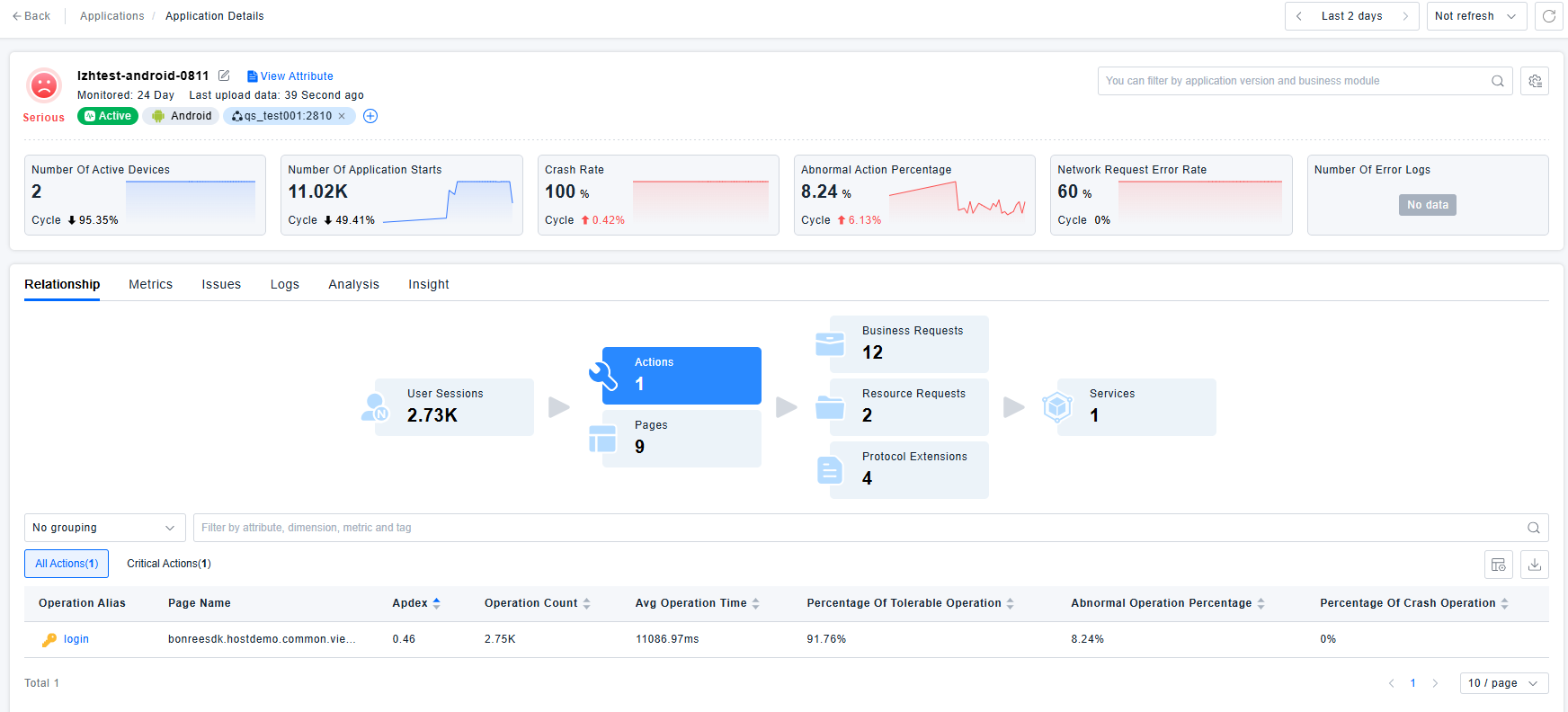
Actions
In Real User Monitoring (RUM), the Action is one of the core analysis objects. An Action serves as the carrier of user interaction behavior and system service capability, acting as a key nexus connecting "user experience perception" with "business goal achievement." Actions directly correspond to the user's core behaviors within an application—whether it's clicking a button to submit an order, loading a product list page, or triggering form validation. Each Action represents a step the user takes to advance a business process.
By monitoring an Action's response time (e.g., how long until feedback is received after a click), success rate (e.g., whether submission Actions frequently fail), and the performance of underlying dependent resource loads/API calls, it's possible to precisely capture 'user experience breakpoints'. For example, a login button Action with a delay exceeding 3 seconds might directly cause users to abandon login; a payment Action with a low success rate can directly impact final transaction conversion rates.
By correlating Action data with user sessions and business metrics (e.g., conversion rate, retention rate), one can quantify the actual impact of Action experience on user behavior. This also provides technical teams with a complete analysis path from "user complaint" to "technical root cause," ultimately achieving the goal of enhancing user satisfaction and business value by optimizing Action experience.
Definition
An Action refers to a single, goal-oriented interaction initiated by a user within an application, encompassing both the user's act and the subsequent system response process. It is the core unit of analysis connecting "user proactive behavior" and "system passive feedback," and is the fundamental dimension for quantifying user interaction experience.
Triggered by active user operations (e.g., clicking a button, submitting a form), an Action is typically associated with backend resource requests or frontend logic processing. Such Actions can be categorized as "single-request associated" (e.g., one button click corresponds to one Ajax API call, the Action completes upon API response) or "multi-request aggregated" (e.g., one "Place Order" Action requires sequential calls to product validation, inventory locking, and order creation APIs; the Action is only deemed successful upon the return of all calls). The core principle is to completely cover the end-to-end response chain for the user's single goal-oriented behavior.
Identification Rules
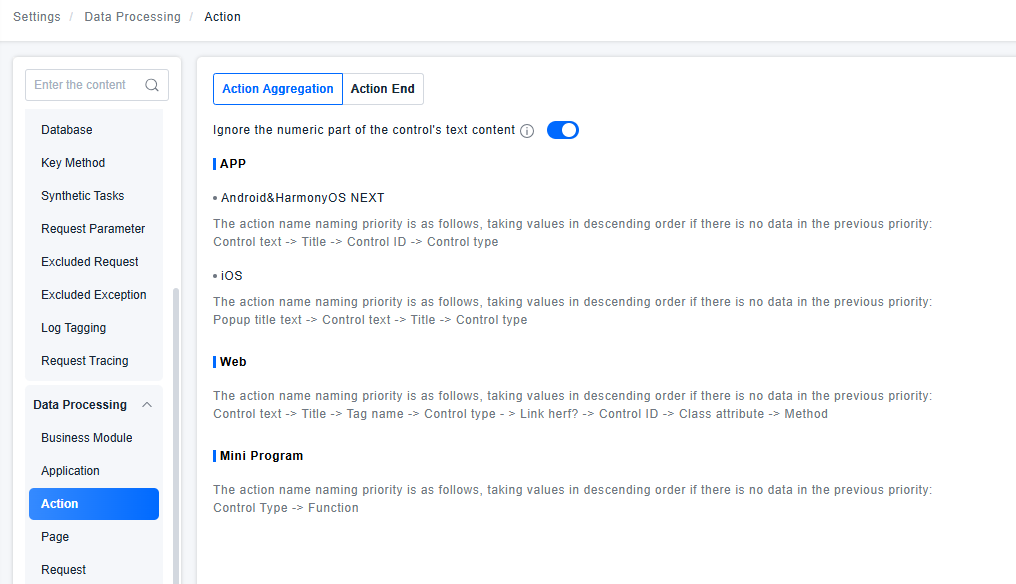
Due to differences in the underlying implementation logic of different applications, precisely defining what constitutes the "same Action" requires combining specific business scenarios and application characteristics. Accurate matching is achieved through multi-dimensional identifiers (such as control text, page title, control ID, control type, trigger method, etc.). This ensures the criteria for Action aggregation align with the needs of business-side Action analysis, preventing ambiguous definitions from leading to analytical results that deviate from actual business objectives.