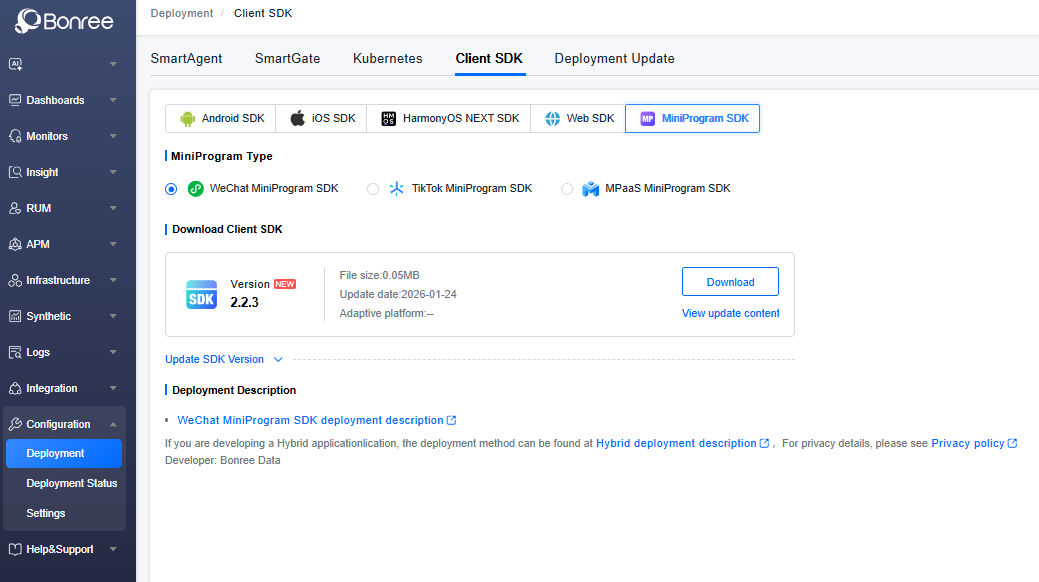
Applications
In Real User Monitoring (RUM), customer applications (websites, mobile apps, etc.) are instrumented to report real user visits to the platform for monitoring and analysis. Typical user entry points include web applications running in browsers, as well as mobile applications running on iOS or Android smartphones or tablets.
The user entry point determines the type of application created in the platform. The method of data collection and the content of the collected data vary depending on the application type. For example, for web applications running in a browser, the RUM JavaScript is automatically or manually injected into the application's HTML pages and begins monitoring each user interaction.
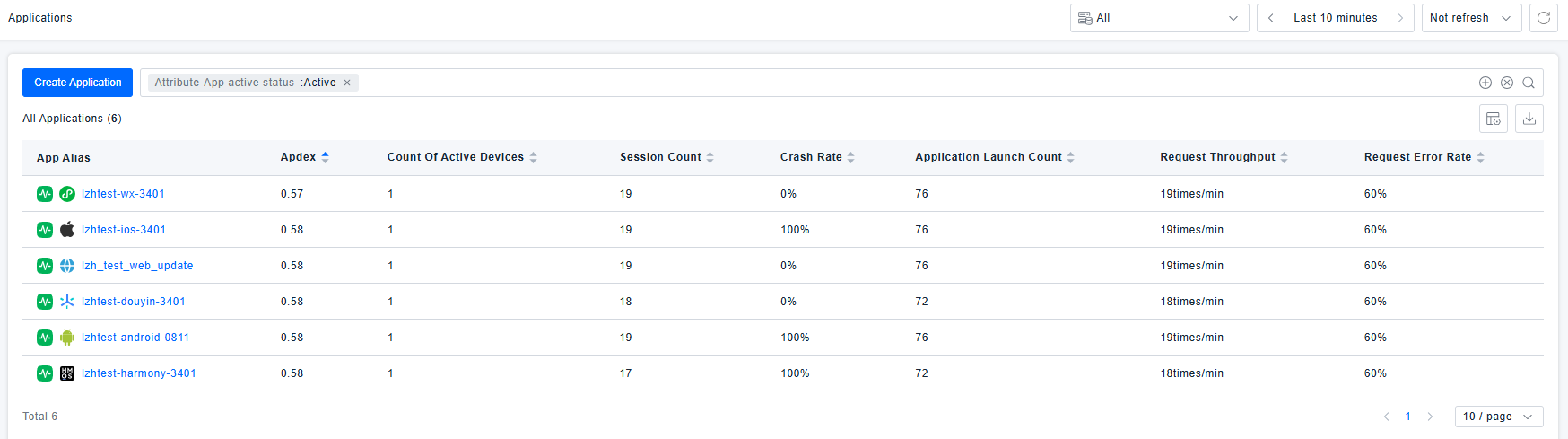
To view detailed application analysis data, navigate to Applications.
Definition
An End User Application refers to the software entity that is monitored, with which users directly interact, and which generates real usage behavior. It serves as the core boundary and foundational dimension for RUM data collection, analysis, and experience evaluation. All user sessions, pages, actions, and network performance metrics are aggregated and analyzed around it.
In the ONE platform, different types of the same application are considered distinct applications. For example, if you want to monitor Web Taobao, iOS Taobao, and Android Taobao, you need to create three separate applications in the ONE platform for instrumentation and monitoring.
Supported Application Types
- Web: All HTML pages (such as static web pages or single-page applications running in a browser) are considered web applications.
- Android: Mobile applications running on the Android system.
- iOS: Mobile applications running on the iOS system.
- HarmonyOS NEXT: Mobile applications running on the HarmonyOS NEXT system.
- WeChat Mini Program: Mobile applications running on the WeChat platform.
- TikTok Mini Program: Mobile applications running on the TikTok platform.
- mPaaS Mini Program: Mobile applications running on the mPaaS platform.