Pages
User perception of digital product experience essentially boils down to "a complete cycle of page loading and interaction". For instance, when opening an e-commerce homepage, a checkout page, or a payment result page, factors like how fast the page loads, whether it freezes, and whether it functions properly directly determine user satisfaction. Isolated metrics divorced from the "Page" (e.g., "An API response time of 200ms") cannot directly reflect user experience. Only by taking the "Page" as the carrier and correlating technical metrics—such as API performance, resource loading, and frontend rendering—with "user behaviors on the page" (e.g., button clicks, time spent) can we determine whether a technical issue actually impacts users.
Page Vitals:
- First Contentful Paint (FCP): The time it takes for a page to display the first non-blank content (e.g., text, images), indicating "whether the page has started loading".
- Largest Contentful Paint (LCP): The time it takes for the largest visible content element (e.g., main image, title) to be fully rendered during page loading. It measures "the speed at which core page content is displayed" and directly influences whether users will wait for the page to load.
- Page Loading Time: The time it takes for all page resources (JS, CSS, images, third-party scripts) to finish loading and for the frontend main thread to become idle. It measures "the overall loading completion of the page" and is suitable for "resource-intensive pages" (e.g., e-commerce homepages).
Definition
A page is a core concept used to track where users are accessing within an application, identified by the URL in the browser's address bar. For example:
https://example.com/useris the user list pagehttps://example.com/productis the product list page
Identification Rules
Feature Scenarios
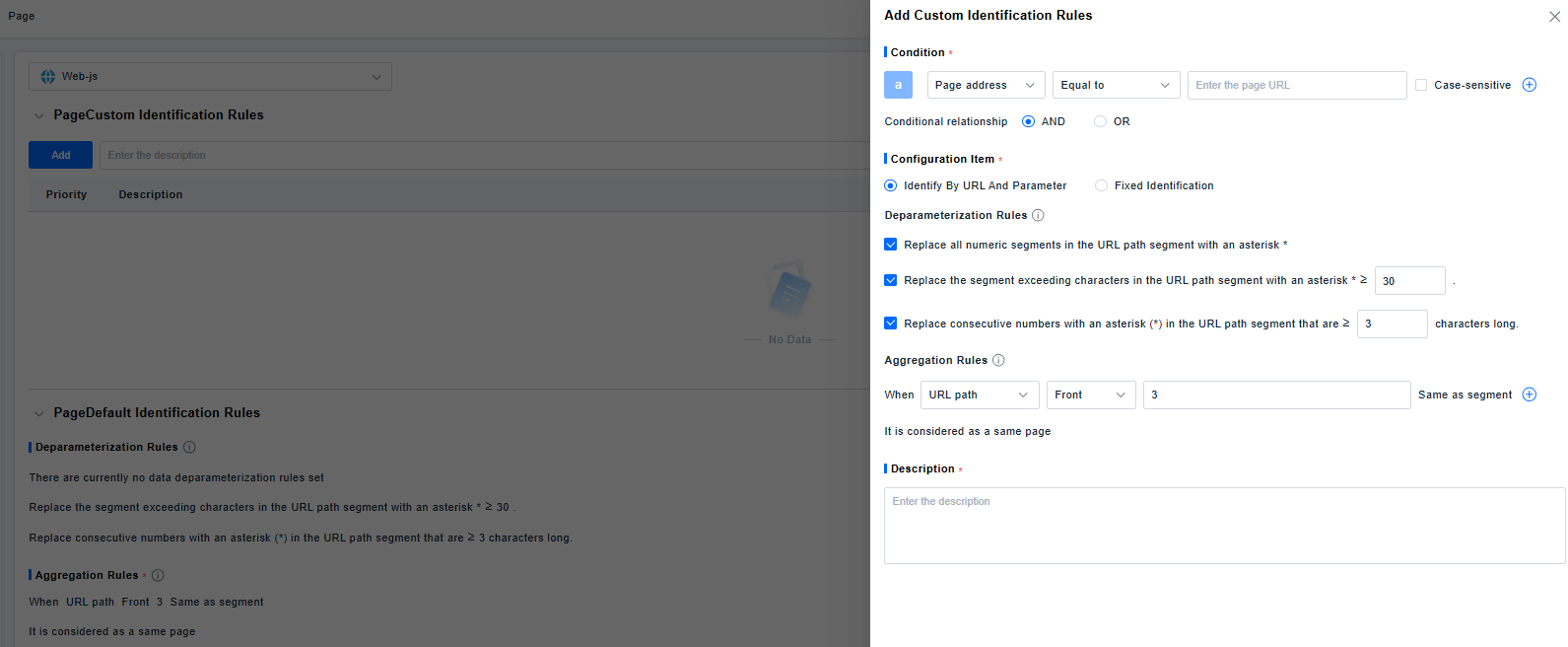
Different applications have varying implementation logics. It is necessary to flexibly customize page identification rules based on domain names, URL paths, and URL parameters according to actual scenarios. This ensures accurate definition of what constitutes the same page, meeting business requirements for aggregated page analysis.
For collected raw URLs, parameter stripping rules are first applied to eliminate interference from irrelevant parameters. Then aggregation rules are executed to group URLs based on core characteristics. Through these two steps, different URLs that essentially represent the same page can be aggregated, ensuring accuracy and consistency in page analysis.
Getting Started
Aggregation Rules
A URL consists of three parts: domain name, URL path, and URL parameters.
- If you set the page identification rule to: consider URLs as the same page when the first segment of their URL paths is identical, the identification logic works as follows:

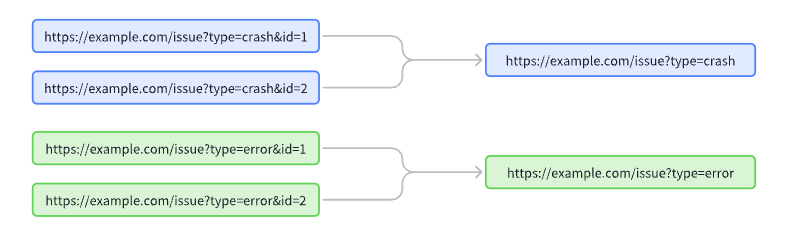
- If you set the page identification rule to: consider URLs as the same page when the first segment of their URL paths is identical and the value of the "type" URL parameter is the same, the identification logic works as follows:
Parameter Stripping Rules
To avoid interference from IDs and similar elements in URL paths, specific parameter stripping rules can be configured. You can check the required stripping rules and configure their specific lengths as needed.
