invocationanalysis
In the field of application performance monitoring and fault troubleshooting, Invocation Analysis is a specialized analytical technology for "invocation behaviors between functions, interfaces, and services". Its core functions focus on "disassembling invocation chains, locating invocation bottlenecks, and restoring invocation context", covering full-dimensional analysis from "single-function invocations" to "cross-service full-link invocations". Specific capabilities include: full-link tracing of invocation behaviors; accurate localization of invocation performance bottlenecks, etc.
Usage Scenarios
- Full-Link Fault Troubleshooting in Microservice/Distributed Architectures: A single user request typically passes through multiple services (e.g., "order placement request → Order Service → Inventory Service → Payment Service → Notification Service"). A fault in any link will cause the entire request to fail, but logs from a single service can only show local errors, making it impossible to locate the specific faulty node.
- Invocation Performance Bottleneck Localization (Single Service/Cross-Service): Core business interfaces (e.g., "product detail query") respond slowly. Real-time monitoring can only show "total interface latency of 300ms", but cannot disassemble the "latency distribution" (e.g., "whether the slowness comes from local function computation, cache query, or dependent service invocation").
- Service Dependency Governance and Fault Impact Scope Assessment: In distributed systems, service dependency relationships are complex (e.g., "User Service is dependent on three services: Login, Order, and Membership"). When a service (such as User Service) fails, it is necessary to quickly determine "which upstream services will be affected" to prevent fault propagation.
- Root Cause Diagnosis of Abnormal Interface Invocations (Errors/Timeouts): Interfaces occasionally encounter invocation errors (e.g., "504 Gateway Timeout", "400 Bad Request") or timeouts. Logs only record error codes without detailed context, making reproduction and localization difficult.
Get Started
-
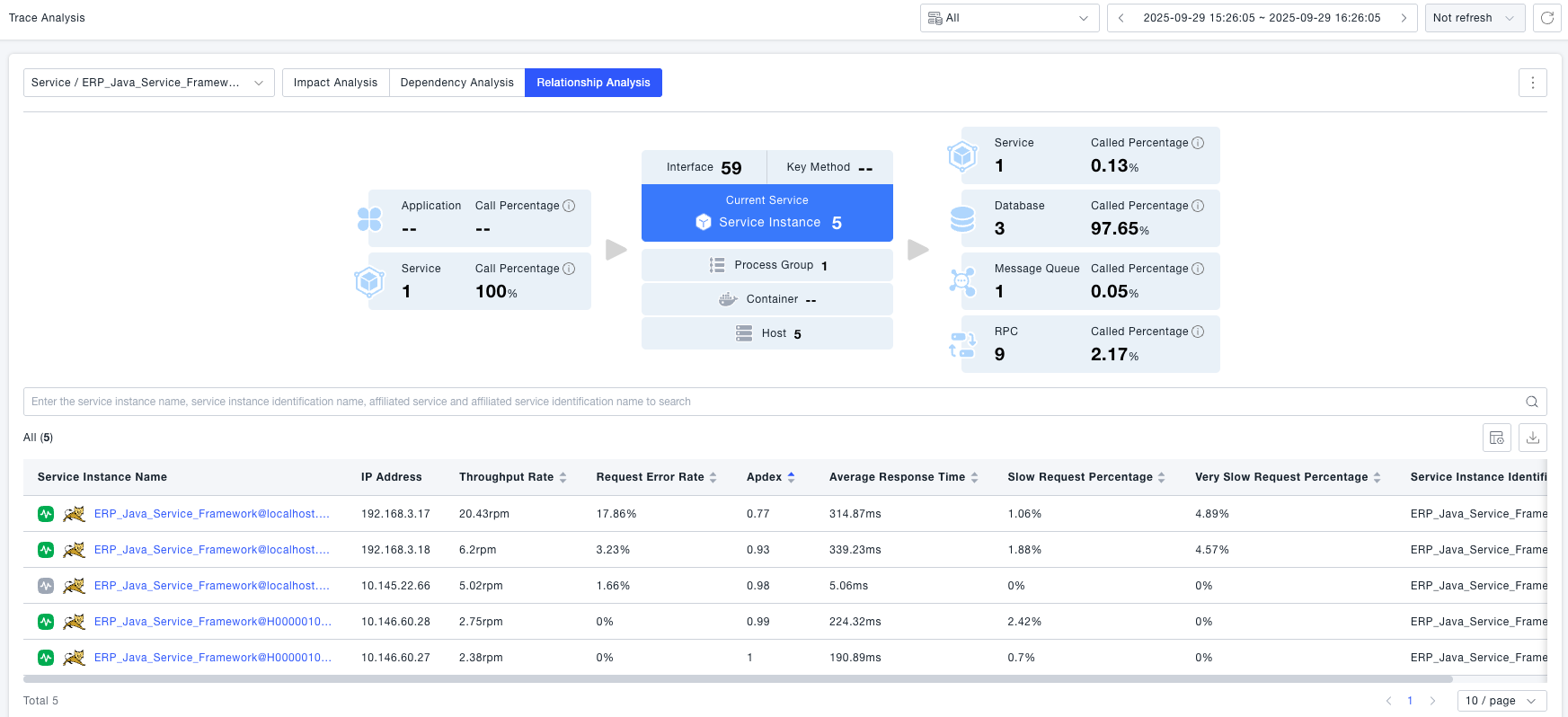
Navigate to the System Services -> Link Analysis page, then select the Relationship Analysis tab. Through Relationship Analysis, you can view content such as the horizontal invocations and vertical relationships of objects. This page supports relationship analysis by dimensions such as service, application, and interface.
 tip
tip- For a detailed explanation of the relationship graph, please refer to Systems
-
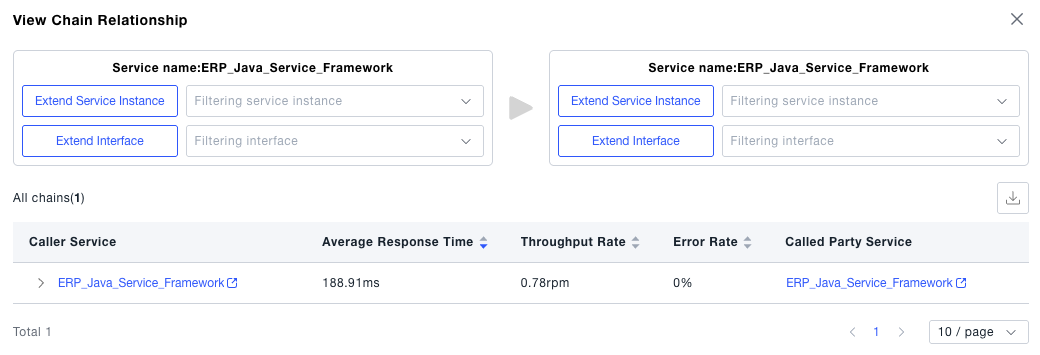
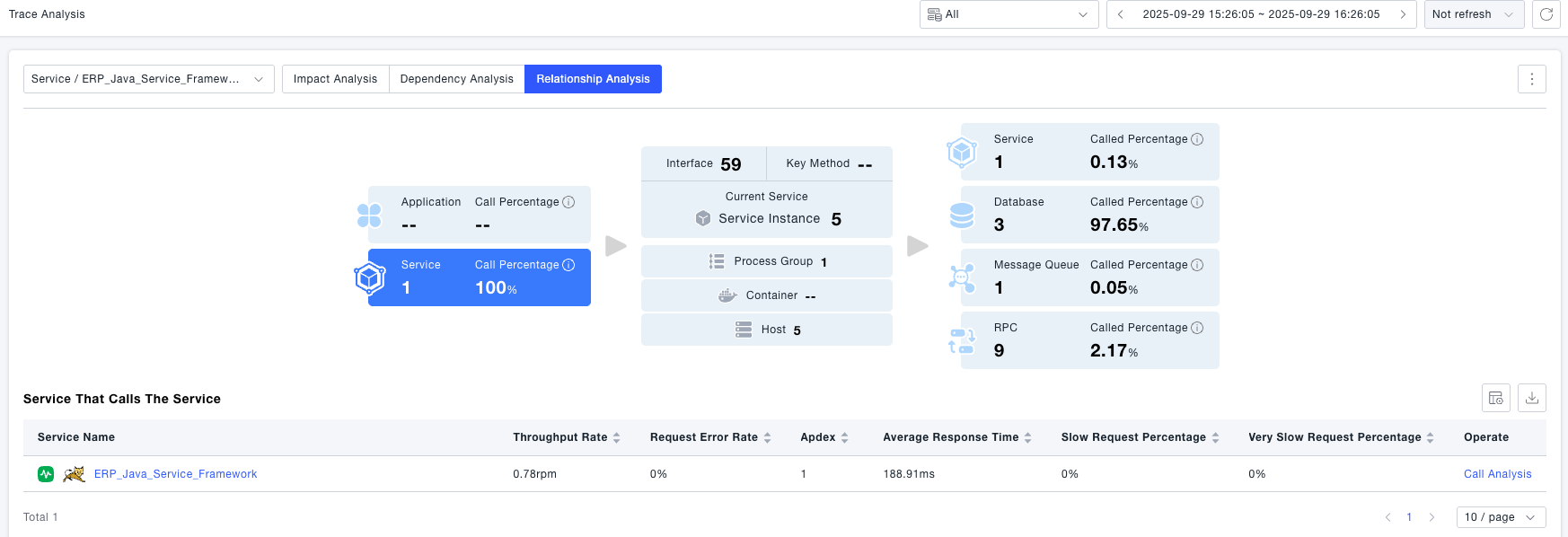
To view Invocation Analysis details, click the horizontal relationship in the relationship analysis graph, then click the Invocation Analysis button of the specific invoking (or invoked) object.
-
In the analysis details, you can expand and query detailed information by dimensions such as service instance and interface.