Business Observability Best Practices
The long-term usefulness of a business trace depends on stable scope, complete data, and consistent health criteria. Use these recommendations after completing the initial implementation.
Start with the minimum business path
- Organize one trace around one verifiable business outcome instead of placing every technical dependency in the same view.
- Keep systems, services, and components that directly affect the outcome.
- Add interfaces, technical components, third-party entities, and vertical architecture after validating the first version.
This makes node direction, metric scope, and anomaly propagation easier to validate.
Keep nodes and relationships stable
| Configuration | Recommendation | Reason |
|---|---|---|
| Entry node | Use the actual point where business requests enter | The entry node affects the core metric calculation scope. |
| Edges | Always match the real call direction | Investigation depends on correct upstream, downstream, and propagation direction. |
| Interface scope | Define interfaces only when part of the traffic belongs to the business | Unrelated calls do not affect trace metrics. |
| Relationship discovery | Use a time range that contains real business requests | Discovered relationships reflect the current business path. |
Define health from business outcomes
- Choose request volume, response time, error rate, or other metrics that represent the business outcome.
- Use node metrics for local health and trace metrics for the overall outcome.
- Associate only alert rules whose anomalies should be reflected in the business trace.
- When metrics are missing, check ingestion, time range, and metric configuration. Do not interpret no data as normal.
Use a consistent monitoring order
On the Business Trace page, use the same sequence:
- Filter by status to review red anomalous cards first.
- Find the target business by trace name, group name, or sharing source.
- Review key metrics and period-over-period changes to establish timing and direction.
- Review the alert count and open details to identify anomalous nodes and related resources.
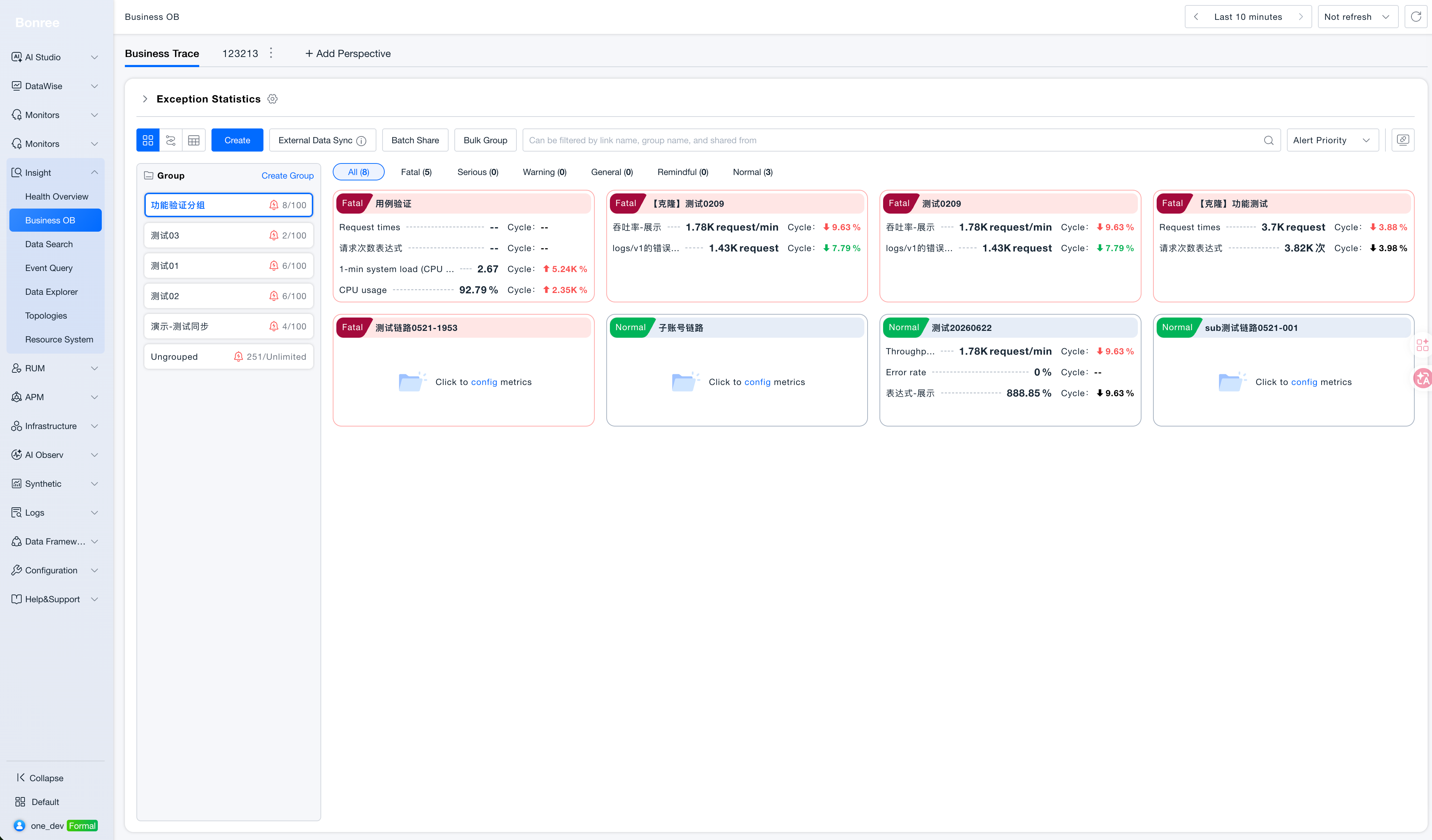
Use card groups by business domain, team, or on-call scope to reduce unrelated traces. Add a custom view only when the trace needs an additional business or instance dashboard.
Keep drill-down paths usable
Regularly verify that critical nodes open metrics, interfaces, alerts, logs, traces, and call relationships. When resource analysis is required, configure vertical architecture and verify related hosts, processes, and service instances.
Use external synchronization for the right topology owner
Use external synchronization when a third-party system centrally owns the business topology. Return stable unique IDs for topologies and nodes. To support interface-to-service drill-down, provide matching relationBindings.
For the workflow and endpoint requirements, see External Data Synchronization and the External Synchronization API Reference.
Review regularly
| Review item | Confirm that |
|---|---|
| Business scope | Nodes still directly support the current business outcome. |
| Data | Critical entities and metrics continue to update. |
| Metrics and alerts | Health criteria still match current business operation. |
| Topology | Nodes, interfaces, and dependency direction match the actual business. |
| Drill-down | Required observability data remains accessible during an anomaly. |
For the first implementation, see Implementation Steps. When an anomaly appears, follow the Business Trace Investigation Practice.