Baseline Template
Prerequisites
- Baseline Template: Serves as a standardized foundational template, uniformly configured and mandatorily distributed by administrators. It establishes a basic monitoring baseline for all resource domains, ensuring out-of-the-box availability and standardized uniformity of fundamental monitoring capabilities.
- Recommended Template: Functions as an optional repository of expert knowledge, created and maintained by administrators. It is flexibly referenced by resource domains as needed to promote best practices and enrich monitoring scenarios, suitable for non-mandatory but recommended rules.
- Personal Template: Acts as a personalized rule library, independently created and privately visible to users. It addresses customized monitoring needs, supports the rapid reuse of personal operational experience, and is exclusively usable within the user's own resource domains.
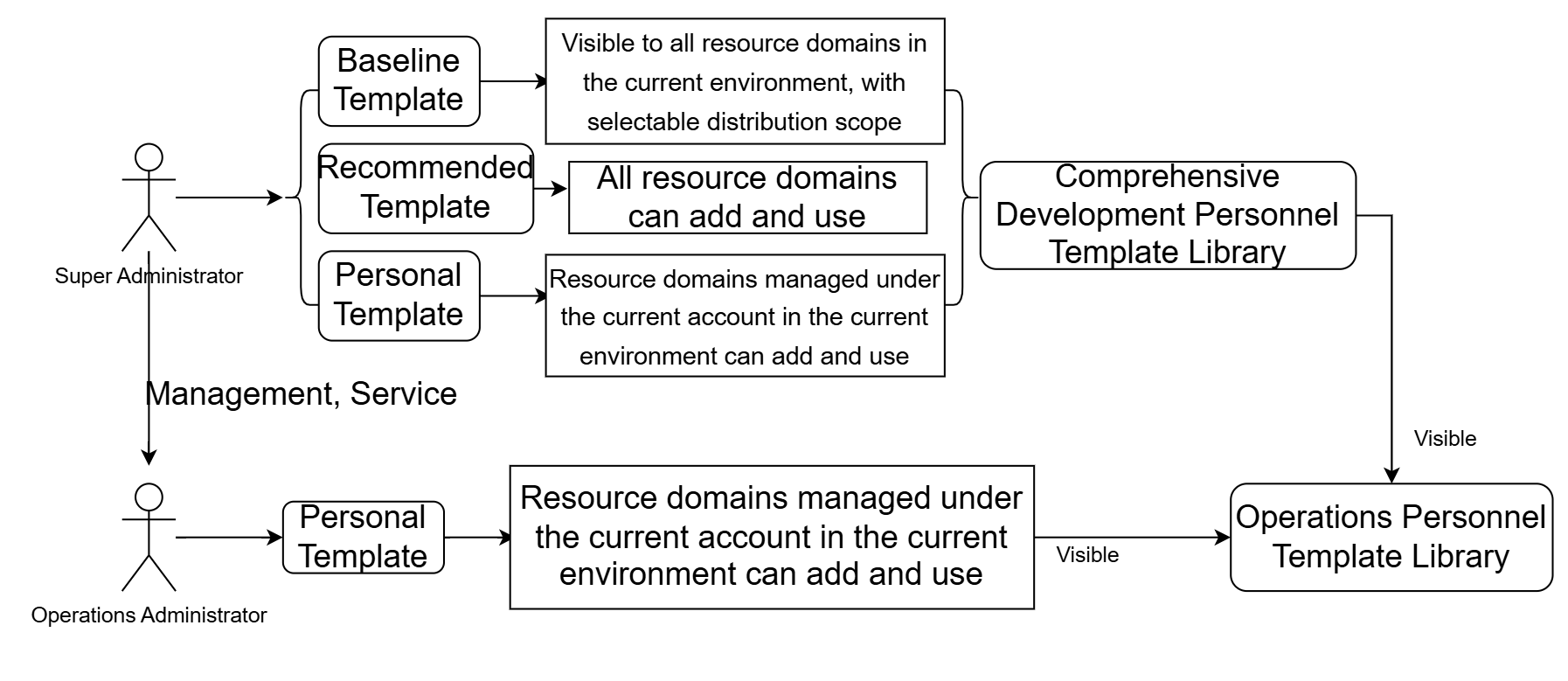
Baseline Template
Primary Purpose
- Establish monitoring baseline standards to ensure all systems meet minimum monitoring requirements.
- Achieve standardization and unified management of rule configurations.
- Provide automated rule initialization for new resource domains.
Applicable Scenarios
- Enterprise-level monitoring standard system construction.
- Rule specification unification under multi-team collaboration.
- Rapid rule deployment for newly created resource domains.
Usage Methods
- Select distribution scope (specific resource domains or full environment).
- The system automatically creates corresponding alert rules in target resource domains.
- Supports global coverage including subsequently created resource domains.
Precautions
- If modifications are needed after distribution, withdrawal must be performed first.
- Selecting all for distribution will affect all existing and future new resource domains.
- Features mandatory enforcement characteristics - distribution scope requires careful planning.
Baseline Template
Primary Purpose
- Share validated best practices and expert knowledge
- Provide high-quality rule references for operations teams
- Lower the barrier to rule configuration in complex scenarios
Applicable Scenarios
- Optimized monitoring solutions for specific technology stacks
- Specialized monitoring requirements for business scenarios
- Capability enhancement and knowledge transfer within operations teams
Usage Methods
- Each resource domain actively selects references based on actual needs
- After referencing, templates are converted to local alert rules and can be adjusted
- Supports multiple repeated references of the same template
Precautions
- Non-mandatory usage requires evaluation of applicability based on specific scenarios
- After referencing, decoupling from the source template ensures independent modifications
- Recommended to provide clear usage scenario descriptions
Personal Template
Primary Purpose
- Meet personalized requirements for individuals or specific business scenarios
- Accumulate and reuse personal operational experience
- Improve efficiency of repetitive configuration tasks
Applicable Scenarios
- Specialized monitoring needs for personally managed systems
- Validation and accumulation of experimental rules
- Experience and reuse within teams
Usage Methods
- Visible and usable only by the creator's account
- Can be referenced within personally managed resource domains
- Supports flexible editing and adjustments
Precautions
- Completely private, does not support team-level sharing
- Affected by changes in account permissions
- Suitable for personalized requirements of non-critical business operations