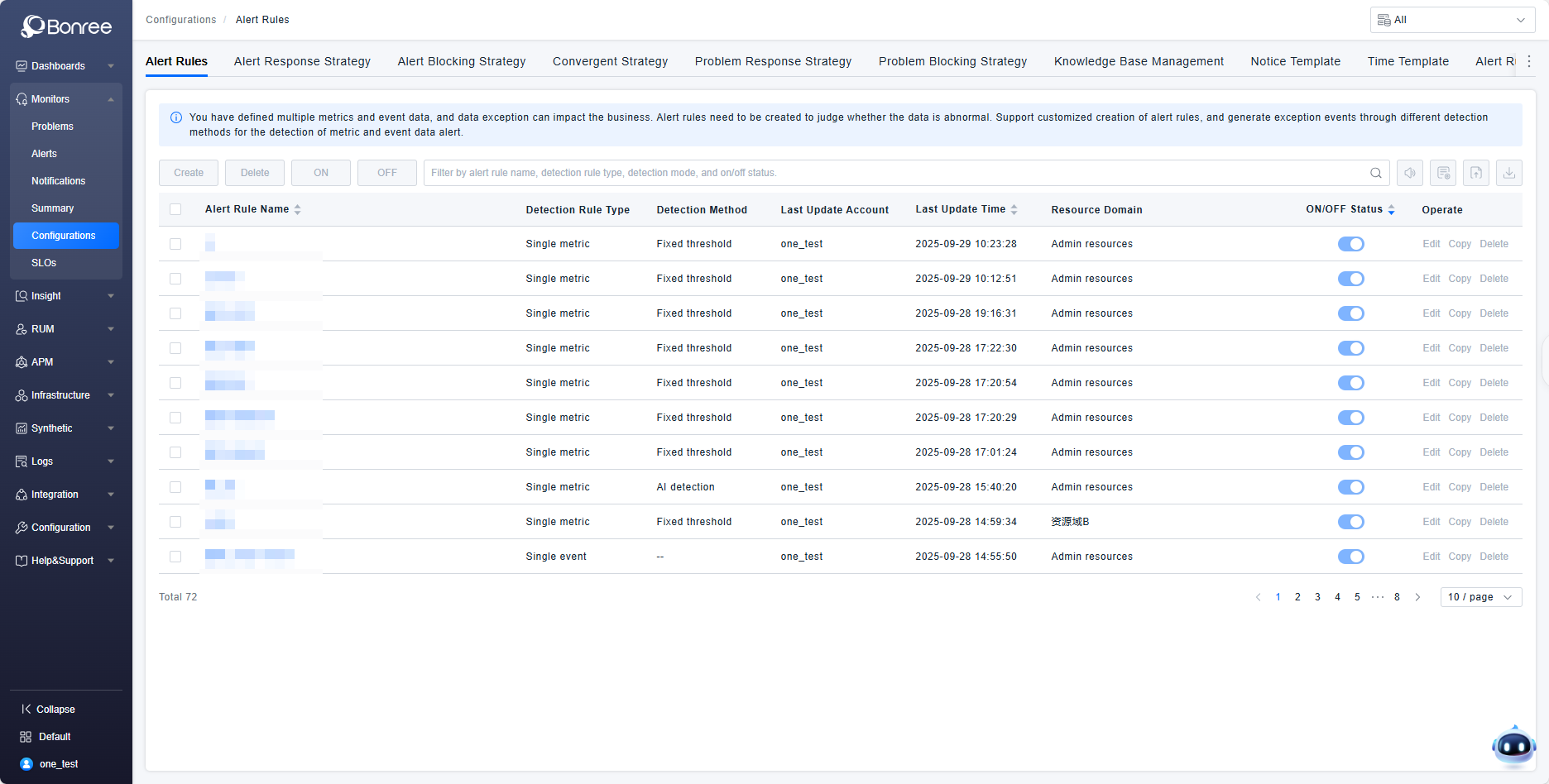
Monitoring Configuration
Overview
- The monitoring configuration module is an integrated management center for rules, policies, and templates. Its core function allows users to define custom alert rules and employ multiple detection methods to identify anomalies in metrics and event data.
- With alert rules as the engine, it establishes a comprehensive support system: fine-grained control over the alert lifecycle through robust policy management (such as response, suppression, and convergence policies); facilitation of experience accumulation and reuse through knowledge assets; and improved configuration efficiency and standardization via a unified template library (including notification, time, and rule templates). The ultimate goal is to automatically generate precise abnormal events, providing high-quality source information for subsequent alert processing.
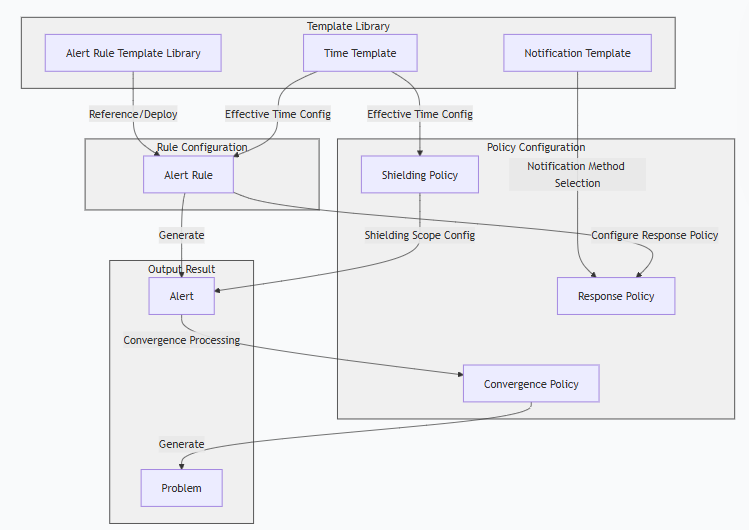
Value
-
Achieve Precision and Intelligence in Alerting
Custom rules and diverse detection methods ensure alert accuracy, while convergence, suppression, and other policies proactively filter out noise, directly enhancing alert quality and enabling operational teams to focus on genuine threats.
-
Improve Operational Efficiency and Standardization
The template library enables "configure once, reuse multiple times," significantly reducing the complexity and time cost of rule configuration while ensuring standardized operational practices and the implementation of best practices.
-
Promote Knowledge Accumulation and Process Closure
Knowledge base and script management transform individual expertise into shared team assets, preventing knowledge loss. Combined with response policies, they ensure knowledge accumulation and process automation from alert generation to resolution, forming a continuous improvement loop.
-
Ensure Business Continuity and Stability
Through proactive anomaly detection and rapid response mechanisms, the system minimizes the impact of failures on business operations, serving as critical infrastructure for safeguarding business SLOs (Service Level Objectives) and user experience.