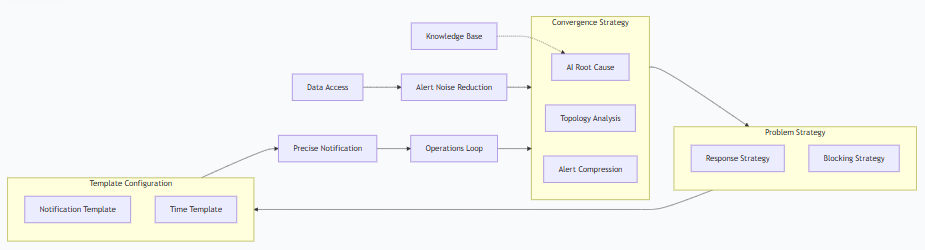
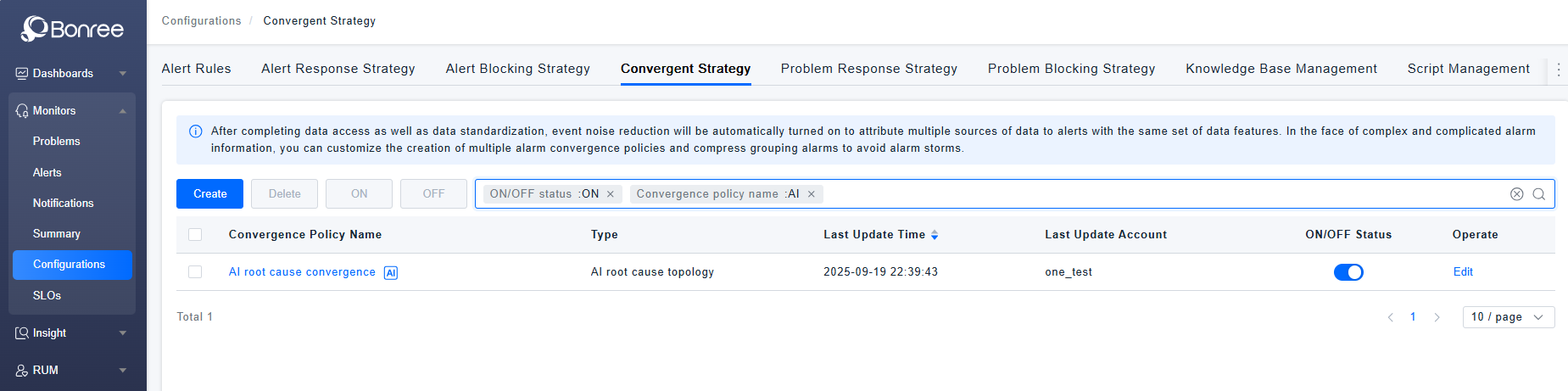
The Problem Configuration module serves as the core decision-making layer within the emergency response system. It establishes a systematic problem handling framework through convergence strategies, problem response strategies, and problem blocking strategies. After alerts are generated, configured convergence strategies enable intelligent merging and compression of multi-source alerts, automatically categorizing alerts with similar data characteristics into unified problems.
Through customizable convergence strategies, the system effectively compresses duplicate alerts and prevents alert storms. Combined with notification templates and time templates, it achieves precise and time-based problem notifications. Leveraging AI root cause convergence and topology analysis capabilities, it automatically identifies the root cause of problems, forming a complete automated closed loop from alert merging and problem identification to notification response.
Intelligent Alert Governance
Through AI-driven convergence strategies and root cause topology analysis, duplicate alerts are automatically merged and key issues are identified, fundamentally preventing alert storms and improving the signal-to-noise ratio of alerts.
Precise Problem Response
Based on problem response strategies and notification templates, problems of different types and severity levels are accurately delivered to the relevant responsible personnel, reducing manual intervention and improving response efficiency.
Standardized Operational Processes
Through unified problem blocking strategies and time templates, operational activities are managed in a standardized manner, avoiding arbitrary blocking and ensuring the controllability and traceability of operational actions.
Automated Root Cause Identification
Using AI root cause convergence technology, the system automatically analyzes problem correlations and topological structures, quickly identifies root causes, significantly reduces fault diagnosis time, and improves system availability.