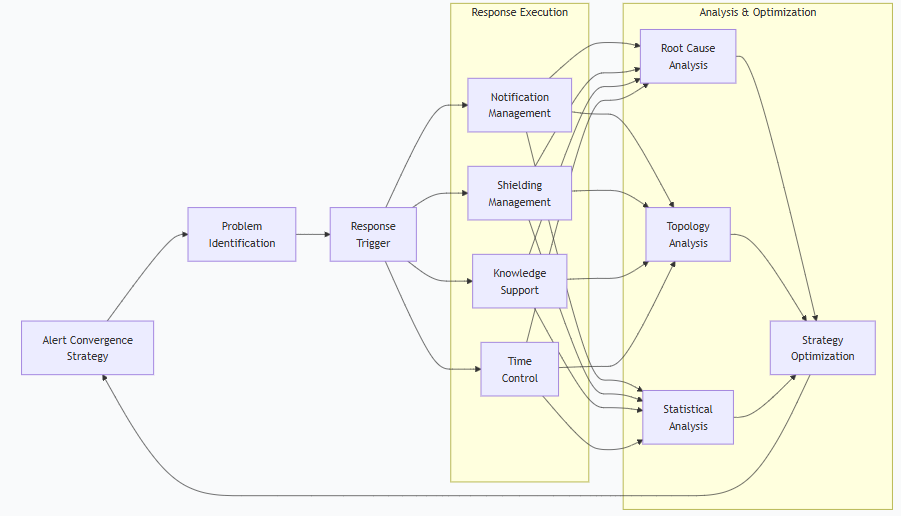
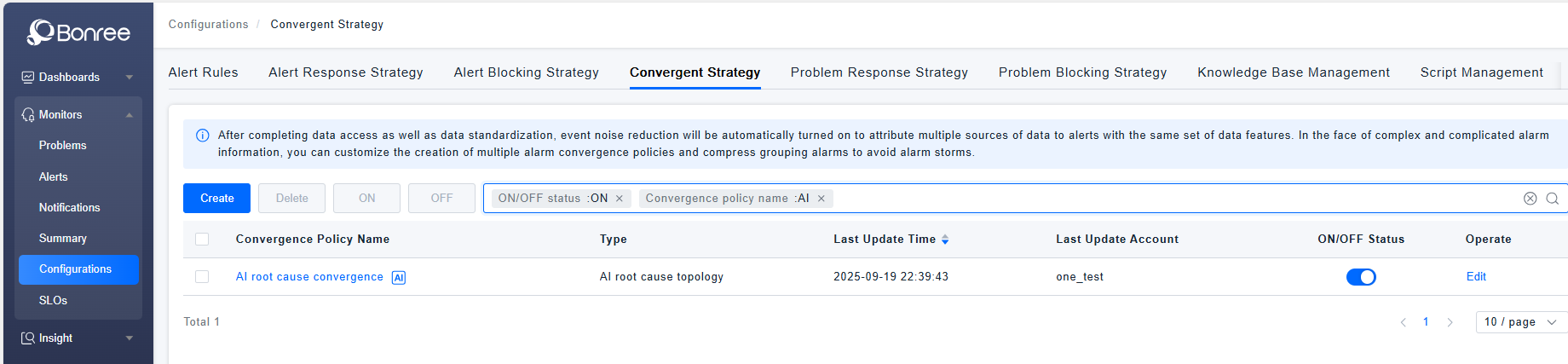
Emergency Response is built around convergence strategies and problem response strategies to establish a complete closed-loop management mechanism. When the system identifies real problems through multi-source data correlation and alert information, it automatically triggers a series of standardized response actions: precise and timely message delivery is achieved through notification templates and time templates; knowledge base management provides immediate solution references for handling personnel; root cause analysis and root graph topology tools quickly locate the source of problems; and statistical analysis functions visually display the distribution and handling status of current issues.
This integrates originally scattered emergency actions into a highly coordinated processing chain, ensuring the entire process from problem occurrence to resolution is controllable and traceable.
Precise and Automated Response
Through predefined convergence strategies and problem response policies, the system automatically matches processing workflows and accurately notifies responsible personnel. This significantly reduces manual judgment errors and intervention delays, ensuring critical issues are never missed.
Significantly Improved Handling Efficiency
By integrating instant knowledge base references and visualized root cause analysis, teams can quickly understand problem context and identify fundamental causes, effectively reducing Mean Time to Repair (MTTR).
Continuous Accumulation of Operational Experience
The synergy between the knowledge base and handling policies allows experience from each emergency response to be solidified and reused, transforming the team's operational capabilities from "reactive firefighting" to "proactive accumulation."
Data-Driven Decision Support
Statistical analysis based on convergence status and problem distribution not only provides real-time insight into system health but also offers quantitative evidence for optimizing alert rules and adjusting resource allocation, driving continuous improvement in operational processes.