Process Group Identification
ONE supports identifying process group names according to rules. Processes will be identified as process groups based on process attributes. Process groups with deep monitoring enabled will be identified as services according to the attributes of requests. A process group is the boundary of a service. A process group is identified as a single service by default. It supports identifying a process group as multiple services by configuring service identification rules. When the default detection identifiers are insufficient, you can use custom detection rules to define your process groups.
Custom Detection Rules
Used to refine business-specific process group identification logic, with higher priority than the default detection rules.
Create Custom Rules
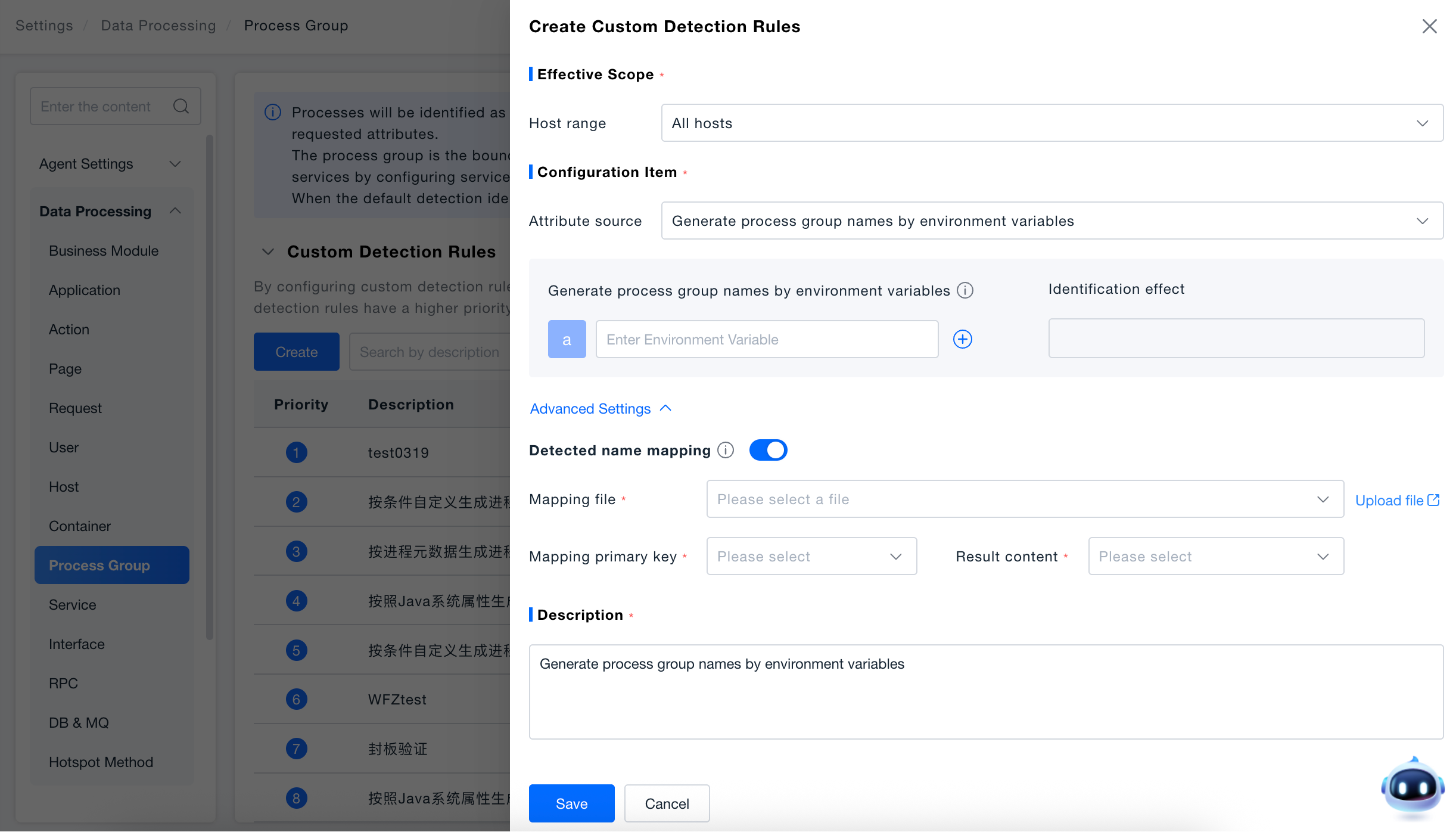
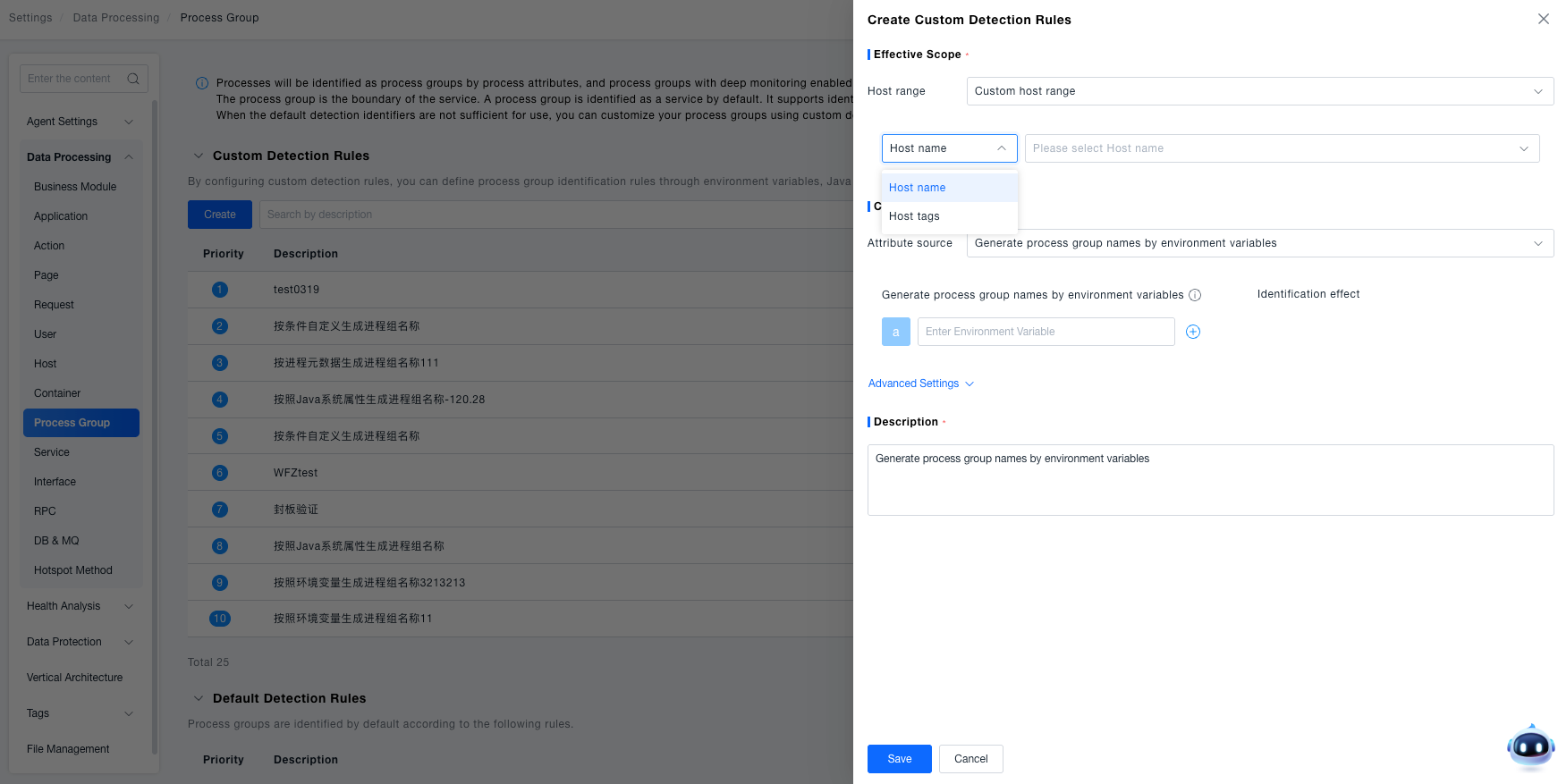
Effective Scope: Customizable host scope is available, including the options of All Hosts and Custom Host Range .
Select the host scope where the rule takes effect through the drop-down box (e.g., "All hosts") to specify which hosts the custom rule applies to for process group identification.
When Custom Host Range is selected, you may define the scope using either Host Name or Host Tag :
- Host Name : Follow the existing logic to select target hosts from the dropdown list.
- Host Tag : Filter matching hosts by selecting tags, with support for the matching conditions: Include Any and Include All .
- Host Name and Host Tag cannot be used simultaneously.
Attribute Source: Select from the drop-down list the basis for generating the process group name. For example, selecting to generate the process group name according to environment variables means generating the process group name based on the environment variables of the process.
Environment Variable Input: In the input box, fill in the environment variable names used to identify the process group (such as APP_GROUP, SERVICE_ID, etc.); click the "+" button on the right side of the input box to add multiple environment variables (supporting identification through multi-condition combination).
Identification Effect: Real-time preview of the process group name style generated based on the input environment variables to help verify the rationality of the rule configuration.
Advanced Settings: Name mapping supports custom modification of process group identification names through mapping files. If the process group identification name automatically collected by the platform matches the "Mapping Primary Key", it will be automatically replaced with the "Result Content" and saved to the platform.
- Status: Advanced configuration is closed and collapsed by default. Click the "Advanced Configuration" text to expand the configuration content.
- Mapping File: The selected file source is the file uploaded in the existing "File Management" feature. After selection, the "Upload File" button jumps to the "File Management" feature page.
- Mapping Primary Key/Result Content: Drop-down to select the column names in the selected file.
Description: Fill in the description of the rule to quickly identify the purpose of the rule later (e.g., "Generate process group name through the environment variable APP_GROUP").
Default Detection Rules
Provide process group identification logic for common scenarios, which takes effect when no custom rules match.
Rule Description

The default rules include the following typical identification logics (the effective status is controlled by the enable switch):
- Generate process group names according to container Labels (e.g., Kubernetes Container Name).
- Generate process group names according to Docker image file names.
- Generate process group names according to process identification rules.
Default rules are system preset logic. Some rules only support "View" (e.g., "Generate process group names according to process identification rules") and do not allow editing/deletion; rules that support "Enable/Disable" can be controlled by a switch to take effect or not.