2026
This page records version updates for the SmartAgent and SmartGate agents and the client SDKs.
ONE 4.0.0.13 2026/08/23
AI Studio
New Features
-
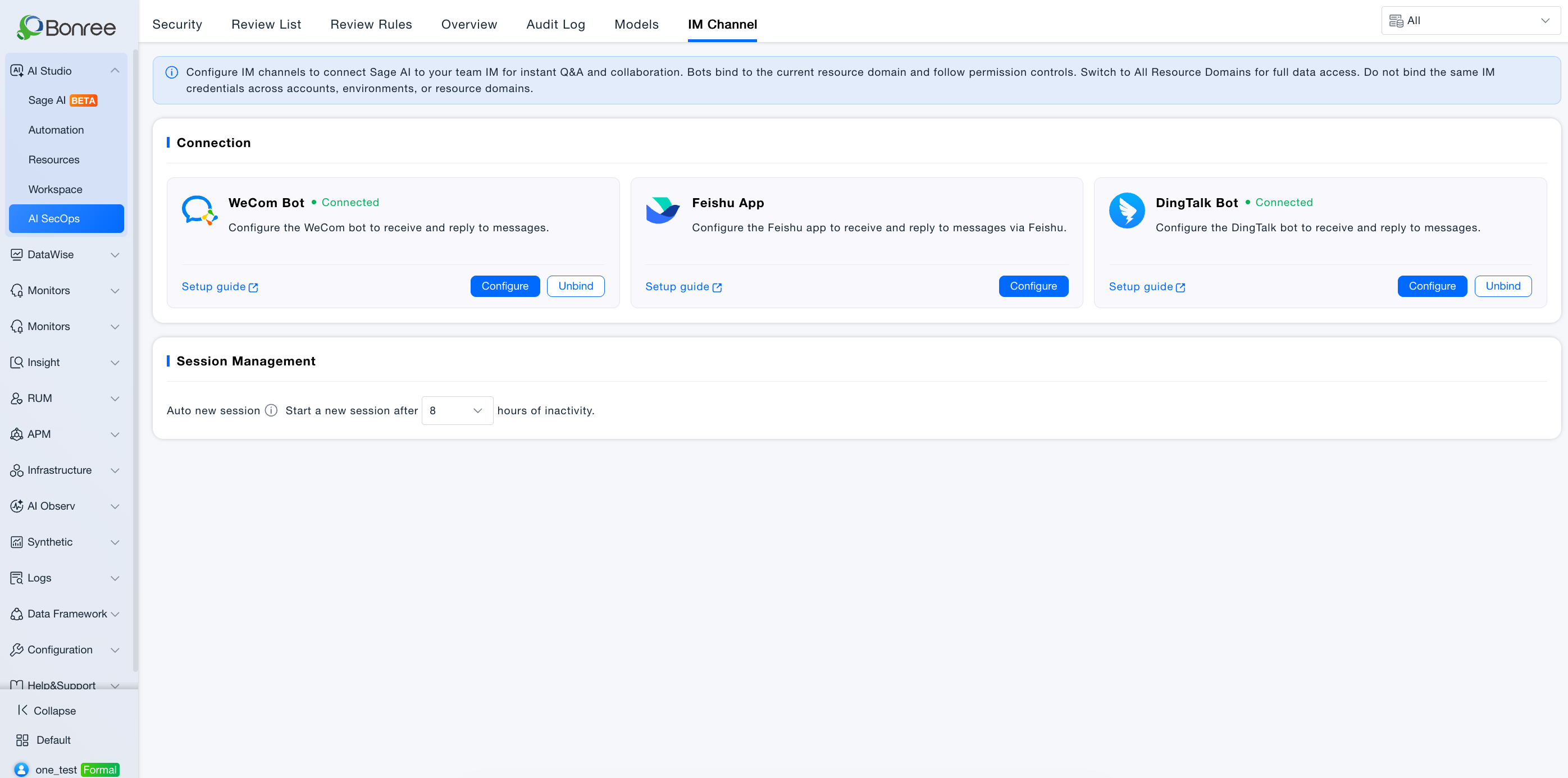
IM Channel: Added IM Channel under AI SecOps to connect Sage AI to WeCom, Feishu, and DingTalk. Teammates can chat in IM DMs or groups without signing in to the ONE console. Bots bind to the account, environment, and resource domain used at configuration time, and follow Content Security, Command Security, and data permissions.
-
WeCom / DingTalk dual connection modes: WeCom and DingTalk support both WebSocket / Stream long connection and URL callback (Webhook / HTTP). The IM console and AI Studio must use the same mode. In this release, the Feishu config form provides URL callback only (app card interactions are kept).
-
Command Security: Added Command Security as a peer module of Content Security under Security Management. Maintain block / ask / allow lists by command prefix, coordinated with approval mode (Block > Ask > Allow > Approval Mode). Applies to Sage AI, IM Channel, and other command-execution scenarios.
-
Automation problem description aligned with Sage AI: The problem description input supports
@resource references and selecting Agent / Skill / model. The former standalone “Trigger capability” option is merged into the input area. Approval mode is fixed to Full access (disabled and not switchable) for unattended scheduled runs.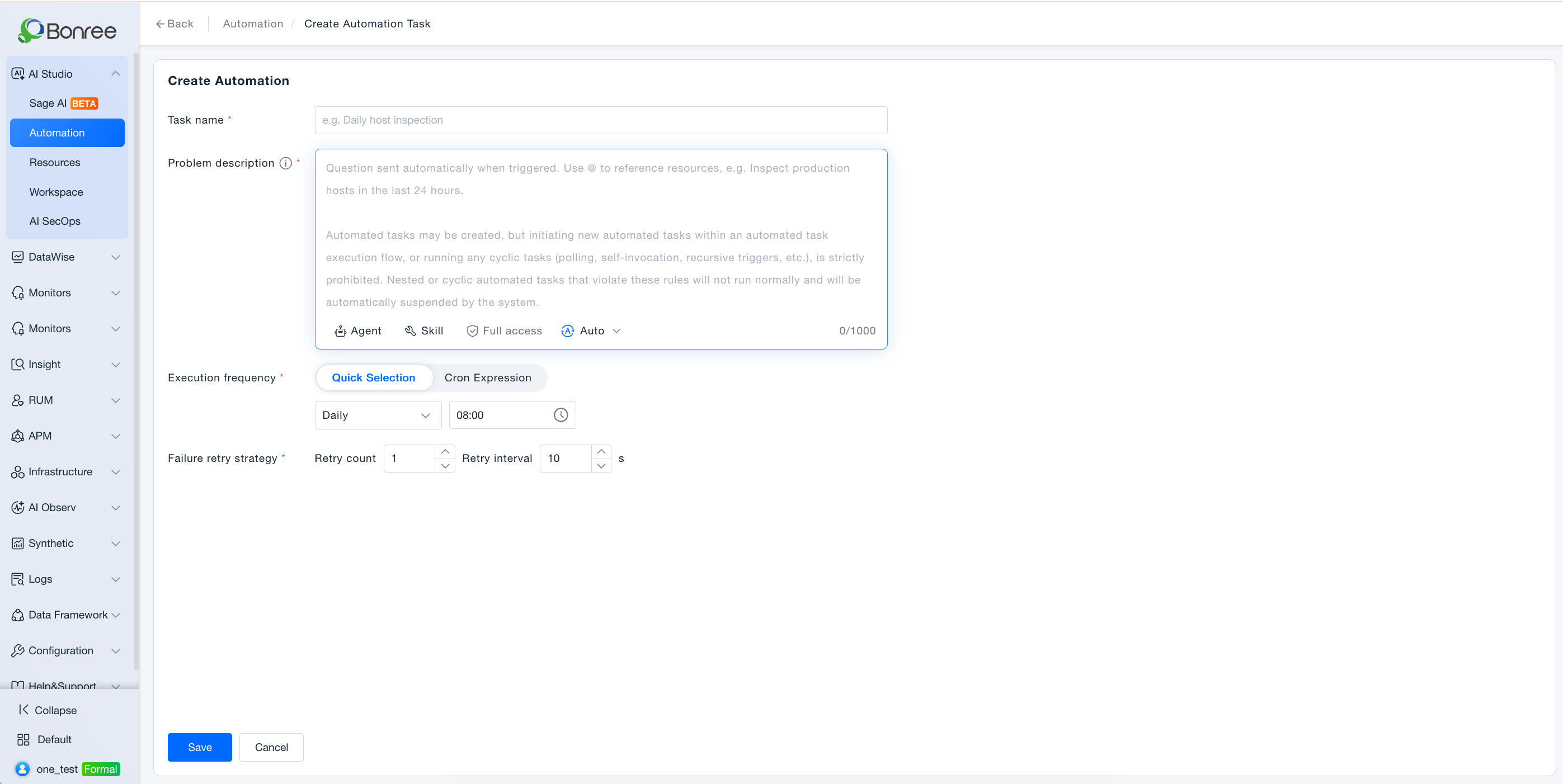
-
Create automation from conversation: In Sage AI, describe scheduled inspection, summary, or report needs; after confirmation, an automation task is created for the current account and resource domain, with a detail link in the reply.
-
Sage AI file capabilities: Conversations support fuller file upload, generation, and online preview (such as PDF, images, and text) to enrich context or review generated results.
Improvements
-
Automation execution type and re-run logic: Task logs add an Execution type column (Scheduled / Re-run / Run now). Re-run / retry on failure creates a new session from that record’s start time and problem description (sorted by execution time, no parent-child nesting), distinct from Sage AI Regenerate, which uses the latest time parameters.
-
Automation quota and creator: At most 20 automation tasks per account / environment / resource domain (Create is disabled with a tip when the limit is reached). Task cards show creator and created time; the list supports filtering by creator.
-
Nested / cyclic automation blocked: Creating another automation task inside an automation run, or running polling / self-invocation / other cyclic logic, is prohibited. Conversation-based creation is rejected with a tip; at trigger time, violating tasks are blocked and automatically paused.
-
Export report file type: The export records list adds a Report file type column (PDF / Word / HTML / Markdown) to distinguish similarly named exports.
-
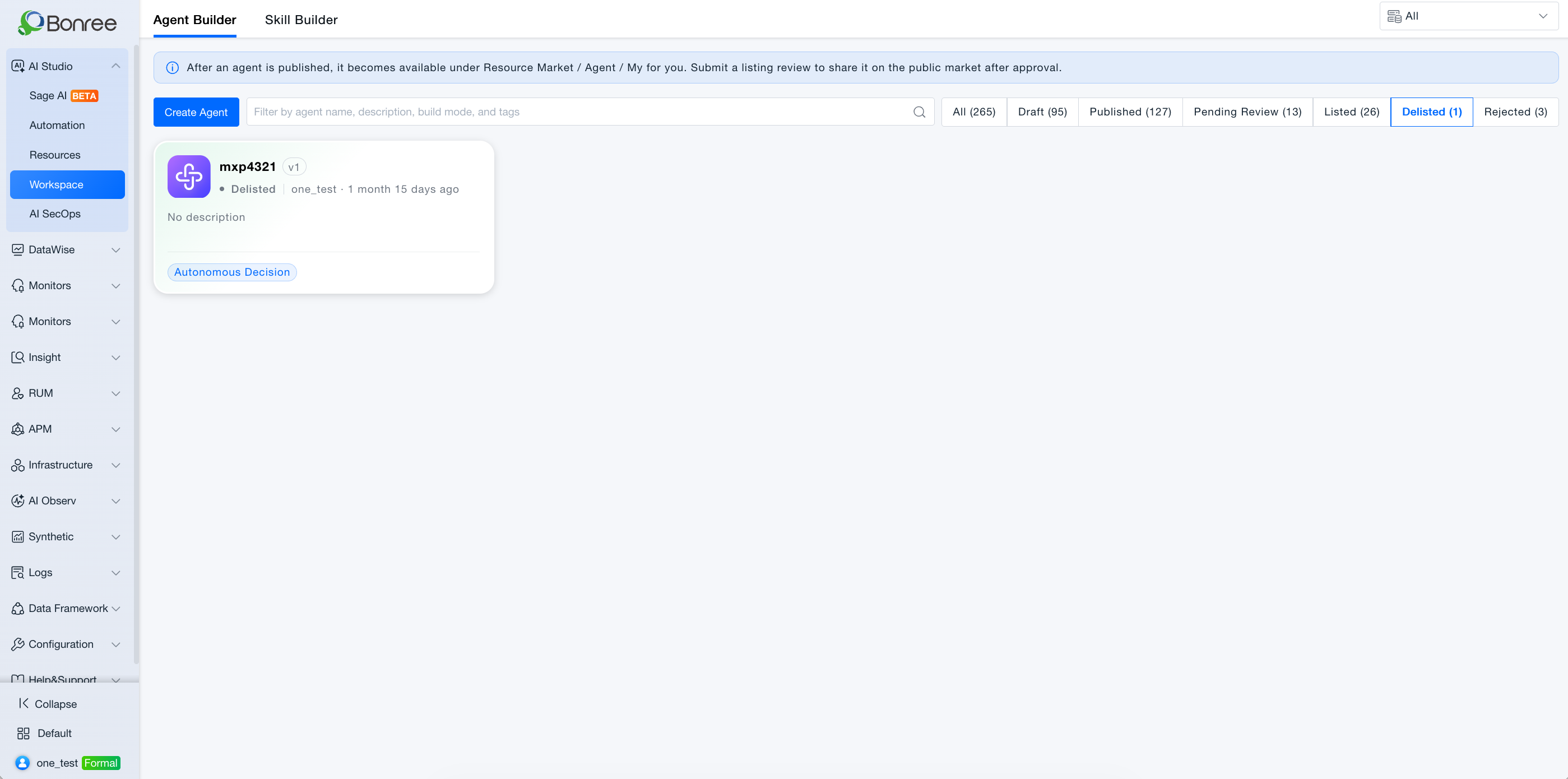
Workspace status quick filters: Agent Builder and Skill Builder lists provide status quick filters (All / Draft / Published / Pending Review / Listed / Delisted / Rejected, etc.) with counts. Tags are required when creating or editing.
-
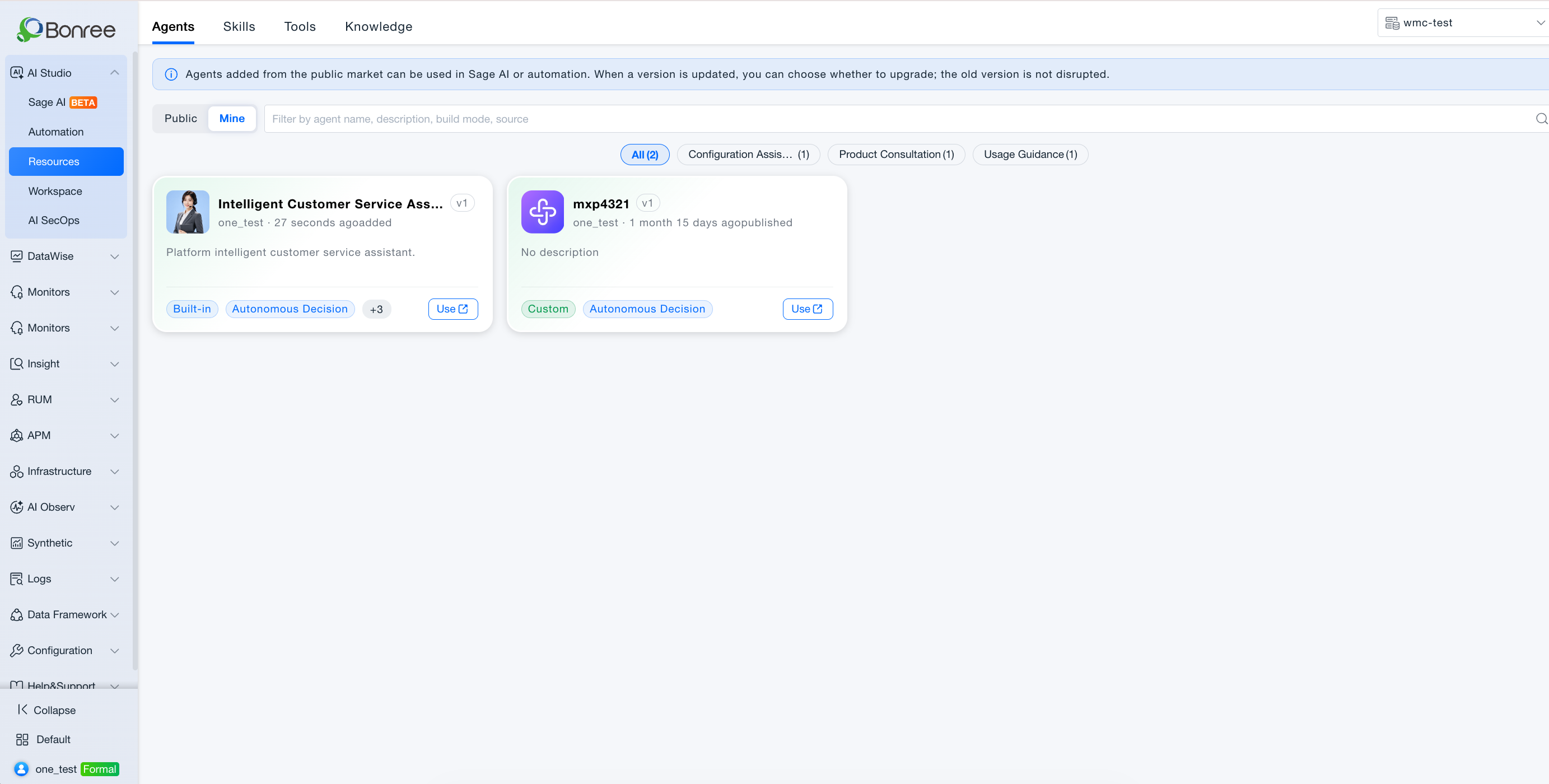
Resource Market tag quick filters: Agent and Skill markets support tag quick switching under the search box (AND with search) for faster filtering of Public / Mine resources.
-
Model Auto and custom headers: The model dropdown pins Auto at the top (default). New sessions default to Auto; each session remembers the last manual selection. Model advanced settings support multiple custom HTTP headers, sent automatically to upstream APIs.
Ask AI
Improvements
- Clarification in built-in scenarios no longer consumes tokens.
- Added entity queries by tags and attributes.
- Added conversation and session sharing.
- Optimized token calculation.
- Optimized root cause analysis.
RUM
Improvements
- Added separate slow-network-request thresholds for different applications.
- Web applications can configure route-switch counts and include them in application-level PV aggregation.
- Added UV aggregation.
- The Metrics tab in application details selects a metric by default.
- Removed the application user-session entry and added an Analyze Sessions button with guidance.
- Improved the SDK startup-probability allowlist prompt.
- Fixed an issue where filters were not retained when drilling down into code errors.
- Deployment Status and End-User Application lists now display 50 items per page by default and use sticky table headers.
- Overseas: Added embed-address guidance when automatically embedding code by service.
- Fixed incorrect application-type filter values for jank records in dashboards.
- Added status-code display to the H5 page-load and route-switch performance tabs.
- Fixed an inconsistency between code-error suppression record prompts and the page display.
- Fixed an issue where code problems with the same summary had different problem IDs.
- Changed the User name label in records to User alias.
APM
Improvements
- Updated the OpenAPI endpoint
/openapi/apm/v3/error/errorDetailListto correct the description of thefilterComponentrequest parameter.
Analysis
Improvements
- Reduced the maximum custom decimal places for dashboard cards from 15 to 10, covering ten chart card types and scorecards.
IAM
Improvements
- Added user import from files.
- Switched QS queries to Titan.
- System services and Agents can be queried by their service and system.
- Grafana themes now follow the system theme.
- Optimized the Dockerfile and updated its base image.
- License billing-item mutual exclusion no longer distinguishes between data centers.
- Optimized the slow V3 billing-reporting endpoint
IamApiController.pushCostDataV3. - The built-in Pilot License self-check supports the latest full set of billing items.
- Added a composite index to the user login Session table to optimize queries.
SmartAlert
Improvements
- Added event-alert recovery.
- Alerts now include the owning system and application.
- Added metric calculation.
- Added queries by specified tags.
- Added a template API required by ETL.
- Optimized high-cardinality queries.
- Added a character limit for notification content.
- Optimized query performance.
- Optimized decimal-place handling for the
valuevariable.
Nebula
Improvements
- Replaced the
ingest-clientdependency withtitan-client.
CMDB
Improvements
- Preset entities now support creating custom attributes.
- The metric registration API now supports metric import.
- Optimized relationship caching and logging.
- Optimized the tag UI.
- Internal storage performance optimization.
Titan-Query
Improvements
- Preset entities can be queried by custom attributes.
- Optimized multi-value queries.
ETL
Improvements
- Merged probe circuit-breaker event types under Alert Project dependencies.
- Preset entities under CMDB dependencies now support custom attributes.
- Truncated large response logs for requests from the ETL API to Ingester.
- Registered data-center dimension names according to the task language environment.
- J&T Express: Added separate network-evaluation rules for different applications.
- Guotai Junan: Added status-code display to the H5 page-load and route-switch performance tabs.
- J&T Express: Fixed an issue where code problems with the same summary had different problem IDs.
Data Integration
Improvements
- When integrating metric data via Prometheus remote_write, the Vector collector is supported for direct reporting.
- Fixed an internationalization issue during custom metric registration.
ONE 4.0.0.12 2026/08/15
AI Studio
Improvements
- Adapted to MCP API changes.
Ask AI
Improvements
- Clarification in built-in scenarios no longer consumes tokens.
- Added entity queries by tags and attributes.
- Added conversation and session sharing.
- Optimized token calculation.
Bug Fixes
- Fixed legacy issues related to reading configuration.
CK
Improvements
- Added support for log and database models.
- Merge-table queries can now join Buffer tables.
- Upgraded the CK kernel.
- Improved CK configuration rendering.
- Added Setting parameter-concatenation configuration to CK Manager and QueryService.
- CK Manager can now automatically cancel Merge-table binding tasks.
- Added read and write support for multi-value dimensions.
QueryService
Improvements
- Added Setting parameter-concatenation configuration.
CMDB
Improvements
- Added support for log and database models.
- Custom metrics in the metric repository can now be exported.
- Entity relationships can now be used to query an entity's owning system and application.
- Completed internal improvements.
Titan-Query
Improvements
- Added support for log and database models.
- Added multi-value dimension queries.
- Improved alert-model queries.
Bug Fixes
- Fixed known issues.
BRFS
Bug Fixes
- Fixed the Fastjson vulnerability.
ETL
Bug Fixes
- Fixed log ingestion through the third-party Logstash integration (case-103-6000).
- Fixed the RUM package issue (case-103-5902) and delivered related RUM improvements.
- Standalone deployments now support all tasks with added slots.
- Fixed events losing tags (case-103-5992).
- Fixed historical issues in frontend and backend task management.
- Consolidated log-model-related capabilities.
- Fixed data loss after Ingester stops.
- Optimized Flink direct-memory calculation to dynamically calculate based on total memory.
- Fixed concurrent Redis queries for the APM entity cache, separate Redis set and expiration operations, and non-shared Redis connection pools.
- Optimized the RUM domain-cache refresh logic.
APM
Improvements
- Added the OpenAPI error snapshot query endpoint
/openapi/apm/v3/error/errorDetailList, which returns both error snapshots and error-log details. - The OpenAPI trace list endpoint
/openapi/apm/v3/trace/listnow limits response-time-sorted queries to 24 hours and automatically uses the last 24 hours when exceeded. - The internal trace list endpoint
/api/apm/trace/search/list/v3now applies the same 24-hour limit for response-time-sorted queries. - Delivered an end-to-end CallMap-to-network-analysis navigation solution for Huawei NCE-Trace traces.
- Updated the dashboard scorecard API to support decimal data.
- Upgraded and encapsulated frontend trace components; the code-stack area can be enlarged for inspection.
RUM
Improvements
- Provide a HarmonyOS NEXT SDK that supports bytecode instrumentation.
- Differentiate ANR types and clearly indicate whether users perceive them.
- Support batch import of domains.
- Add permission points for Issue operations, splitting the permissions for modifying Issue status and creating applications.
- For Web manual instrumentation, add support for starting a new session when the session duration exceeds a certain threshold.
- Add percentiles (P50, P75, P95, P99) for metrics such as LCP, FP, FCP, and page fully loaded time.
- After grouping JS errors by error message, add a fix status.
- Optimize the configuration of collection rules during Web application manual instrumentation.
- Sort out device models, and add a switch to control whether unidentified devices show raw collected data or "Unknown".
- Add memory usage and storage usage to records.
- Optimize the user session list display.
- Support searching by fields in detail conditions in Settings.
- Increase the maximum number of anomaly detection rules that can be created, and make it configurable.
- Load 1000 events by default in session details, with the option to load up to 5000 events.
- When editing user groups, allow adding or removing applications.
- In RUM/Applications, newly created applications will appear in the inactive tab.
- In Data Query, RUM records query data on first access to improve user experience.
- Optimize the filtering and export of Issue summaries.
- Support entering 0 for SDK startup probability.
- Add status code filtering for Web Request records.
- Open Issues in a new tab to avoid returning to the first page issue.
- On the User Details page, User ID and User Name are displayed in black font with no click effect.
- For filtering and display, use only the respective fields for Device ID, User ID, and User Name.
- Define the sorting rule for the first click on lists in secondary menus under RUM.
- Merge the monitoring switch in Deployment Status with the Data Collection switch in Settings, and ensure compatibility for the API that cancels monitoring.
- Make table headers sticky and default to 50 items per page.
- Adapt file line number parsing for Bratos Xcode 26; impact scope: iOS.
- On the Application Details page, clicking on Relationships/Requests should jump to RUM/Web Requests.
- Clicking on User Session should uniformly jump to Data Query/User Session Details.
- Clicking on User ID should uniformly jump to Data Query/User Session/User Details.
- When creating or editing tracing protocols in Request Tracing, ignore case in Header names when checking for duplicates.
- Optimize the copy for auto-instrumentation.
- Optimize the symbolic file sync logic: change to real-time sync on the platform side, while maintaining compatibility with old logic.
- Remove the "!" icon from the Business request error rate in the Application list.
- In the session list of User Details, change User ID to black font and disable drill-down.
- Provide APIs to support the AI workbench module.
- In Deployment Status / Applications, change the label and logic of the Data Center column from 7 days to 3 days.
- In Data Collection, add a jump link for automatic instrumentation based on the service.
- When selecting a HarmonyOS NEXT application in Data Collection, hide the “Max Trace Collection” content highlighted in the red box in the figure.
- Optimize stack parsing for Native Crash and AppFreeze on HarmonyOS NEXT.
- Fix English translations.
- Support searches by JS error message.
- Add a note to the user-session list indicating that the number of displayed records is configurable.
- Correct the English name of the Anomaly Detection menu permission.
- Optimize tab display logic in Page Analysis and Issues based on application type.
- Keep User Details on a single page and reuse related logic.
- Change the default User Details session-list query range from the last 13 days to the last 3 days; when navigating from User ID, filter by User ID, and add an explanation to Current Status that it indicates whether data was reported in the last minute.
- Standardize feature copy across record-detail pages.
Performance Improvements
- Split the health-score query logic for each version on the Application Details page.
- Removed “All Applications” from the application selector on RUM first-level pages.
- Open Issues in a new tab.
- Optimized health-score SQL.
- Optimized session-list queries by merging multiple CK queries into one.
- Changed the RUM snapshot-table Bloom filter false-positive rate from 0.025 to 0.1.
- Run Insights queries on the Application Details page in parallel by their source metric tables.
Bug Fixes
- Fix the issue of duplicate Symbolic File names.
- Fix the issue of missing Page PV collection.
- Fix the issue where the Crash rate does not match after adjusting the SDK startup probability.
- Fix the issue where multiple User IDs are displayed in User Details.
- Fix the issue with feature text in Issue details.
- Fix the issue of no data for city/region.
- Fix the issue of missing PV collection.
- Fix the issue of missing Web Request data.
- Fix the issue where table headers do not correspond to filters.
- Fix the inconsistency between the Issue summary displayed in Issue details and in the list.
- Fix other known issues in RUM.
- Fix other known issues in SDK.
IAM
Improvements
- Rename Group Notifications to Notification Targets and optimize capabilities
- Optimize integration with SageAI
- Migrated notification targets.
- Tabs in the breadcrumb area now support route configuration.
- Reset the refresh-rate option when switching routes.
Bug Fixes
- Fix the issue where switching menus causes incorrect enumeration of the time refresh cycle component
- Fixed email addresses with the
.uatsuffix not being supported. - Fixed authorization-bypass vulnerabilities in
/rest/iam/access/user/authUpdate,/rest/iam/access/group/add,/rest/iam/access/user/add,/rest/iam/access/user/authAdd, and/rest/iam/access/group/authAdd.
LOG
Improvements
- Switched log queries to Titan.
- Adapted new log-model fields and added query support.
- Added queries by multi-value parsed attributes.
- Changed blacklist tables to logical deletion.
- Updated log-byte and other metric registration in Metrics Management.
- Optimized filtering components in Log Query and Live Tail.
- Changed “Add Field” in Log Query to a dropdown and adapted attribute-change processing.
- Added compatibility for historical configurations and improved copy, log-list color rendering, and UI.
SmartAlert
Improvements
- Switched log queries to Titan.
- Filters now support a time picker for
timestamp3. - Adapted multi-value log-attribute filtering.
- Added compatibility for alert rules without
method. - Improved alert notification target content.
Bug Fixes
- Fixed null-pointer exceptions when the metric-detail unit is
null. - Fixed filters not being sent to the backend when “is empty” or “is not empty” is selected.
- Fixed query errors in detection-data charts.
- Fixed API permission issues and Titan filtered-pagination query errors.
Controller
Improvements
- Merged data-collection switches.
- The values for full and partial Web Request collection now come from the database field
dataNetFullCollection.
Analysis
Improvements
- Adapted the alert model so dashboards can query alert data.
- Adapted Titan log queries and added multi-value log support.
- ARM screenshots can now be sent in PDF-format automated reports.
- Retired Health Overview.
- Reduced the maximum custom decimal places on dashboard cards from 15 to 10, including ten chart card types and scorecards.
Pilot
Improvements
- Updated the full self-check API.
- Completed internal improvements.
ONE 4.0.0.11 2026/08/05
AI Studio
Improvements
- Added Workspace for creating Skills and Agents.
- Upgraded Resources with separate Public and My Resources areas.
- Added failure policies and export to Automation.
- Added Security Operations for security management, reviews, review rules, runtime overview, audit logs, and model management.
- Improved Sage AI interactions, added online previews and component-level downloads for generated attachments, and enabled natural-language workflow generation, testing, and versioning.
Ask AI
Improvements
- Added scheduled tasks and
@references. - Added rule-configuration retrieval; health assessment is not yet supported.
- Improved layout width and internationalization.
Bug Fixes
- Fixed missing IDs in split-screen diagnosis.
APM
Improvements
- Call Map backend nodes can switch response-time aggregation between sum and average.
- Improved trace-list performance with lightweight pagination and no default total-count query.
- Reduced ClickHouse queries for AI Observability session details.
Bug Fixes
- Fixed trace attributes becoming unsearchable after case-insensitive deduplication (case-103-4708).
Pilot
Improvements
- Added history for API smoke tests and full API self-checks, and improved Operations Analysis performance.
Titan-Query
Improvements
- Adjusted storage caching and granularity evaluation, and improved value resolution for dimensions containing periods.
BRFS
Improvements
- Added a Bucket property that controls disaster-recovery replication.
STM
Bug Fixes
- Fixed navigation from the deployment-status host column to host details.
- Fixed probes not being notified to stop monitoring after a monitoring point was deleted or removed from a task.
ONE 4.0.0.10 2026/07/21
AI Studio and Ask AI
Improvements
- Split the Ask AI and Sage AI menus, added split-screen Ask AI, and allowed case-insensitive similar matching when exact matching returns no result.
APM
Improvements
- Added automatic service association by tag rules and a top-level connection-pool resource list.
RUM
Improvements
- The All Applications option is hidden by default on top-level RUM pages and can be controlled globally with the hot-reloadable
global.private.rum.show.all.app.enabledsetting. - Improved symbol and SourceMap download interactions.
Bug Fixes
- Fixed expired stack details remaining in a loading state and the application selector covering the global License-expiration message.
Alert
Improvements
- Added N-in-M alert evaluation and OpenAPI operations for creating, editing, and deleting rules.
- Completed full rule migration, added event-type-first selection and rule names, aligned severity metadata, enabled APM database-instance links, and adapted high-cardinality entity filtering.
IAM and Framework
Improvements
- Added authorization types, batch resource-domain filtering, and migrated Alert scripts and rollback scripts to IAM.
- Added the Titan data-source
businessparameter and changed the default parameter-parsing error code to1007.
Bug Fixes
- Fixed missing group remarks for users.
Pilot
Improvements
- Added DB replication, Kafka MM2, and BRFS disaster-recovery trend metrics and health rules.
- Improved slow SQL for RUM operational analysis, hid Alert components when already installed, and set
use_roottofalseautomatically for non-admin users.
ETL
Bug Fixes
- Renamed Data Center ID, fixed RUM billing (case-103-5555), log-unit localization (case-103-5403), RUM TopK, dirty task data, and metric reselection.
- Added enum-value pushdown during CMDB extraction and completed English labels for the data-system menu.
ONE 4.0.0.9 2026/07/01
Ask AI
Improvements
- Added quick tabs, resumable answers after refresh, question navigation, editable response titles, model icons, and a scroll-to-bottom action.
- Improved recommendations, delete confirmations, and exports that include the question.
ClickHouse, BRFS, and Query-Service
Improvements
- Stopped generating
entrypoint.log; logs remain available throughdocker logs. - BRFS streaming GET now uses chunked transfer, and Range requests return
206 Partial ContentwithContent-Range.
Bug Fixes
- Fixed JSON keys containing hyphens and Boolean results from
hasAnypushdown to ClickHouse.
CMDB
Improvements
- Added dynamic Nacos updates for the data-center dictionary, improved ModelKey changes, cleaned obsolete disaster-recovery tables, fixed DM high-frequency synchronization, reduced MySQL spikes, and added last-report and last-monitoring timestamps.
APM and RUM
Improvements
- Adapted the APM AI Agent to Volcengine models.
- Opened terminal-application details in a new tab, merged DM fixes, and separated metric queries from
basicInfo.
Bug Fixes
- Fixed OpenAPI
sortNamevalidation and incorrect highlighting of RUM exceptions with the same timestamp but different IDs.
LOG and Alert
Improvements
- Added the missing BRFS
all.shentry and optimized Alert ClickHouse ordering.
Bug Fixes
- Fixed
@recipient search and bulk rule enable/disable timelines.
Pilot and IAM
Bug Fixes
- Fixed recurring License notifications and historical business-monitoring cleanup.
- Fixed probe-package settings applying only to the first row, limited built-in package uploads to private deployments, and corrected DM
WHERE '%y'and script 3630 errors.
ONE 4.0.0.8 2026/06/23
AI Studio
Improvements
- Added Agent versioning, RestAPI-to-MCP conversion, shareable sessions, file tools,
@mentions, and/commands. - Improved autonomous diagnosis, streaming output, live visualization, flowcharts, focus, authorization, built-in Agent cards, Skill file types, routing, upload errors, templates, Output Schema, and ADK/FastMCP dependencies.
Ask AI
Improvements
- Hid
tool_callcontent.
Bug Fixes
- Fixed RUM issues, missing default-model handling, and PDF export failures caused by Chinese italic text.
ETL and ClickHouse
Improvements
- Added six-level JSON Grok parsing, removed the one-million-row exception limit, added Nacos control for exception storage, and improved RUM TopK, Link initialization, Kafka consumption, Span dictionary queries, CMDB initialization, and JDBC preview handling.
- Removed Savepoint controls, improved Span metric creation, added complex TTL recognition and VM metric dual-write.
Bug Fixes
- Fixed rare Consumer deadlocks during Kafka Rebalance and BRFS bulk Object deletion.
Pilot and Analysis
Improvements
- Added Redis hot-key, big-key, and slow-key collection on Kubernetes; optimized billing and aggregation SQL; changed ClickHouse metric collection from one to three minutes.
- Added list and aggregate views for joined transformed data.
Bug Fixes
- Fixed recurring License alerts, restricted
t_iam_userSQL, topology-card rendering, and field-join interaction parameters.
APM, RUM, LOG, and Alert
Improvements
- Adjusted APM AI Agent Token limits, deployment addresses, and trace Input/Output display.
- Hid private RUM addresses in single-center public cloud and limited session-event queries to eight hours around session start.
- Reduced Redis calls in LiveTail and optimized notification-record indexes, SQL, email templates, and historical status cleanup.
Bug Fixes
- Fixed APM business-trace UI issues, missing log-index IDs, and Titan-Query alert filtering (case-103-5540).
ONE 4.0.0.7 2026/06/16
【AI Studio】
New Features
Optimizations
Bug Fixes
【APM】
New Features
-
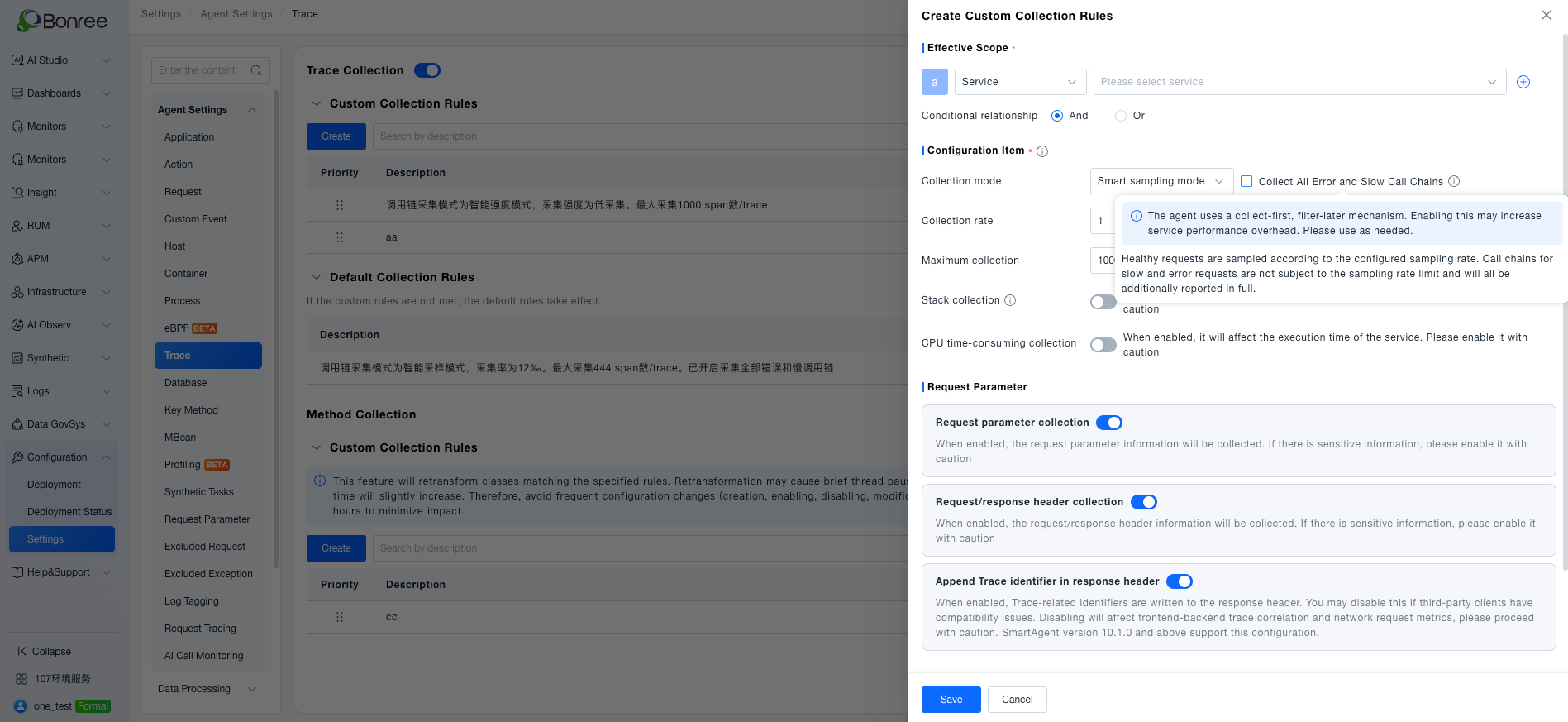
Optimized call chain collection mode configuration, added collection switch control to improve collection strategy flexibility and meet data collection requirements for different scenarios
-
Provided service-level configuration capability for response header Trace identification, resolving third-party client compatibility issues. Enabled by default without affecting existing users
-
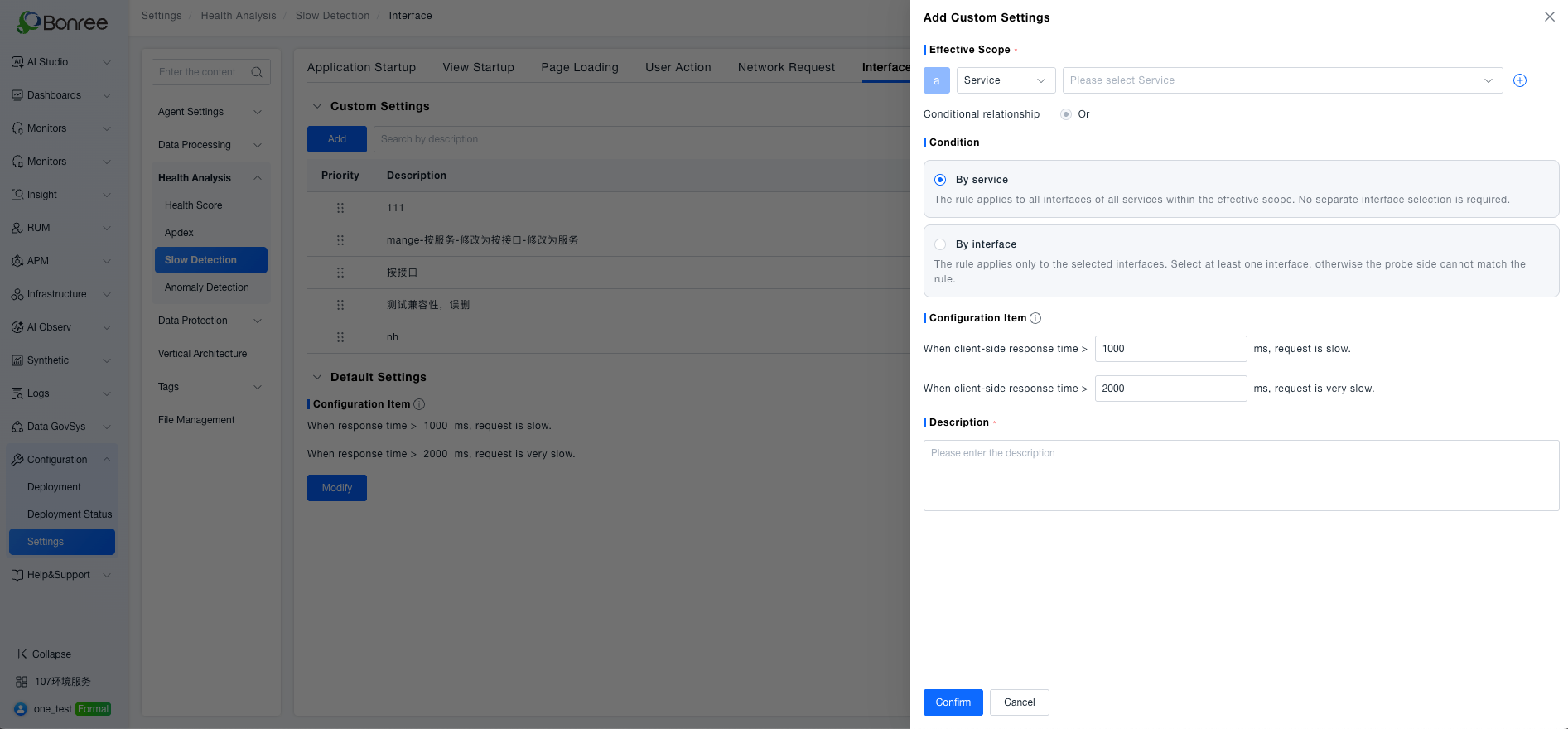
Extended slow judgment configuration dimensions, supporting fine-grained threshold configuration by service and other dimensions to meet differentiated performance monitoring requirements
-
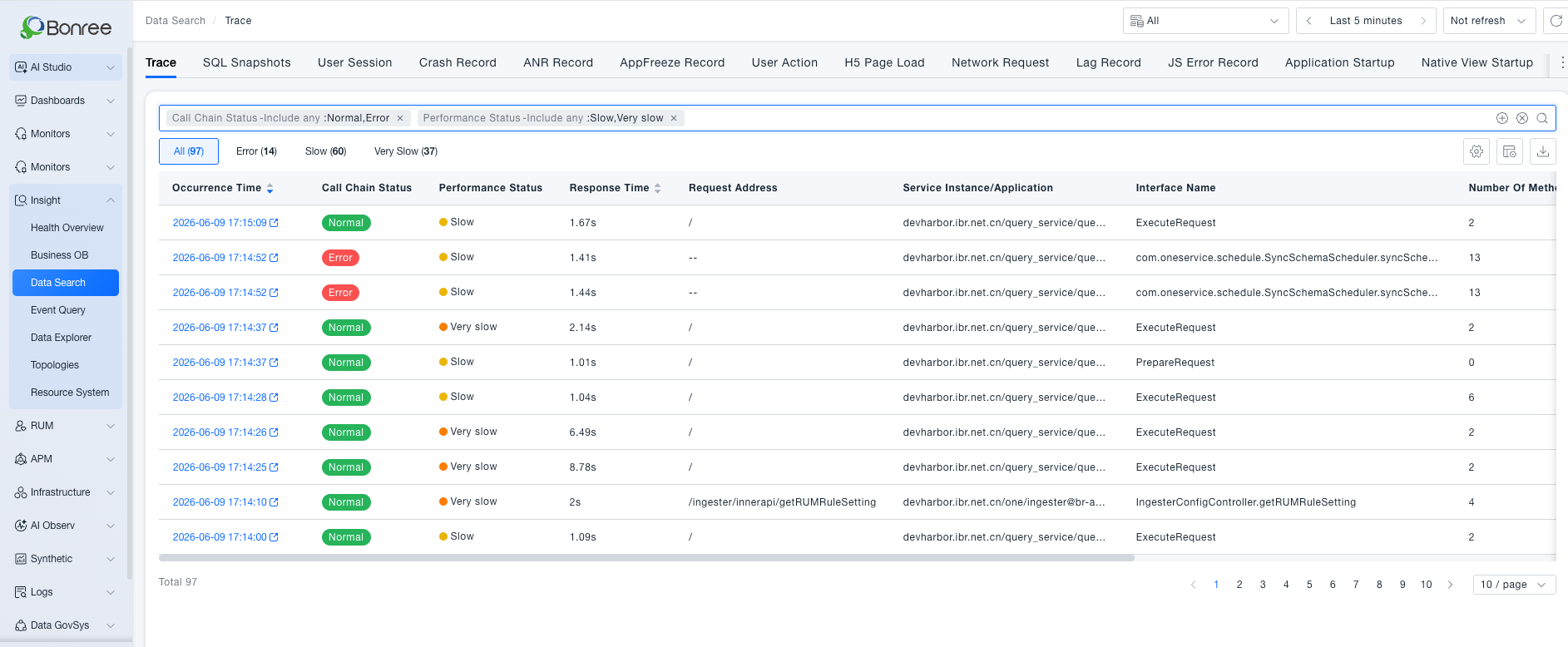
Split call chain status and performance status into independent filter dimensions, supporting multi-dimensional combined queries to resolve incomplete filter results and dimension mixing issues, improving retrieval accuracy
-
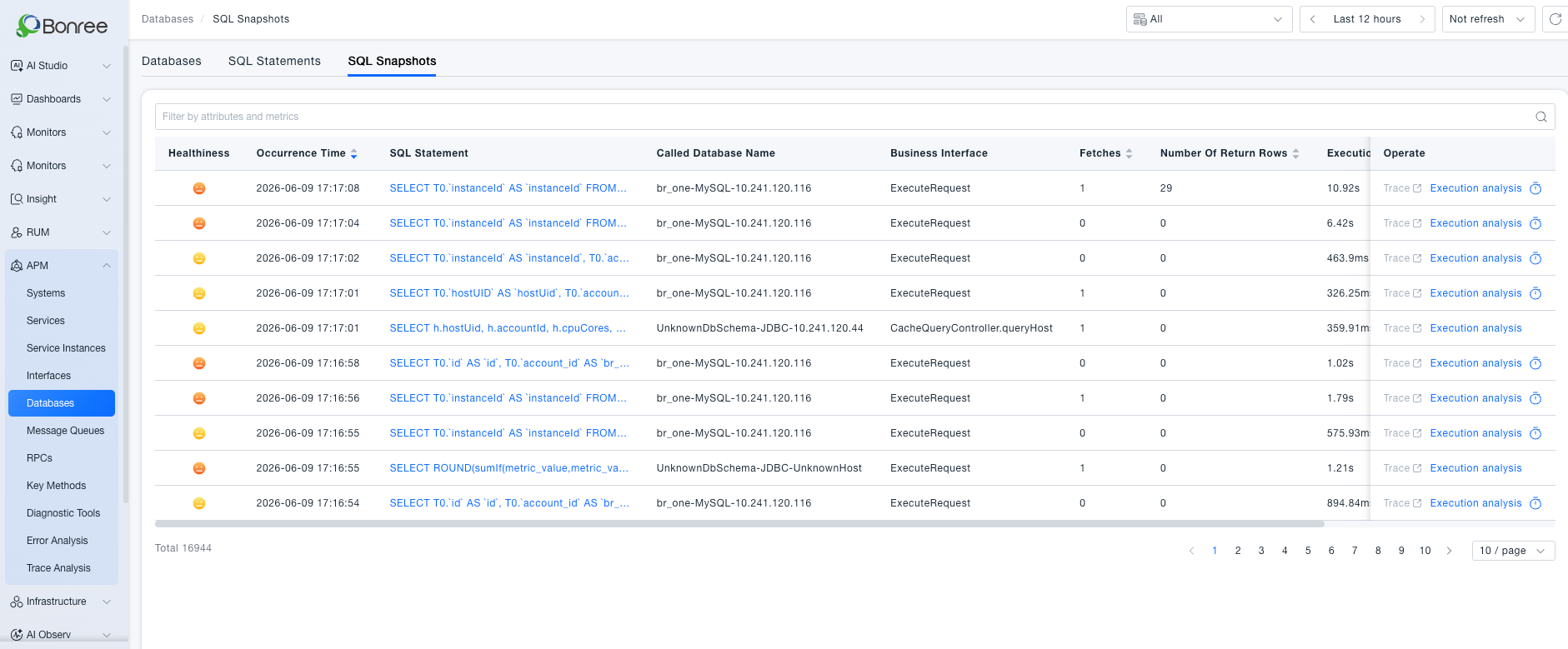
Added SQL execution plan identification and total time consumption dimensions, expanded cross-database query capabilities for SQL statements and business snapshots, improving database troubleshooting efficiency
-
Added probe package format validation and version number format validation in Admin platform to reduce installation/update failure rates and improve operational efficiency
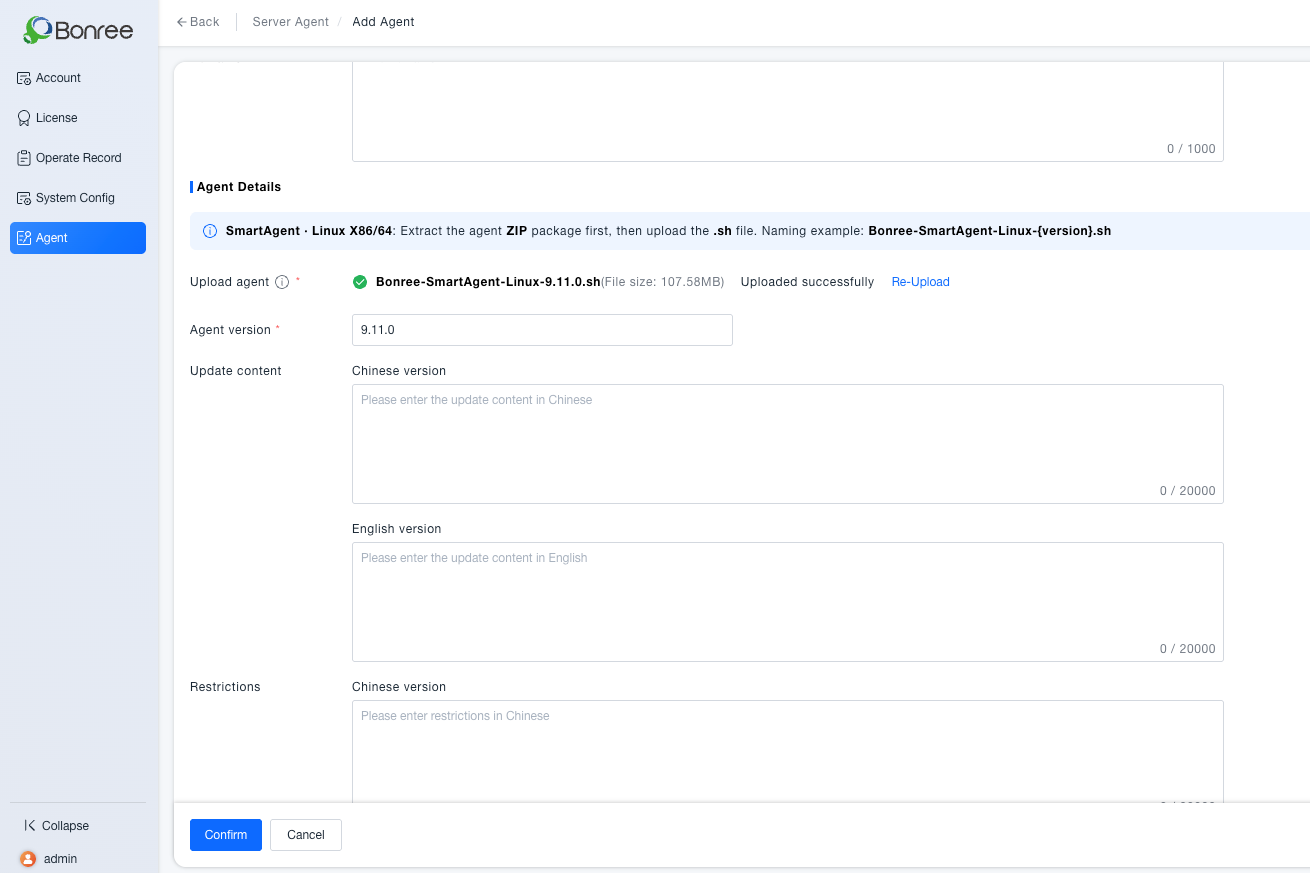
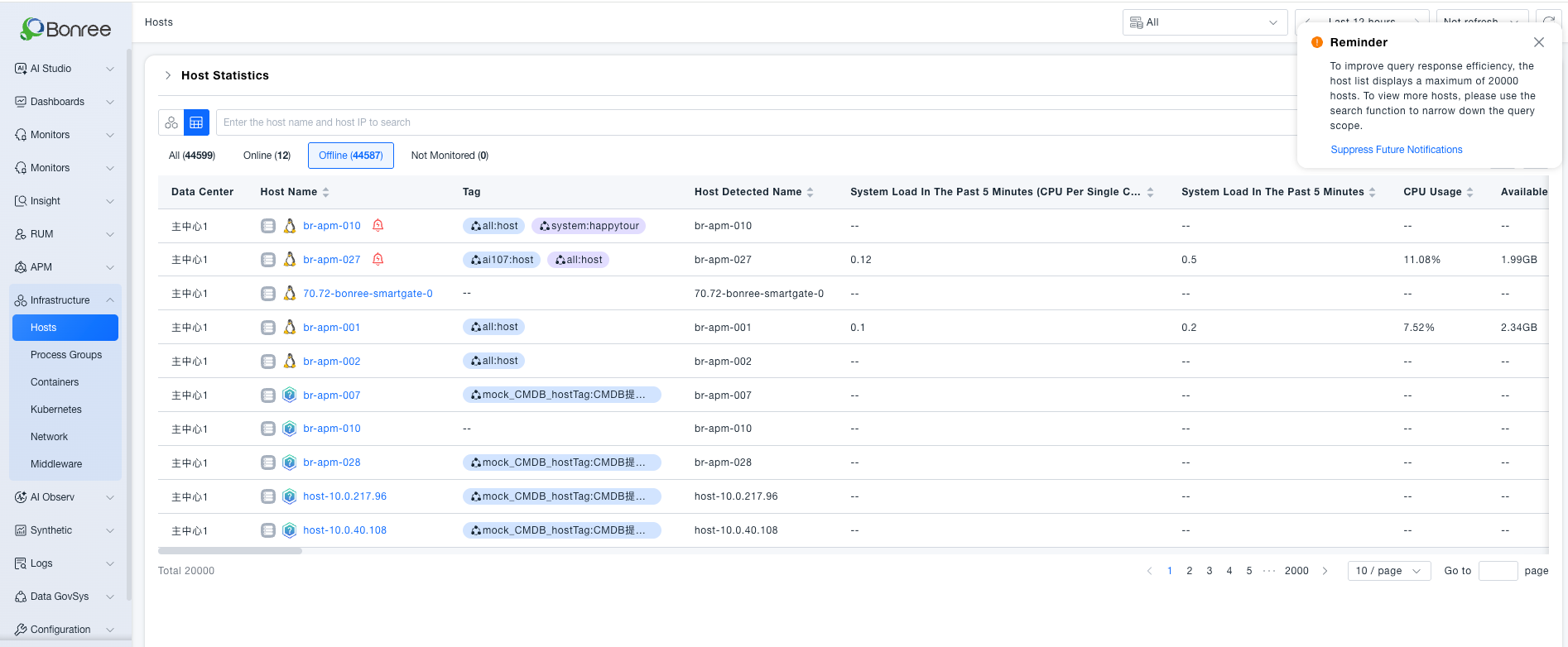
-
Unified data display scope between list view and honeycomb view, displaying all status hosts and adding quantity statistics to reduce full asset troubleshooting operation costs
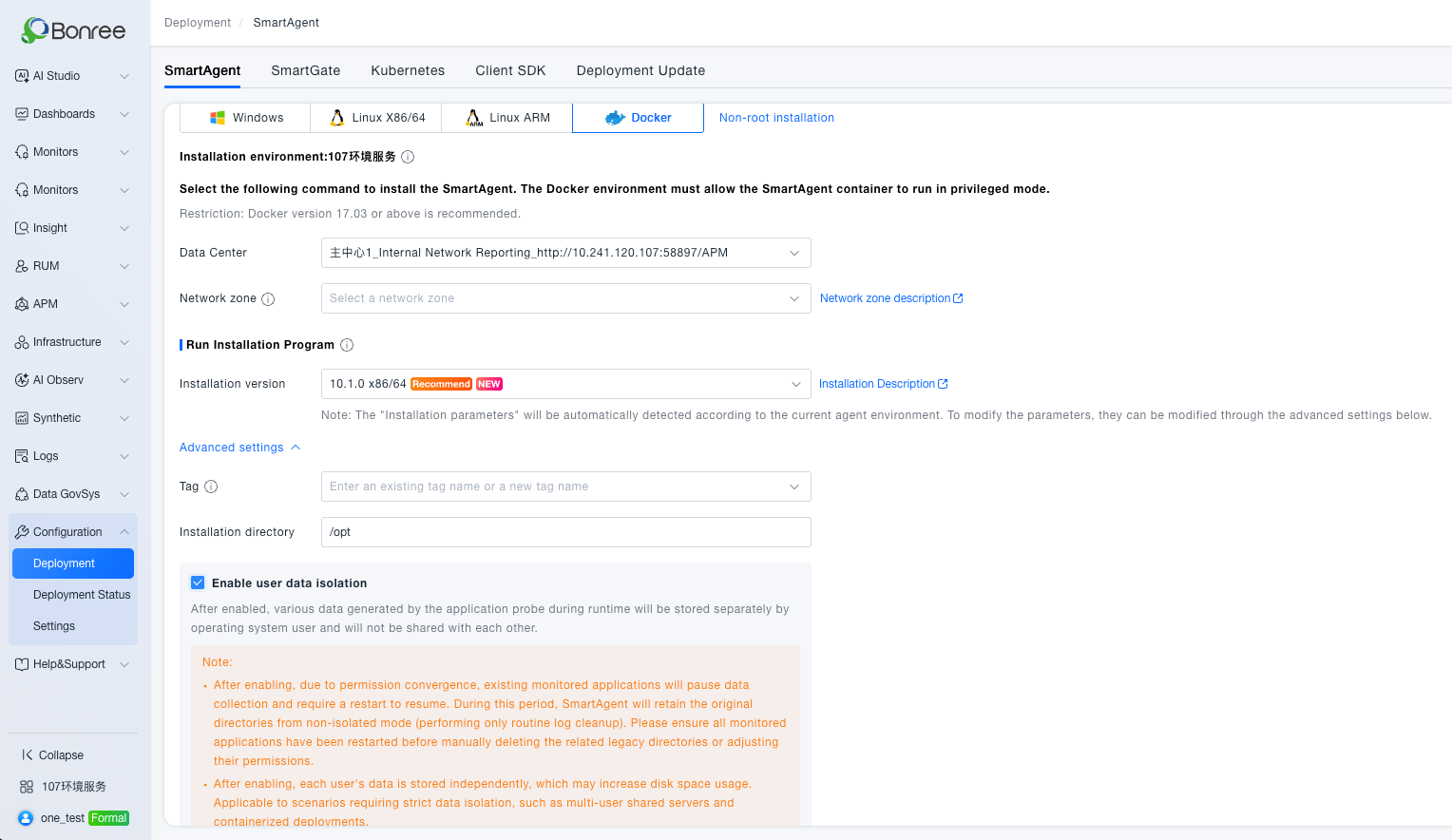
-
Added "Enable User Data Isolation" parameter entry in Docker installation page and improved notice copy (added restart requirement explanation) to maintain consistency with Linux platform
-
Registered atomic metrics such as disk write bytes, disk read bytes, network sent data volume, and network received data volume to the metric system, supporting ETL data ingestion mapping and writing
-
Added no-data status (status=2) to alert list query interface to ensure both "alerting" and "no-data" alert types can be displayed normally
-
Removed default time range parameter behavior in alert list queries to ensure ongoing alerts are not lost due to time limitations, improving alert information integrity
-
Business Observation module: added auto-discovery for database calls, remote service instances, and message queue calls.
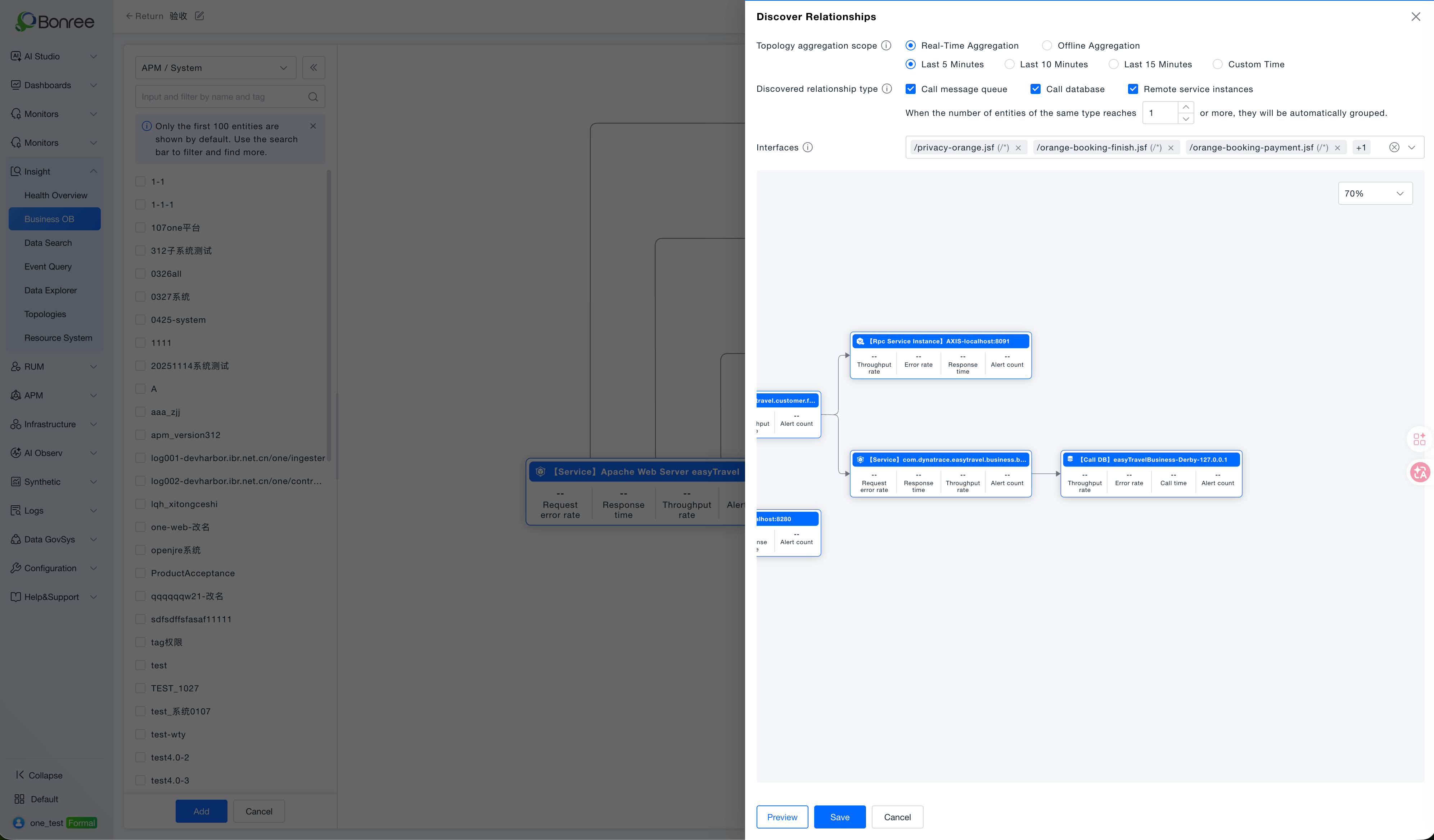
Optimizations
-
Added internal/external network identification for data reporting addresses in SmartAgent installation deployment page for single-center scenarios, and supports configuring default reporting address via Nacos (default internal network), reducing risk of misoperation
-
Aligned eBPF billing and Pod billing restriction logic with existing APM system, providing 7-day grace period when IAM interface fails or package expires, avoiding mistaken feature restrictions
-
Added OpenAPI interface to support querying system group list (including groupId, groupName and other fields), achieving complete closed loop of "query group → create system in specified group"
-
Added audit records for SmartAgent and SmartGate registration reset operations, recording operator, time, IP, environment and object to support traceability and accountability
-
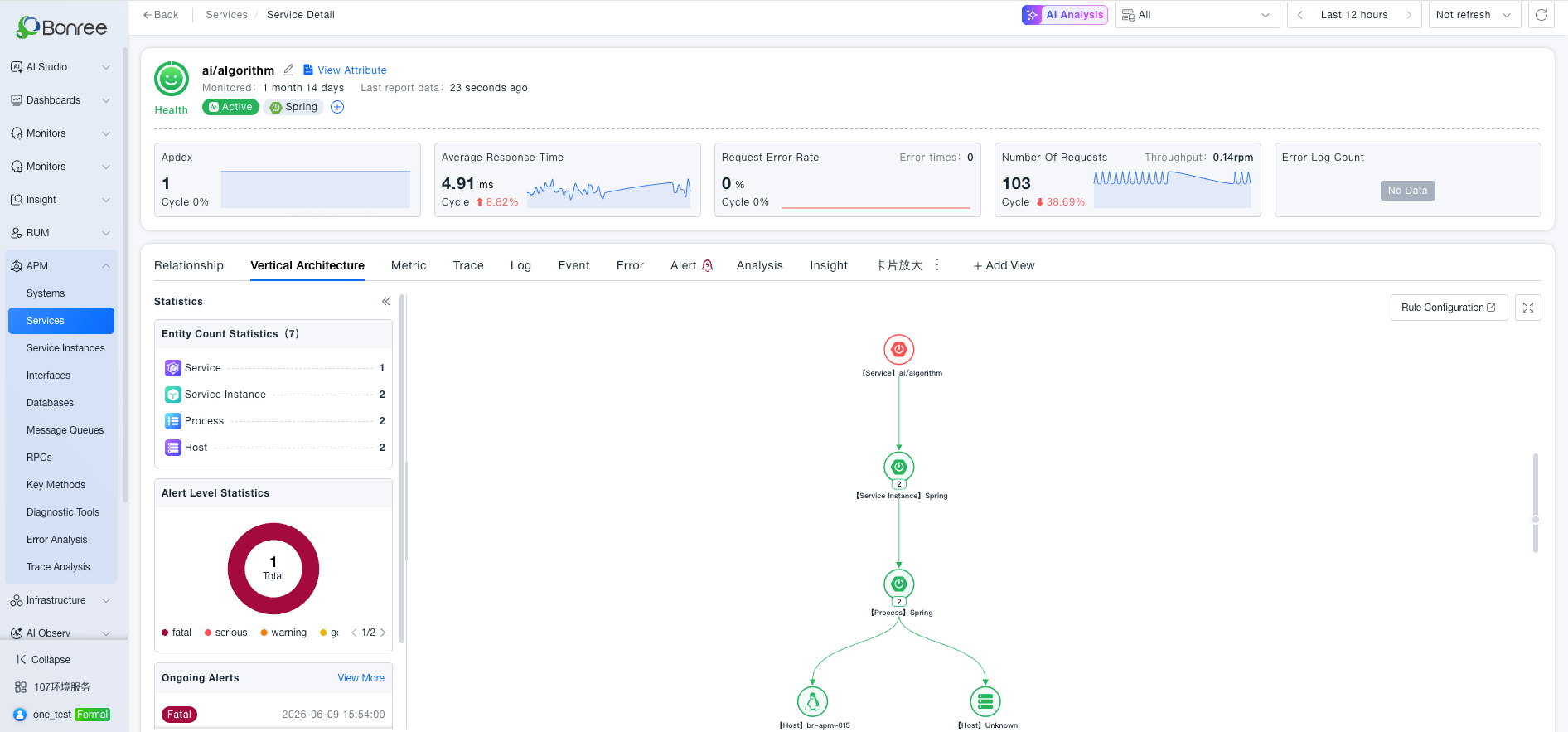
Fixed inconsistency between alert count in vertical architecture page and alert popup list data, ensuring valid main entity parameters are passed when calling alert interface
-
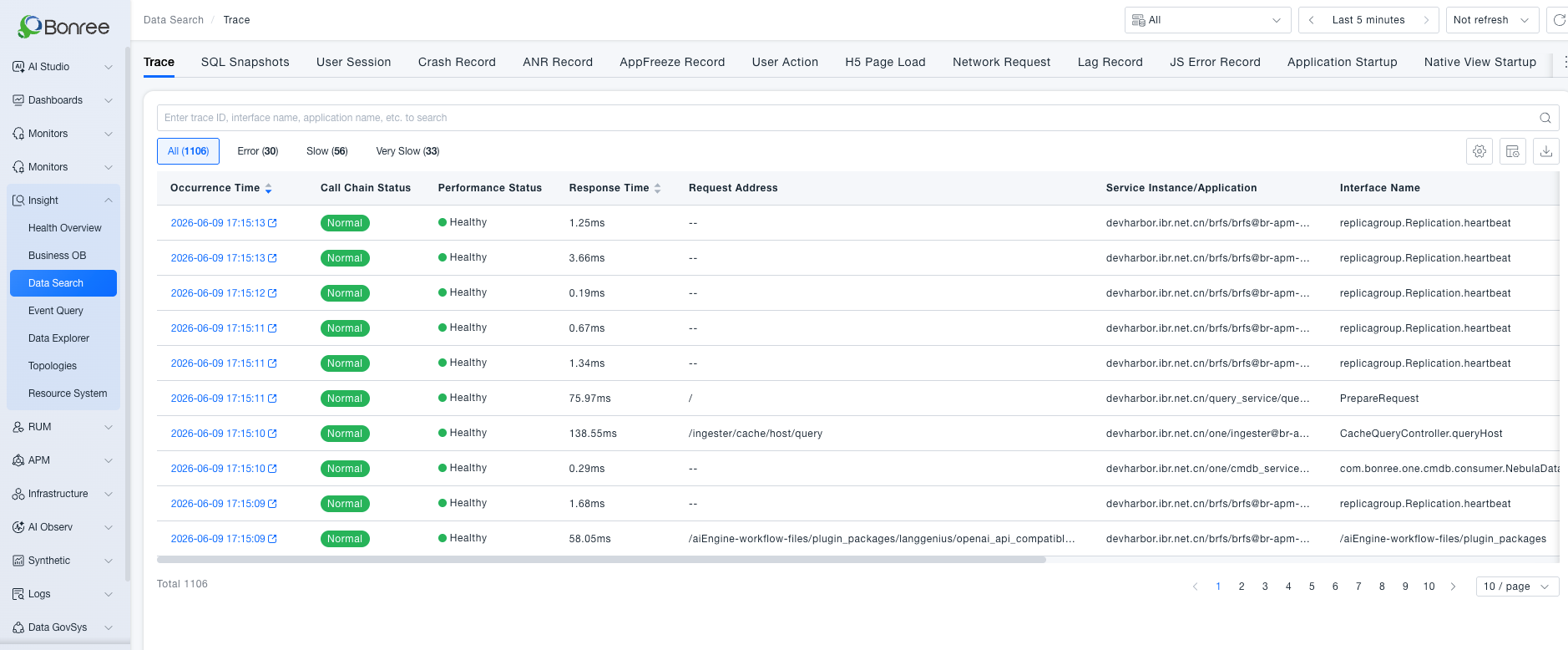
Optimized default query logic for call chains in retrieval center, automatically triggering query when entering page, shortening default time from 10 minutes to 5 minutes to improve user experience and reduce resource overhead
-
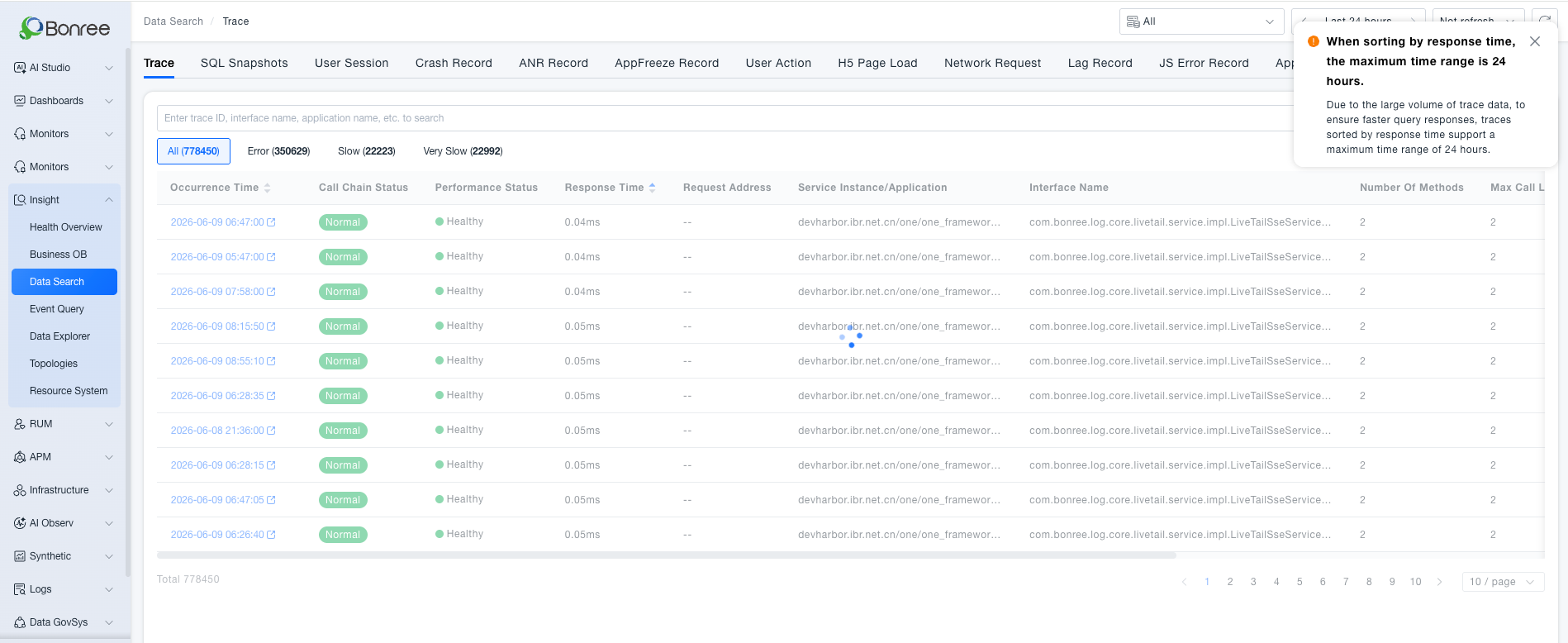
Refactored call chain list query logic, retaining only occurrence time and response time sorting (response time sorting limited to 24 hours), and set whether to display statistics
-
Added "Last 15 Days" quick option to time filter controls in pages supporting queries over 7 days across the platform, with customized components adapted by business side
-
The maximum number of business observation groups has been increased to 100
Bug Fixes
【RUM】
New Features
-
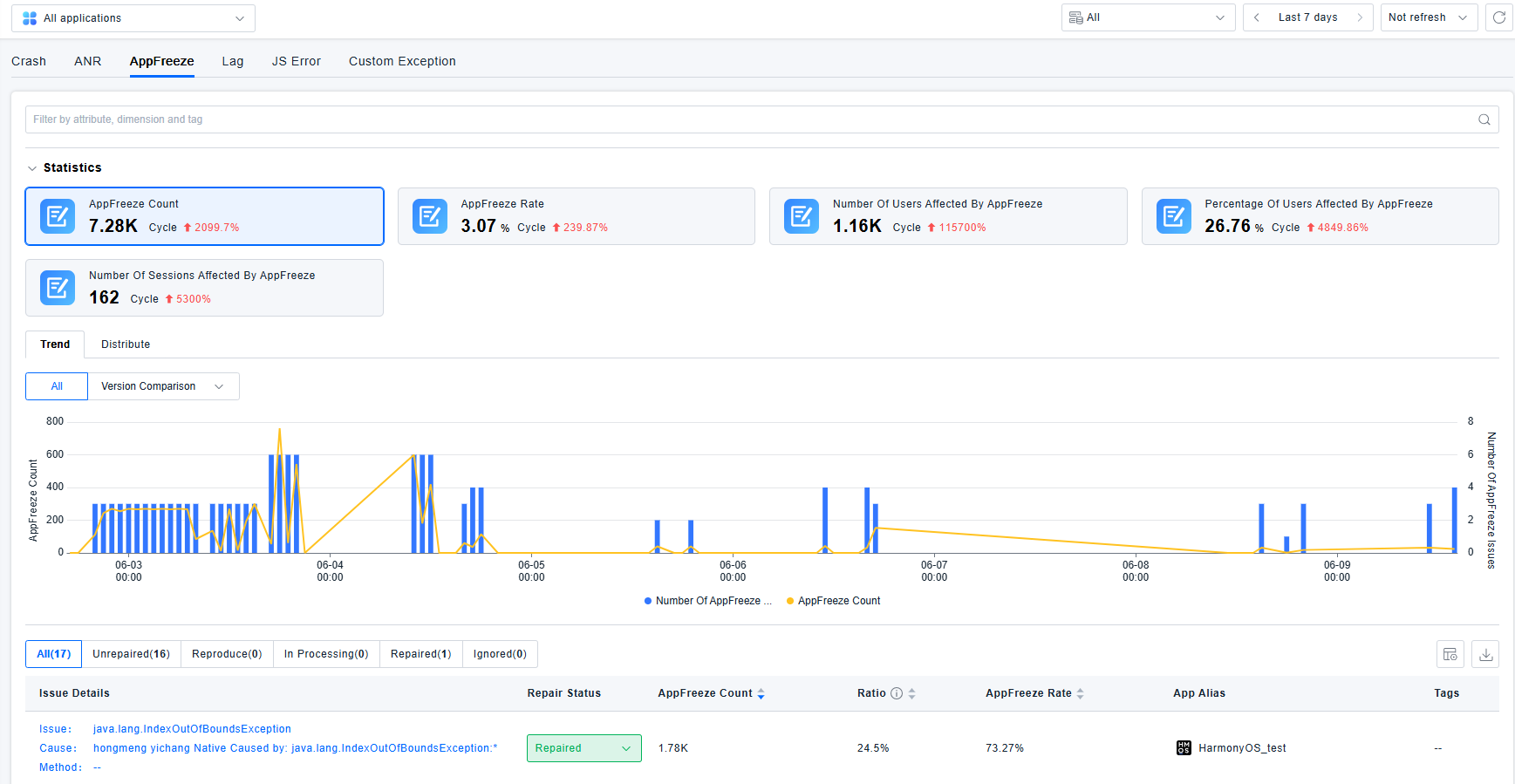
Add AppFreeze issue analysis capability for HarmonyOS NEXT applications
-
Separate internal and external network instrumented addresses for web applications
-
Add toggle to control display of click actions that do not trigger network requests. By default, only clicks triggering network requests and crashes are shown.
-
Add toggle to enable deduplication for repeated reports such as lags. Deduplication is disabled by default due to performance overhead.
-
Add toggle to control display of crash stacks without the "caused by" string, hidden by default.
Optimizations
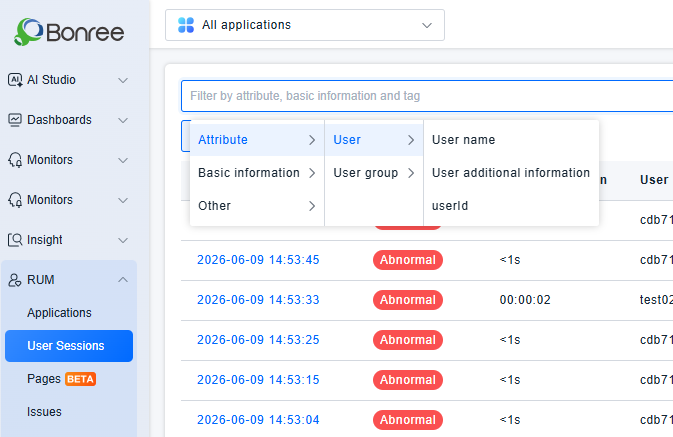
- Add filters for additional user information in RUM - User Session and Application Details - Relations - User Session
- Support jumping to Data Query for filtering and analysis from RUM and network request details
- Change the application filter to mandatory single selection for secondary menus under RUM and Data Query - User Session
- Add date labels to events in session details
- Open a new browser tab when clicking entries in Data Query
- Optimize JS SourceMap Management and related APIs
- Optimize jump logic for the TraceID column in network request records
- Optimize judgment logic for page loading status
- Optimize pagination interactions for all records in Data Query
- Prevent overlaps between custom domain names and CDN domain names
- Rename Page Loading to H5 Page Loading and View Startup to Native Application Startup within Data Query
- General performance improvements
Bug Fixes
- Fixed incorrect proportion calculation of error types
- Fixed inconsistency between JS error counts under Issues - JS Error and total regional distribution figures
- Fixed failure to cancel ongoing snapshot queries when switching search criteria during slow loads in Data Query
- Fixed incorrect pop-up prompt text when uploading invalid files in Symbolic File Management
- Resolved other known issues
【SDK】
New Features
-
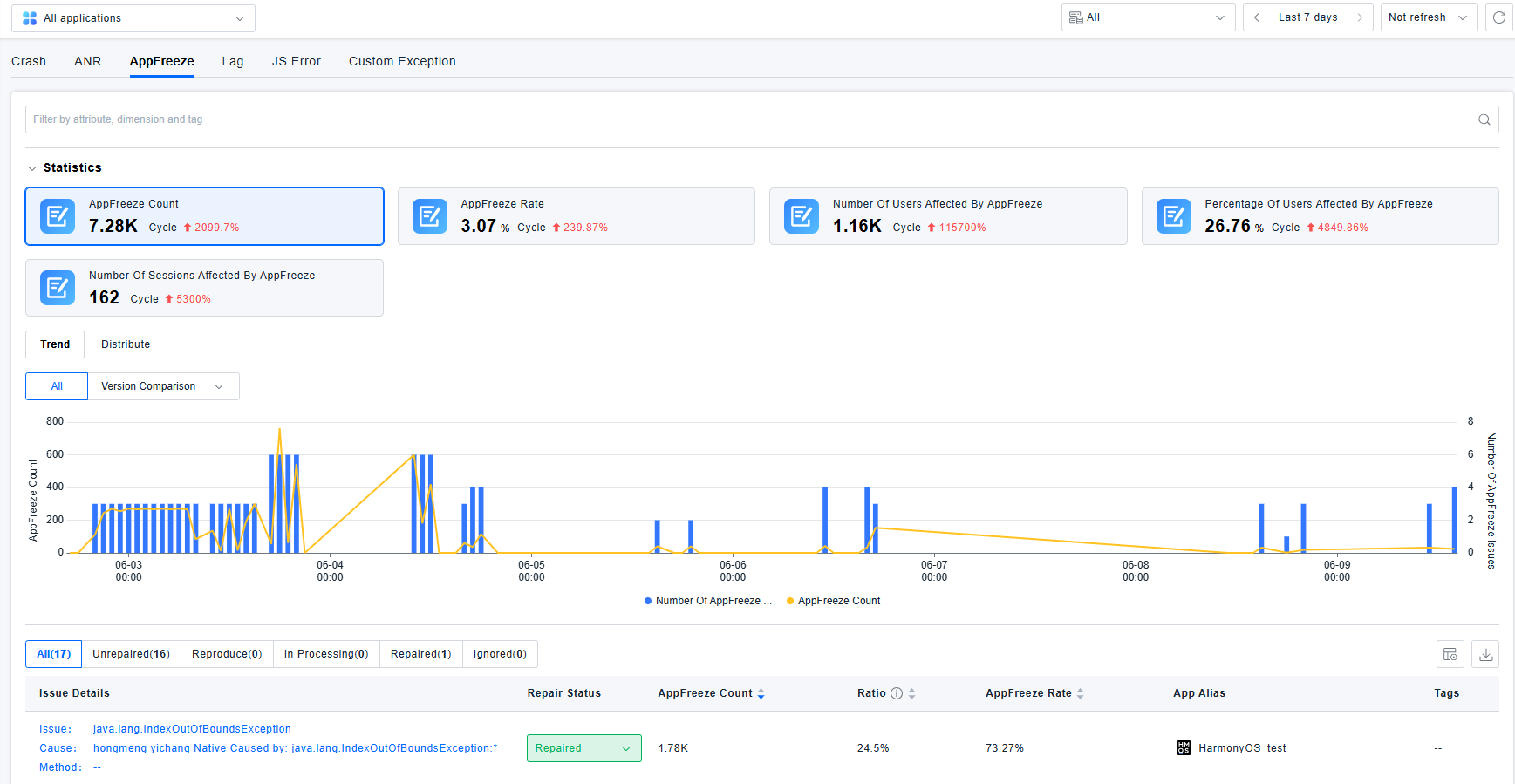
Add AppFreeze issue analysis capability for HarmonyOS NEXT applications
-
Enable observability support for HarmonyOS NEXT 6 (API 23)
-
Support dynamic configuration of header parameters for Android and iOS
-
Provide HarmonyOS NEXT SDK with bytecode instrumentation
Optimizations
- Optimize judgment logic for page loading status
【Alert】
New Features
-
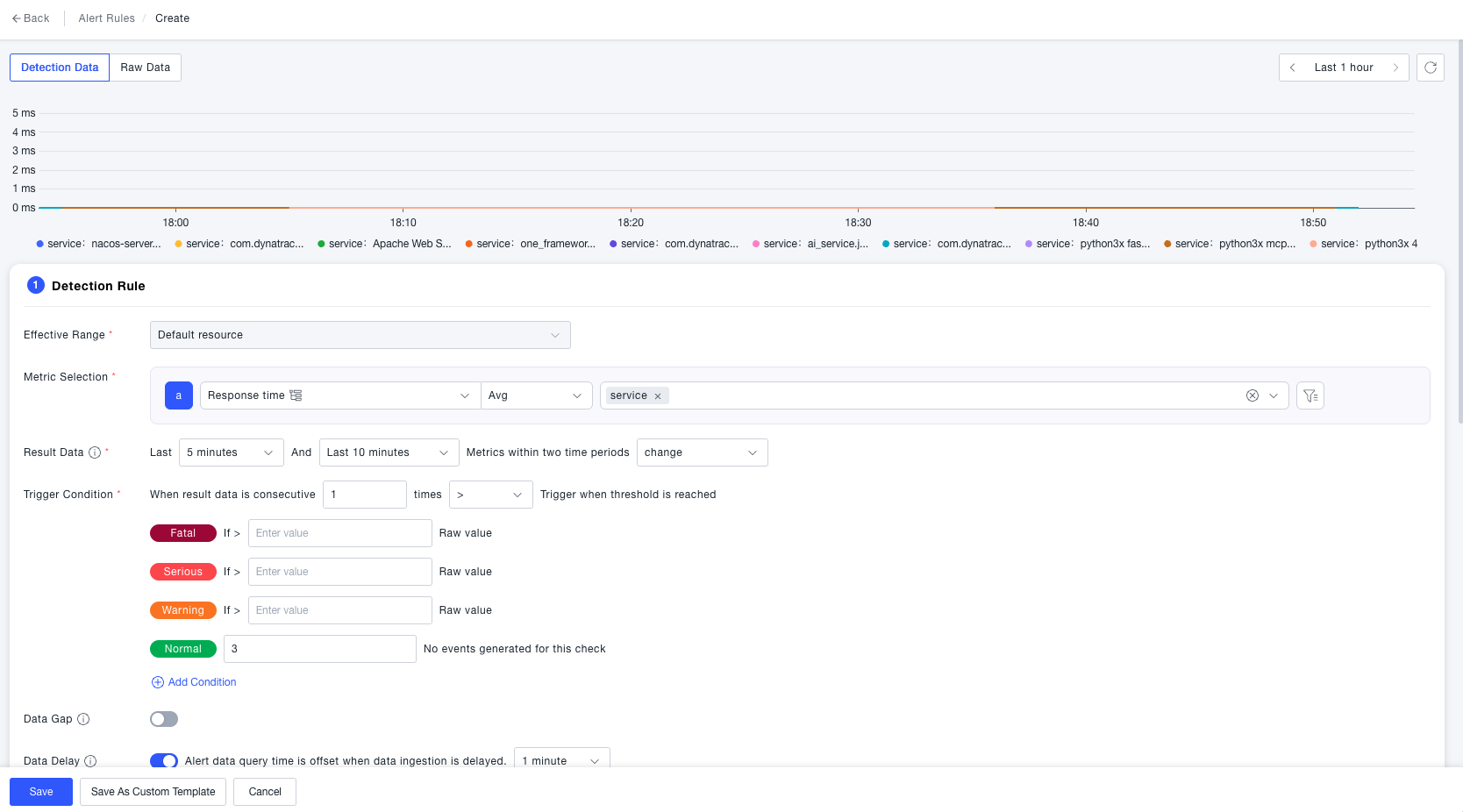
Change Detection rule : Triggers an alert when the aggregated difference between the current metric value and its value N minutes ago exceeds a configured threshold. Best suited for detecting sudden anomalies in business metrics.
-
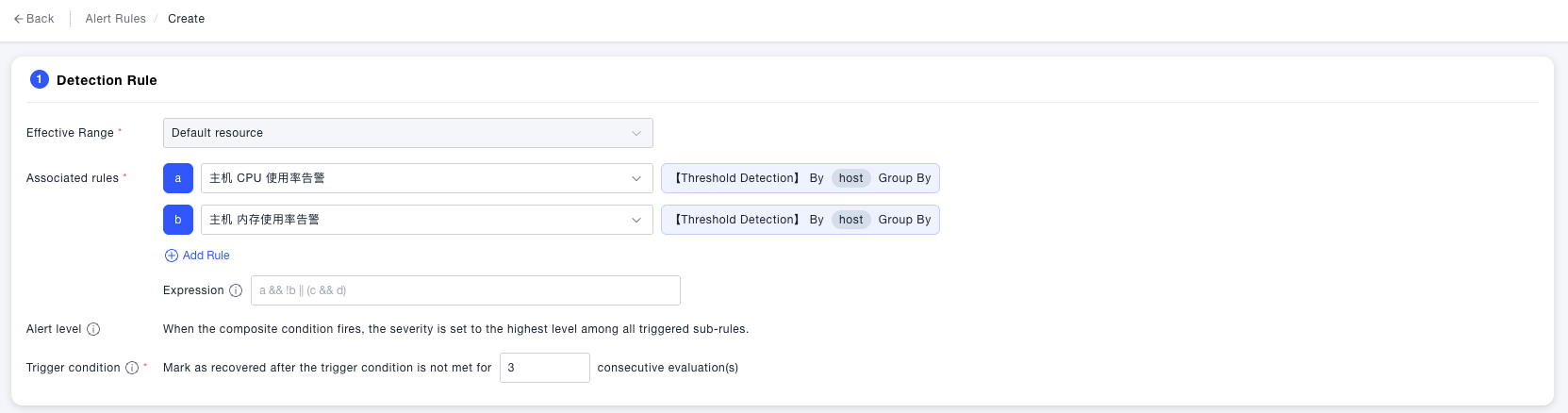
Composite Detection rule : Combines the states of multiple monitors into a single result using logical expressions. Best suited for complex scenarios requiring multi-condition evaluation.
-
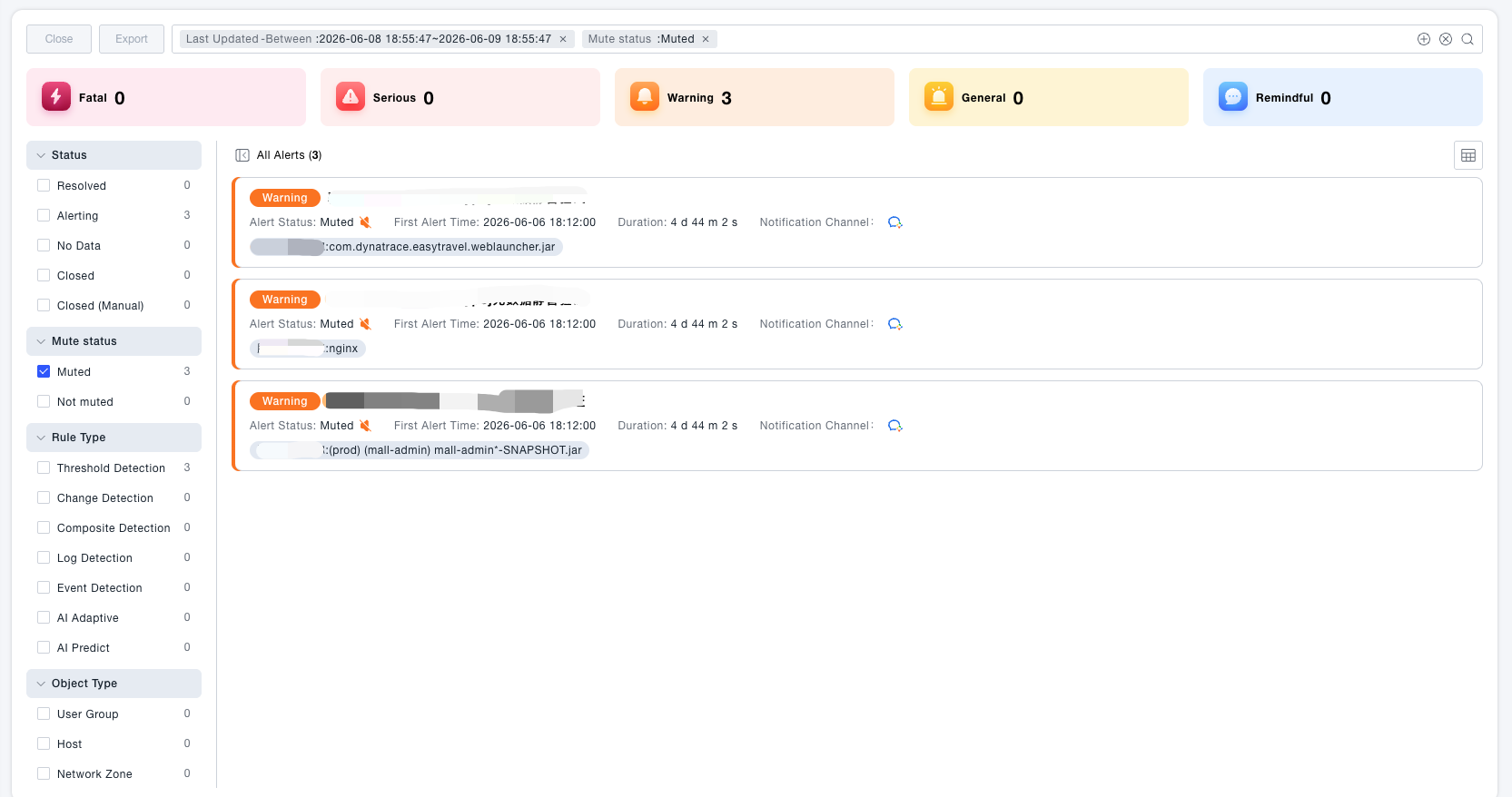
Alert Mute : Apply a mute to an individual firing alert instance to suppress notifications for a specified duration. Use cases: planned maintenance windows, emergency noise reduction, expected fluctuations.
-
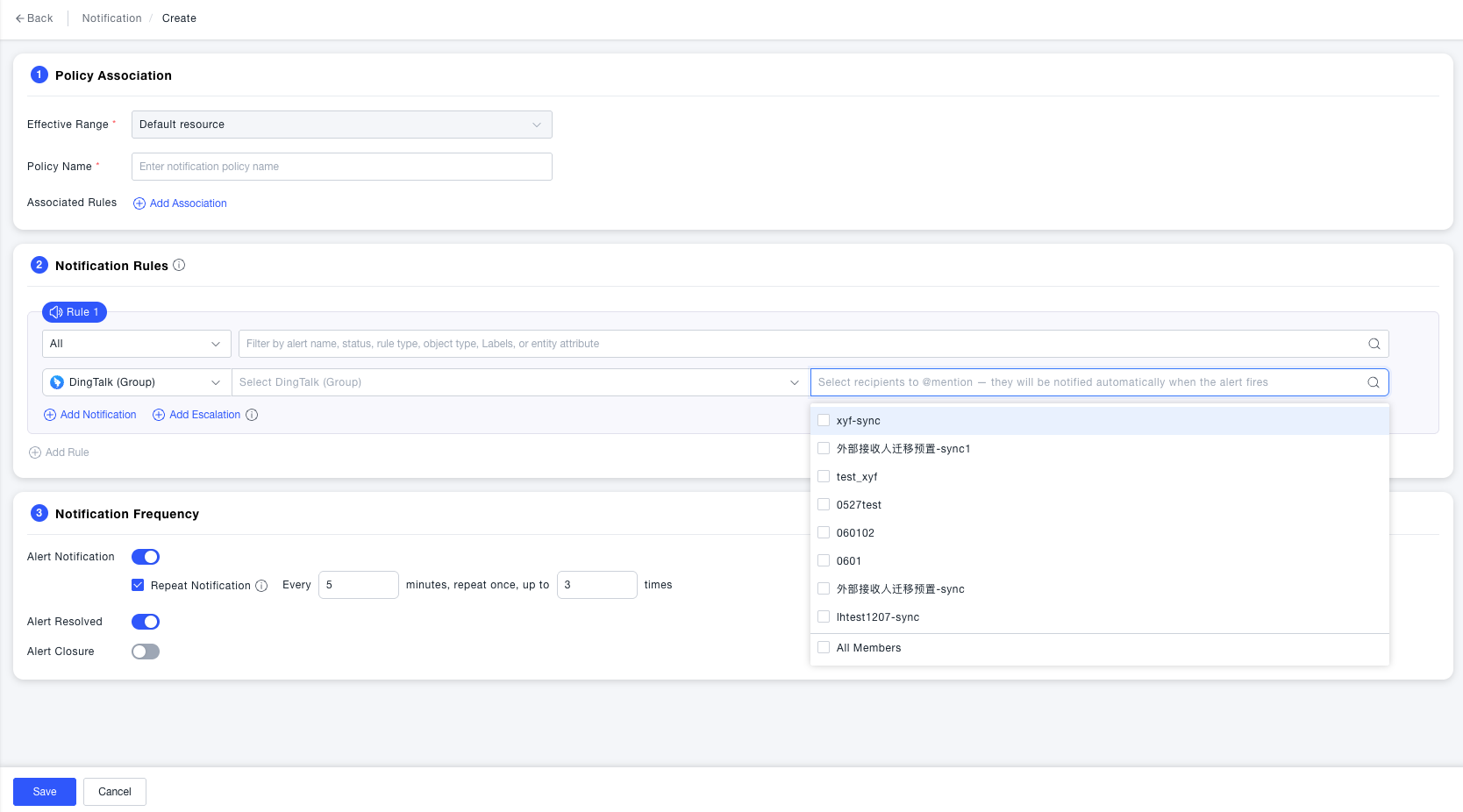
@mention in notifications : Notification policies currently support delivering alert messages to group chat channels such as DingTalk, WeCom, and Feishu. However, messages are delivered silently to the group with no way to directly notify specific members. In high-priority alert scenarios, this increases the risk of alerts being missed or responses being delayed if recipients are not actively monitoring the channel. This release adds @mention support to directly notify designated recipients.
-
Python script support for script-based push notifications
Optimizations
- Notification policies now support selecting all associated rules at once
- Script notifications in the notification log now display the script name as the recipient
- Alert notification variables now include trigger reason, anomaly type, notification policy name, and more
- Optimized the data query time range on the alert detail page
- For no-data alerts, the corresponding timeline node now displays the alert severity label
Bug Fixes
- Fixed an issue where cross-chart synchronized reference lines were not fully rendered when multiple alert targets were displayed in alert details
- Fixed an issue where searching for a notification policy in alert rule configuration displayed the policy ID instead of its name
- Fixed an issue where metric names failed to populate when referencing an alert template or viewing template details
【Analysis】
New Features
Optimizations
Bug Fixes
【Log】
New Features
Optimizations
Bug Fixes
【Event】
New Features
Optimizations
Bug Fixes
【CMDB】
New Features
-
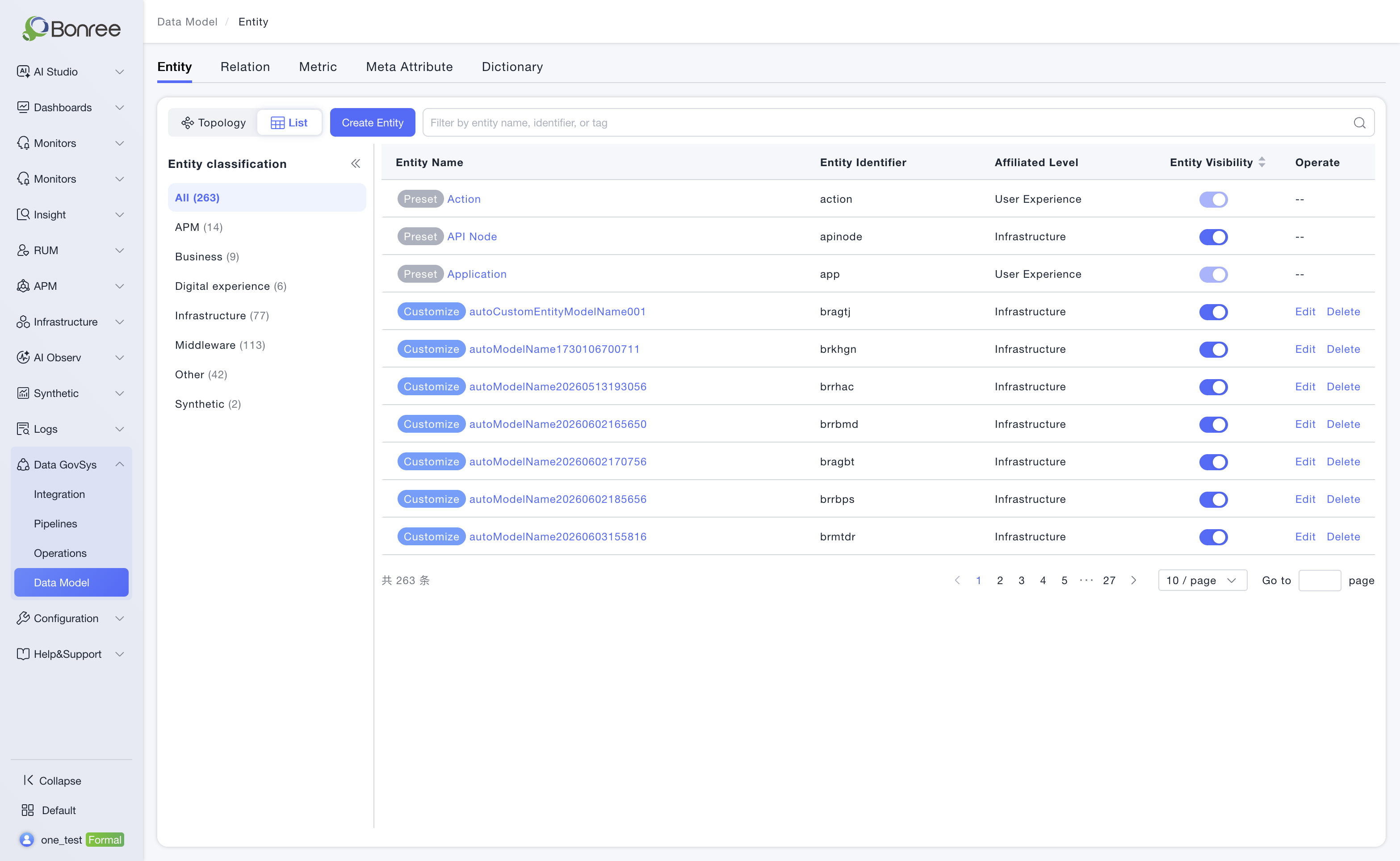
The Data Model module has been migrated under Data GovSys (Data Governance System), consolidating data GovSys management. Entity and relation page interactions have been optimized, with new entity list and relation list views added.
-
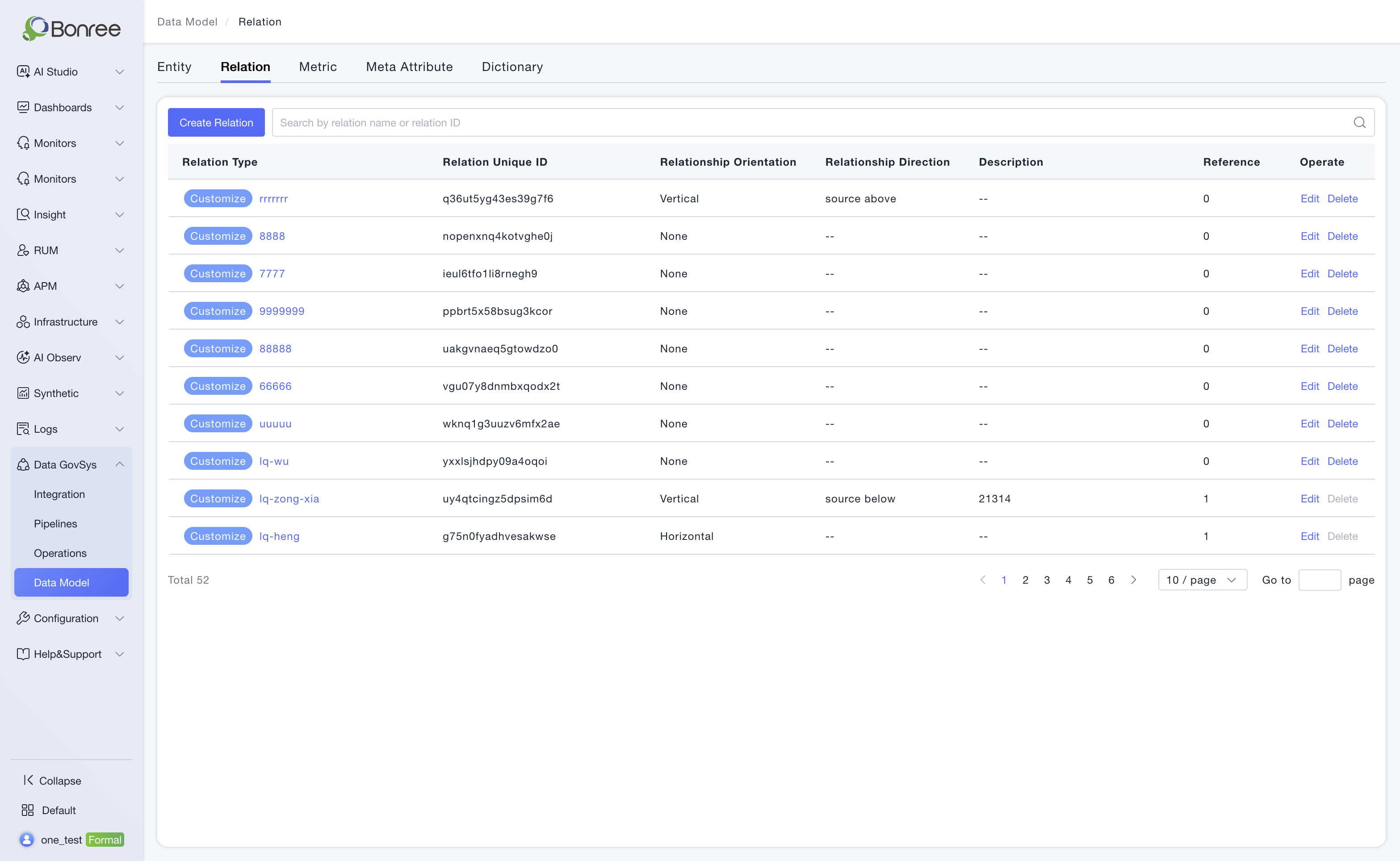
Custom relation types are now supported to meet the need for expressing complex relation semantics in operations scenarios.
This update supports creating three relation directions: horizontal, vertical, and directionless. Horizontal and vertical relations can be referenced by the tags module to propagate permission tags to target entities based on relation direction. Directionless relations are used only for relation representation and do not participate in permission tag propagation.
Considering that relation data checks and updates may involve large data volumes, ONE supports creating up to 20 relation types to ensure system stability and processing performance.
Bug Fixes
- Fixed the failure to retrieve dimensions for custom composite metrics.
- Optimized query performance for the metric category tree and list APIs.
【ETL】
New Features
-
Data Integration has been upgraded to Data GovSys, unifying data ingestion and data modeling capabilities under data GovSys management. This improves platform information architecture consistency, enables users to complete ingestion, modeling, maintenance, and subsequent use around data asset construction, reduces cross-module navigation costs, and improves data management efficiency.
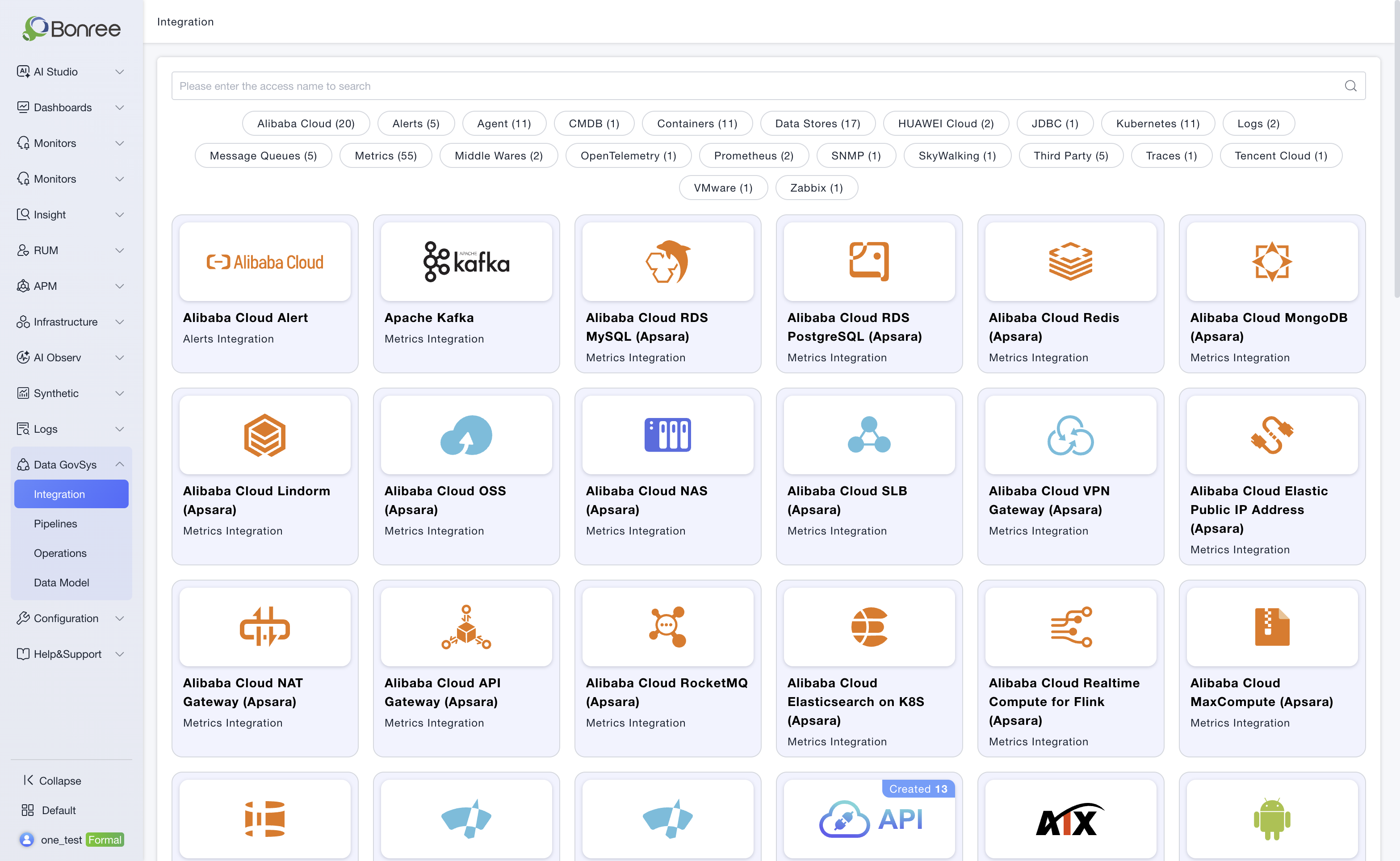
Optimizations
-
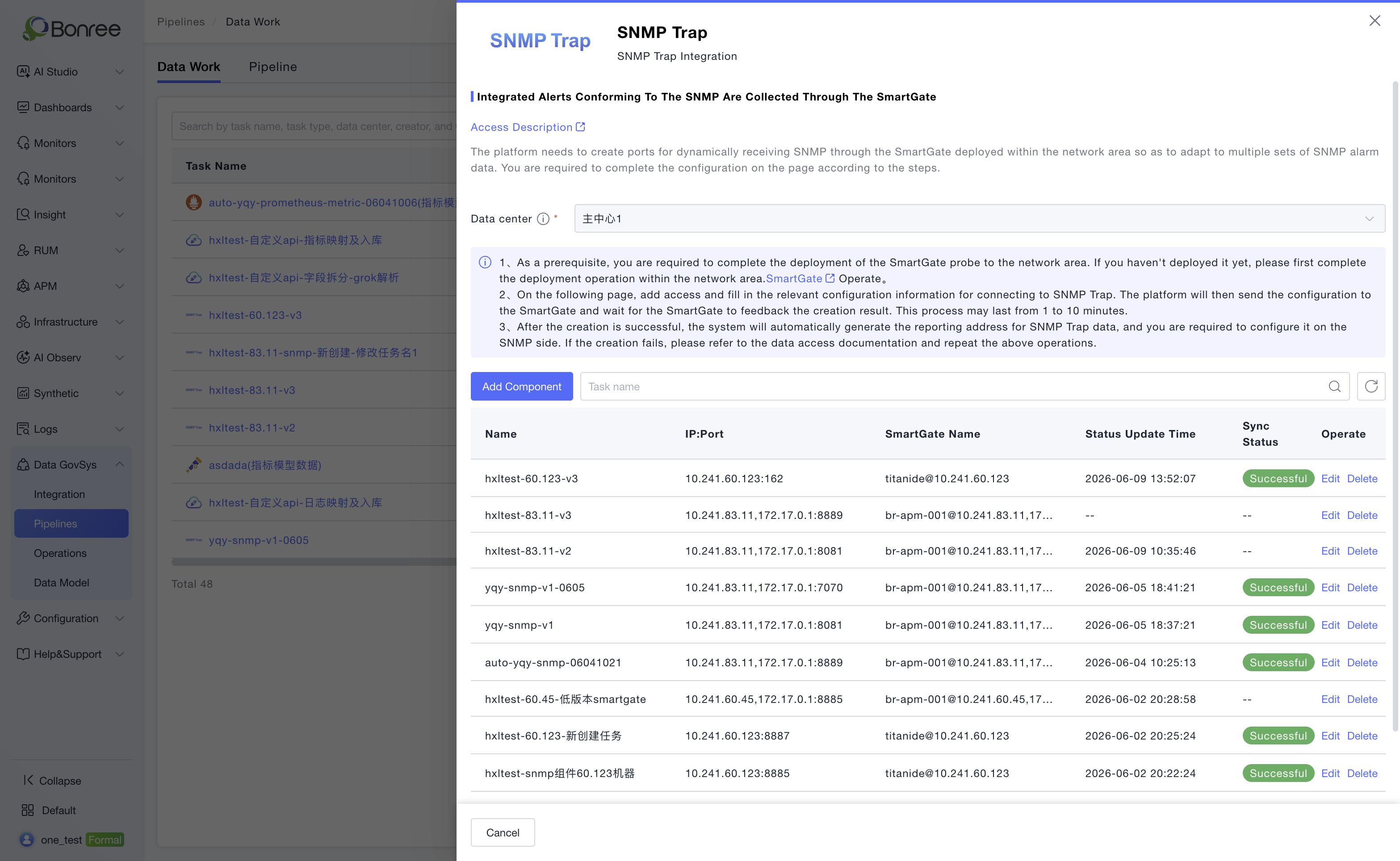
Optimized the exception handling process for SNMP Trap task delivery and added delivery status statistics.
-
Optimized data processing engine performance to improve data processing efficiency and stability.
Bug Fixes
- Fixed IPv6 compatibility issues.
【IAM】
New Features
-
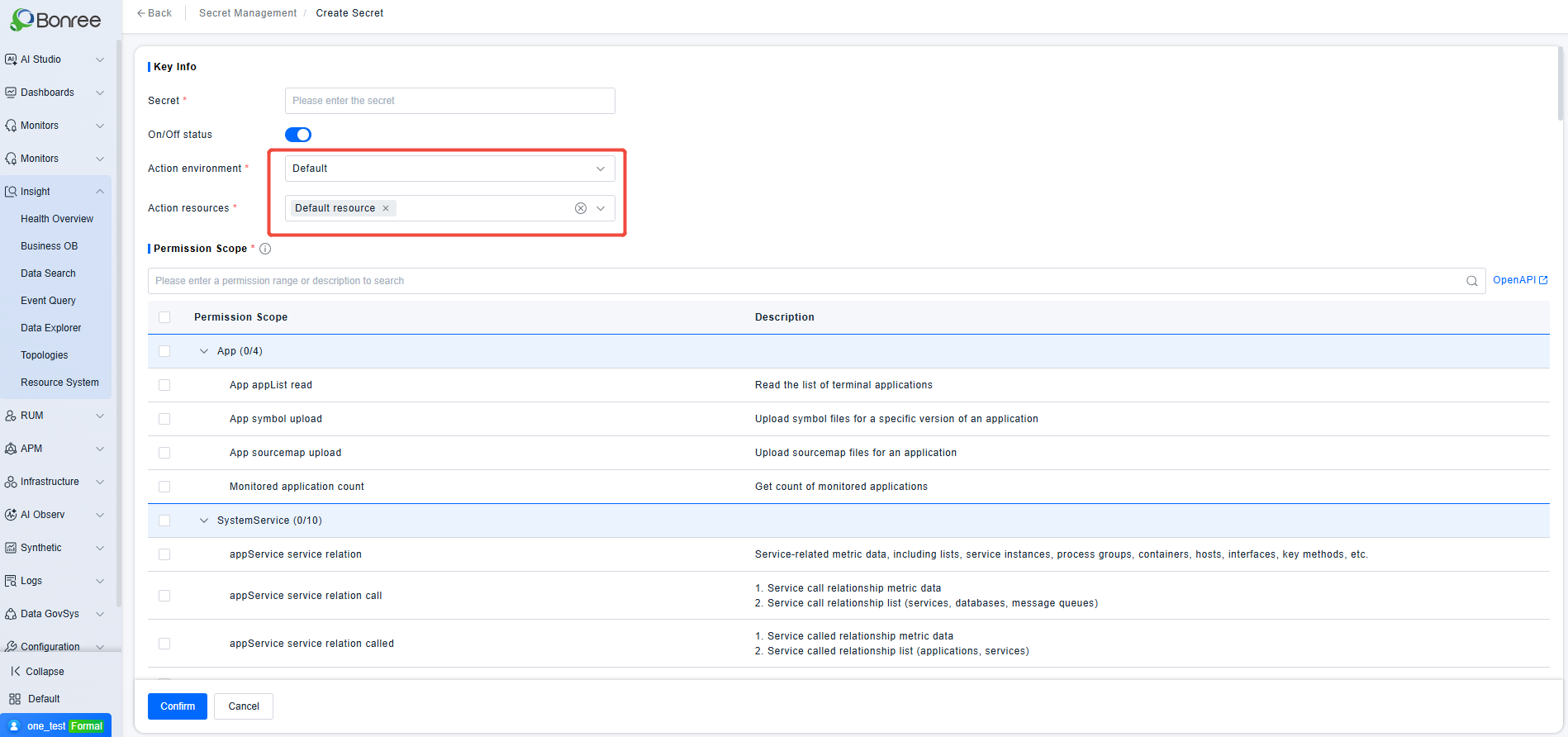
Secret Management: When creating a new secret, the selectable environments and resources are restricted based on permissions — users can only pick environments and resources they are authorized to access or all environments and resources.
-
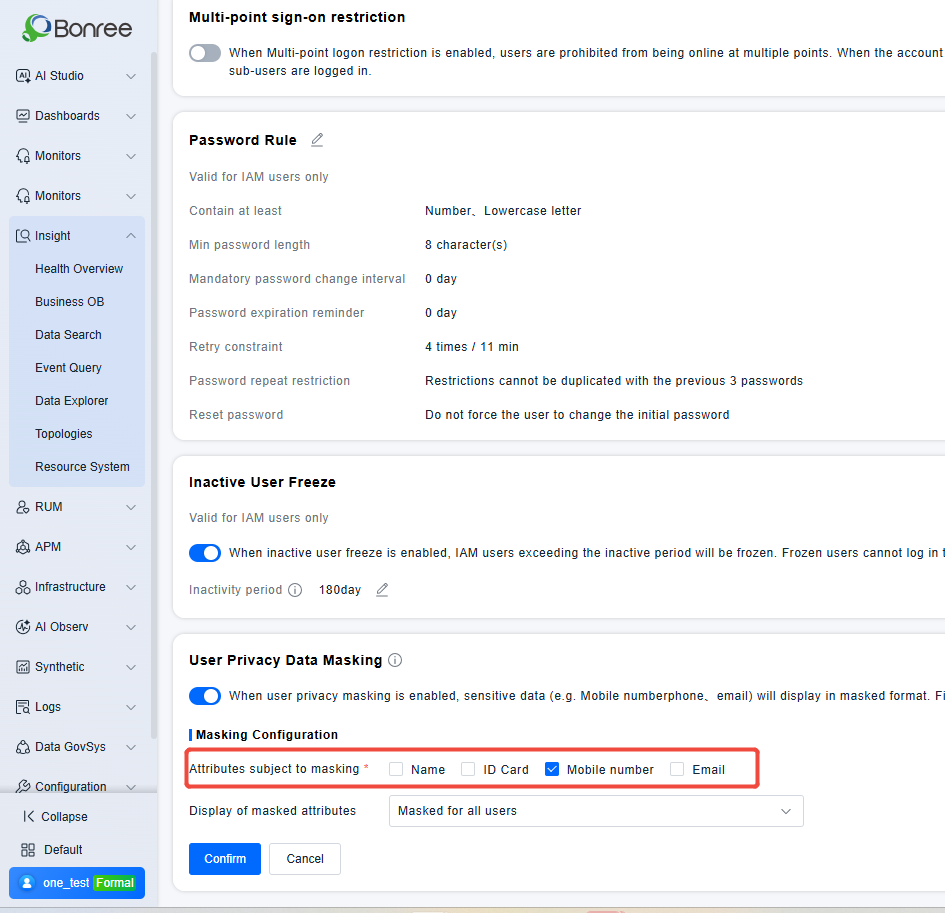
Encrypt sensitive information in database storage, optimize query performance for sensitive data, and support desensitization of names and ID numbers.
-
Background switch to control display and mandatory status of name and ID number fields.
Optimizations
- Usage consumption optimization
- Add primary account and billing item name to alert notification emails of the ONE platform
- Add Last 15 Days option to the time selector
- Align the menu permission order in role creation/editing with the left primary navigation bar
- Add Intelligent Query as a usage scenario for tokens of the AI Workbench
- Move Intelligent Query under the Sage AI menu
Bug Fixes
- Fixed security vulnerabilities
ONE 4.0.0.6 2026/06/03
AI Studio and Ask AI
Improvements
- Added MCP Keys, scheduled-task capability filters and confirmations, editable and pinned session history, knowledge categories, Skill import guidance, file previews, diagnosis exports, Token and duration details, and suggested follow-up questions.
- Improved knowledge-base matching, routing, service and interface analysis, and bilingual built-in scenarios.
RUM and ETL
Improvements
- Improved network requests, application relationships and health scores, application lists, session events, resource isolation, Grok extraction, MathUtils, and OTel metric tasks.
- Added a dedicated non-CPU back-pressure thread pool and removed obsolete APM task scripts.
Bug Fixes
- Fixed garbled Trace IDs during OT Trace conversion.
ClickHouse, Query-Service, and Titan-Query
Improvements
- Added a system-log table switch, set its TTL to five days, reduced
select 1queries, removed Offset validation, and adjusted full table loading. - Optimized
global in; PQL now supports Entity syntax for preset metrics, custom expressions, and consistent tag queries.
Bug Fixes
- Fixed negative
StorageBufferBytesvalues and crashes on empty Object JSON columns with lazy materialization.
IAM, Event, Alert, and CMDB
Bug Fixes
- Required the original password when changing a user password, fixed event pagination, Alert table headers and domain-filter hints, and aligned custom service-instance names with APM.
ONE 4.0.0.5 2026/05/25
AI Studio and Ask AI
Improvements
- Improved diagnosis parallelism, Skill loading, Redis session caching, RAG knowledge imports, DeepSeek V4 compatibility, answer rendering, model encryption, database access, sandbox capabilities, and asynchronous bulk uploads.
- Improved Ask AI duration and Token units, prompts, multi-turn dialogs, reasoning output, recommendations, and platform operations.
Bug Fixes
- Fixed diagnosis alert filtering, trend grouping by
monitor_time, and OpenAPI metric queries.
BRFS, CMDB, and ETL
Improvements
- Upgraded
titan-clientandproto-utilto 6.4.0.0, standardized CMDB meta-attribute names and IDs, and improved the primary-entity dimension logic. - Changed RUM Span transmission to every ten minutes and improved upload validation, Pod billing, traffic aggregation, and IPv6 display.
Bug Fixes
- Fixed Sonar findings, build dependencies, OneDatas latency metrics, composite-dimension intersections, and exception-query performance.
APM and RUM
Improvements
- Limited AI trace analysis to seven days and response-time sorting to 24 hours; added optional total counts and optimized single- and multi-center queries with
global.private.apm.datacenter.query.trace.num. - Improved AI session APIs and RUM session, detail, and event queries around an eight-hour session window.
LOG, Event, Alert, and IAM
Improvements
- Changed the default log index to
default, improved log details, dictionary fields, parallel table-header queries, third-party event properties, and default Ask AI diagnosis from Alert lists.
Bug Fixes
- Fixed log exclusion filters, duplicated event fields, account-scoped caches, unnecessary list requests, Base64-decoded alert variables, timeline localization, and invalid time values persisting after quick selection.
ONE 4.0.0.4 2026/05/19
AI Studio and Ask AI
Improvements
- Renamed the original assistant to Sage AI and placed it with Ask AI under the Sage AI menu.
- Unified Token billing, embedded Ask AI, and added knowledge Q&A plus preset crash, page, and network-request scenarios.
Bug Fixes
- Disabled relevant modules consistently when Tokens are exhausted or access is read-only, and fixed the default PQL model.
CMDB, ETL, and IAM
Bug Fixes
- Fixed primary-entity dimension marking, lifecycle-rule filters, dynamic-registration selectors, and US/MAU query performance.
- Fixed ColumnList loading that could drop Trace, container, and backend metrics (case-103-5191; upgrade recommended).
- Added repeated reporting across dimensions to billing V4 and included the MetaService plugin in default removal settings.
Alert, APM, RUM, LOG, and STM
Improvements
- Applied the APM trace-query and AI-session optimizations introduced in 4.0.0.5.
Bug Fixes
- Fixed high-cardinality Alert queries that could cause OOM and AI-generated values not being inserted.
- Fixed RUM panel dismissal, rule limits, health-score rule creation, resource-domain filtering, and iOS SourceMap resolution.
- Improved log highlighting and fixed missing ClickHouse cluster parameters during upgrades.
- Fixed monitoring-object details failing when the time range changed from seven days to three days.
ONE 4.0.0.0 2026/04/26
【AI】
New Features
- AI Studio Launched: Added the AI Studio module as the central AI capability hub of the ONE platform, centrally managing models, tools, Skills, knowledge bases, and other foundational resources, providing end-to-end capability support for agents in reasoning, action, and retrieval.
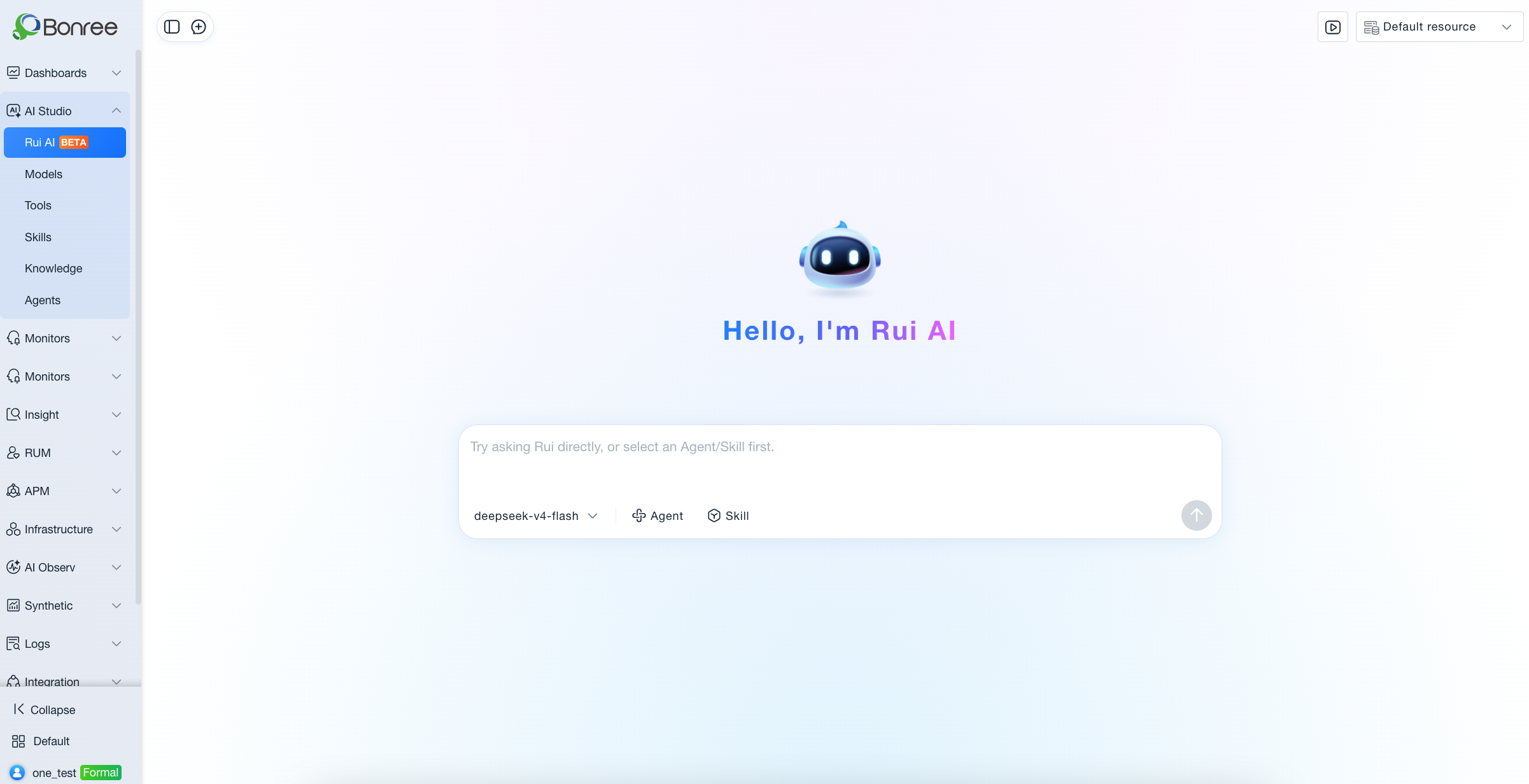
- Agent Hub: Supports two construction methods: workflow and autonomous decision-making. Workflows are suitable for tasks with fixed execution paths, while autonomous decision-making supports multi-round LLM-driven reasoning, addressing diverse O&M scenarios from fixed processes to dynamic decision-making. Built-in general-purpose agents are available out-of-the-box, covering high-frequency scenarios such as fault diagnosis, knowledge Q&A, PromQL generation, and data observation. Users can also build their own personal agents, integrating MCP tools, Skills, and dedicated knowledge bases.
- Rui AI Unified Interaction Entry: Added the Rui AI conversation interface, integrating intent routing, multi-agent selection, and Skill execution capabilities. When no agent is specified, the routing agent automatically recognizes intent and assigns processing logic. Supports three display modes: initialization, single-panel, and split-screen. Complex diagnostic tasks automatically switch to split-screen mode, presenting conversation history and structured reports side by side. Conversation history is retained for 7 days, allowing users to resume context and continue the conversation.
- Knowledge Base Management: Added a knowledge base module, supporting the upload of team troubleshooting experience, SOPs, system architecture descriptions, and other documents, enabling agents to understand business context during diagnosis. A single knowledge base can be referenced by multiple agents simultaneously, enabling one-time maintenance and cross-scenario reuse.
- Tool (MCP) Management: Added a tools module, supporting the integration of custom external tools (log query, metric analysis, change retrieval, etc.) via the MCP protocol, forming a complete diagnostic toolchain together with built-in tools.
- Skill Management: Added a Skills module, encapsulating operational capabilities such as sending notifications, creating tickets, pushing logs, etc., enabling agents not only to "diagnose" but also to "take action," achieving full automation from query → reasoning → execution → notification.
- Model Management: Added a models module, supporting the integration of LLMs, embedding models, and reranking models compatible with the OpenAI API protocol. Connectivity checks are automatically performed upon saving.
Optimizations
- Cloning Mechanism: All agents support cloning, enabling rapid derivation of new versions from built-in or existing custom agents. After modifying configurations, users can publish directly without rebuilding from scratch.
【APM】
- The original Core Links module has been officially renamed to Business Observation.
-
Business Observation is officially released with the Beta label removed.
-
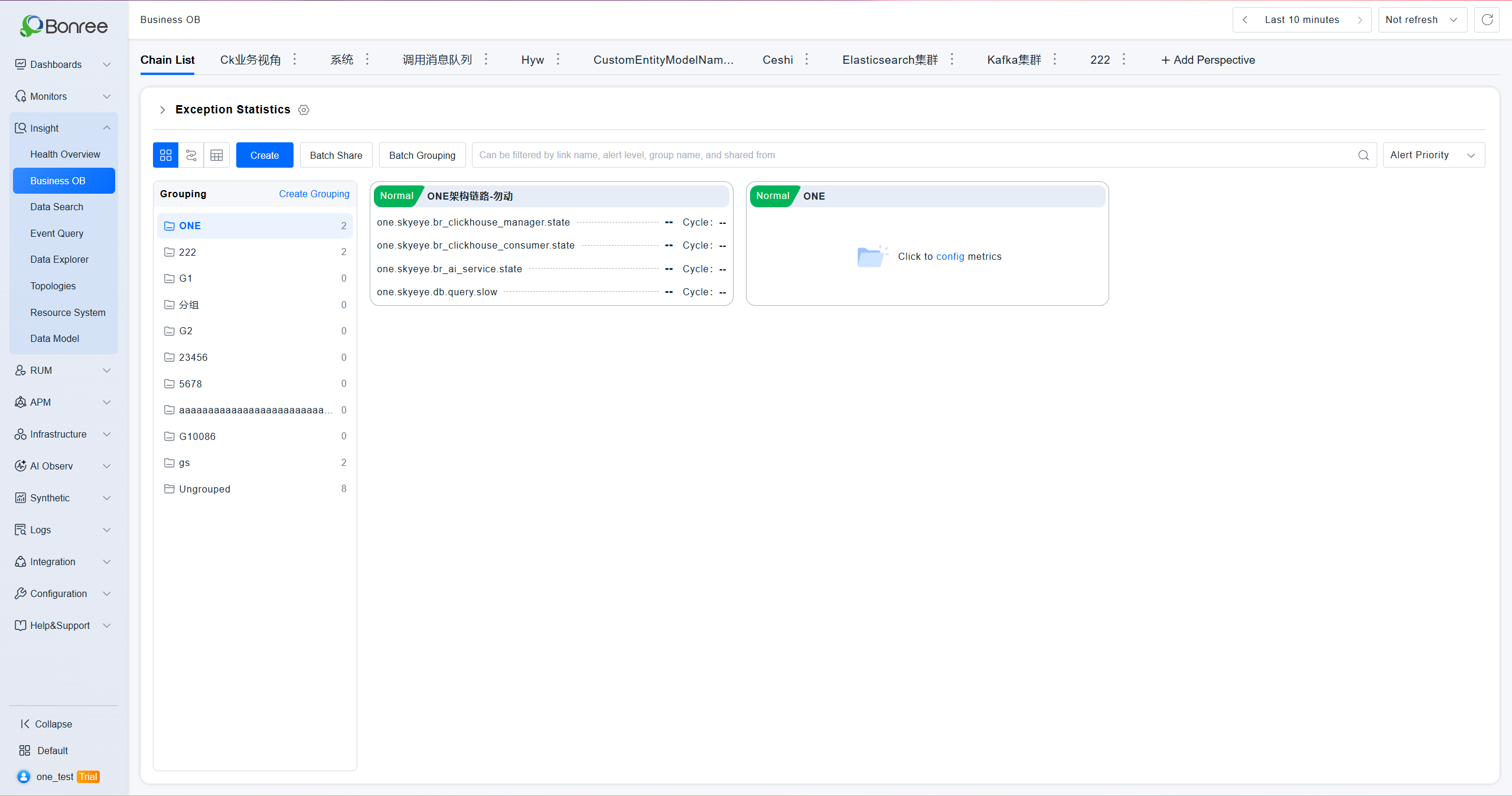
Added Card Grouping function; all cards are placed in Ungrouped by default.
-
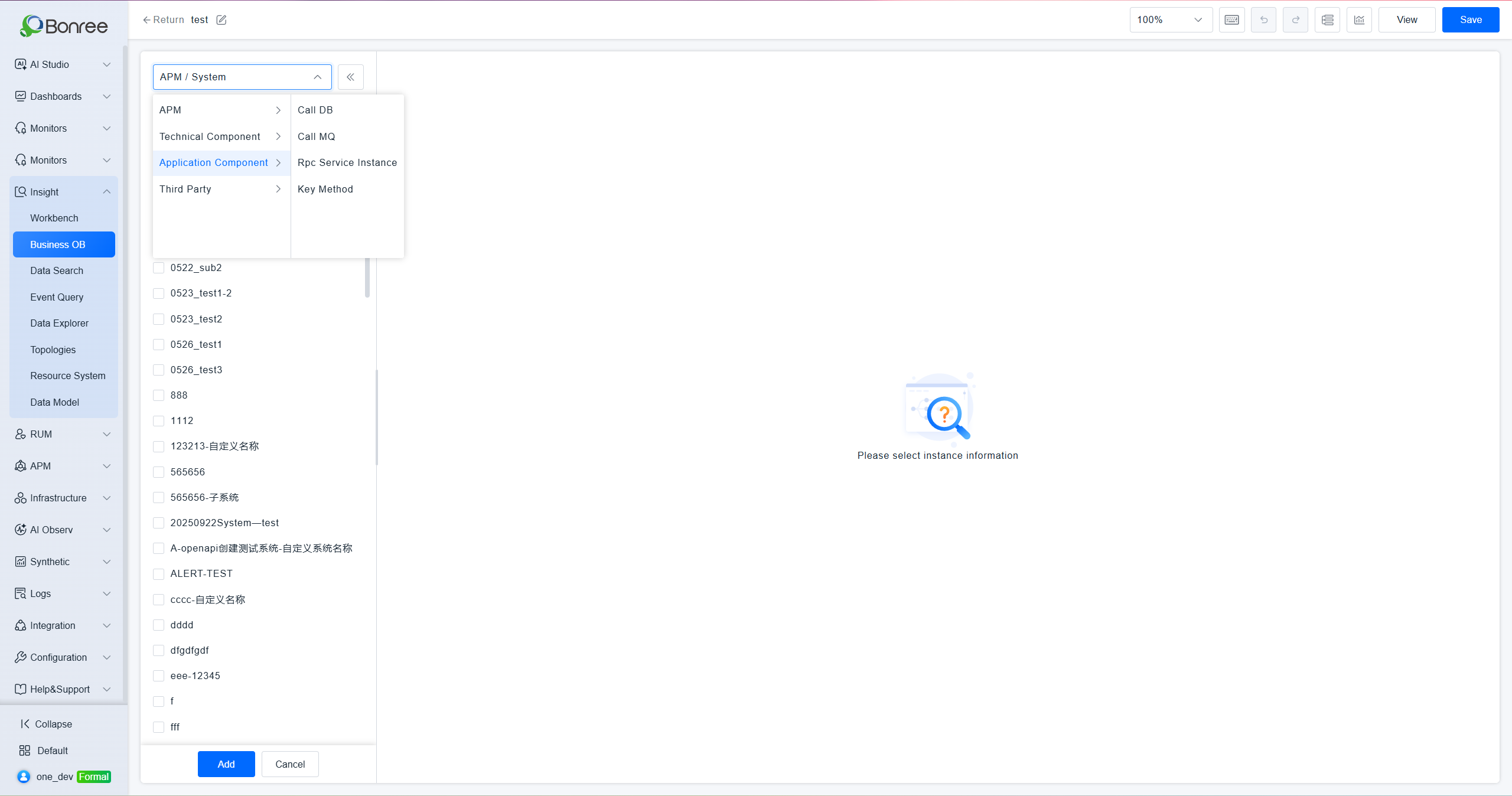
Business Observation supports selecting and configuring application component entities: database calls, message queue calls, remote service instances, and key methods.
-
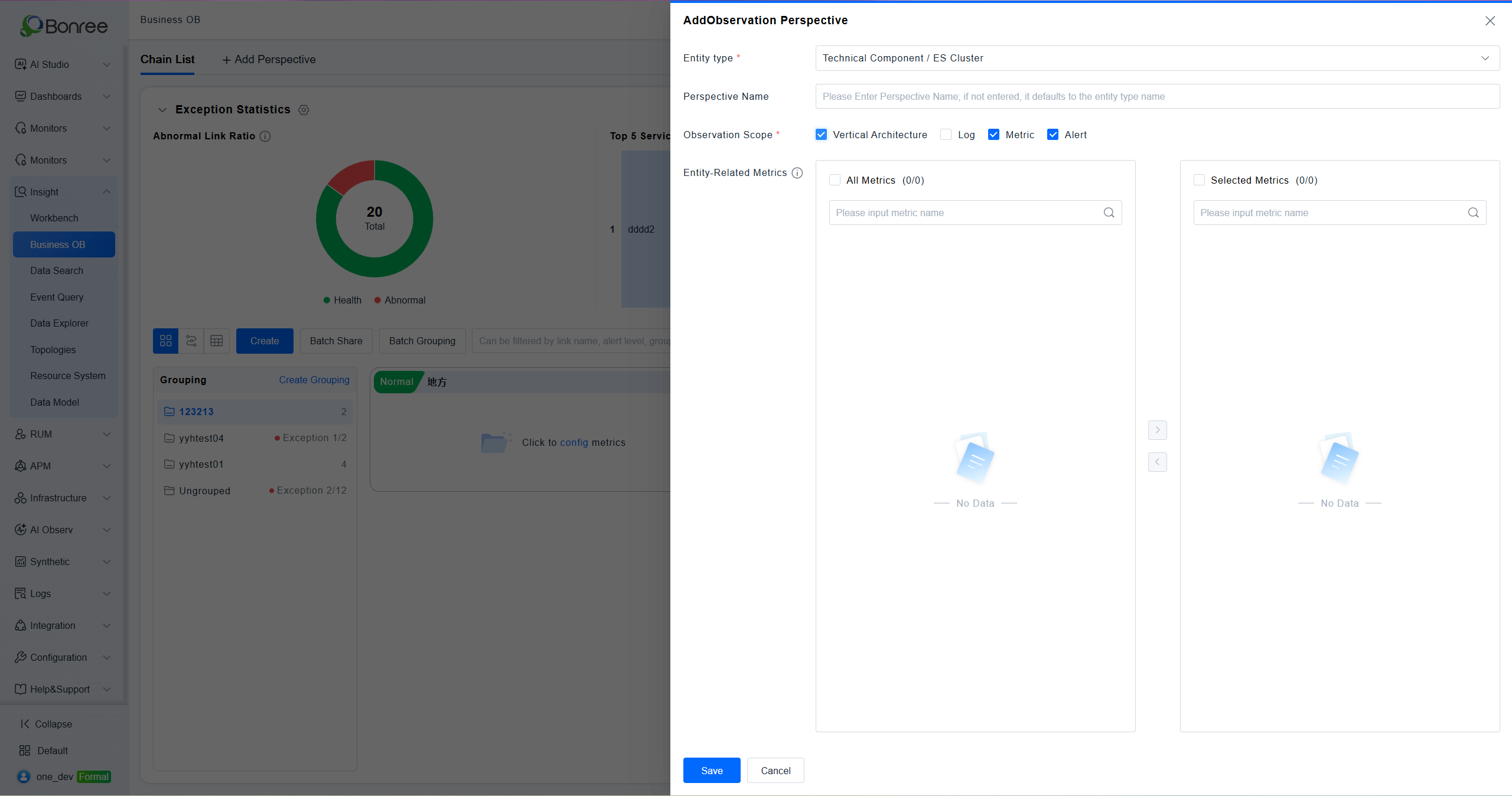
Added a new Observation Perspective module to Business Observation. Users can customize entity observation dimensions; details on supported entity scopes can be found in the documentation.
-
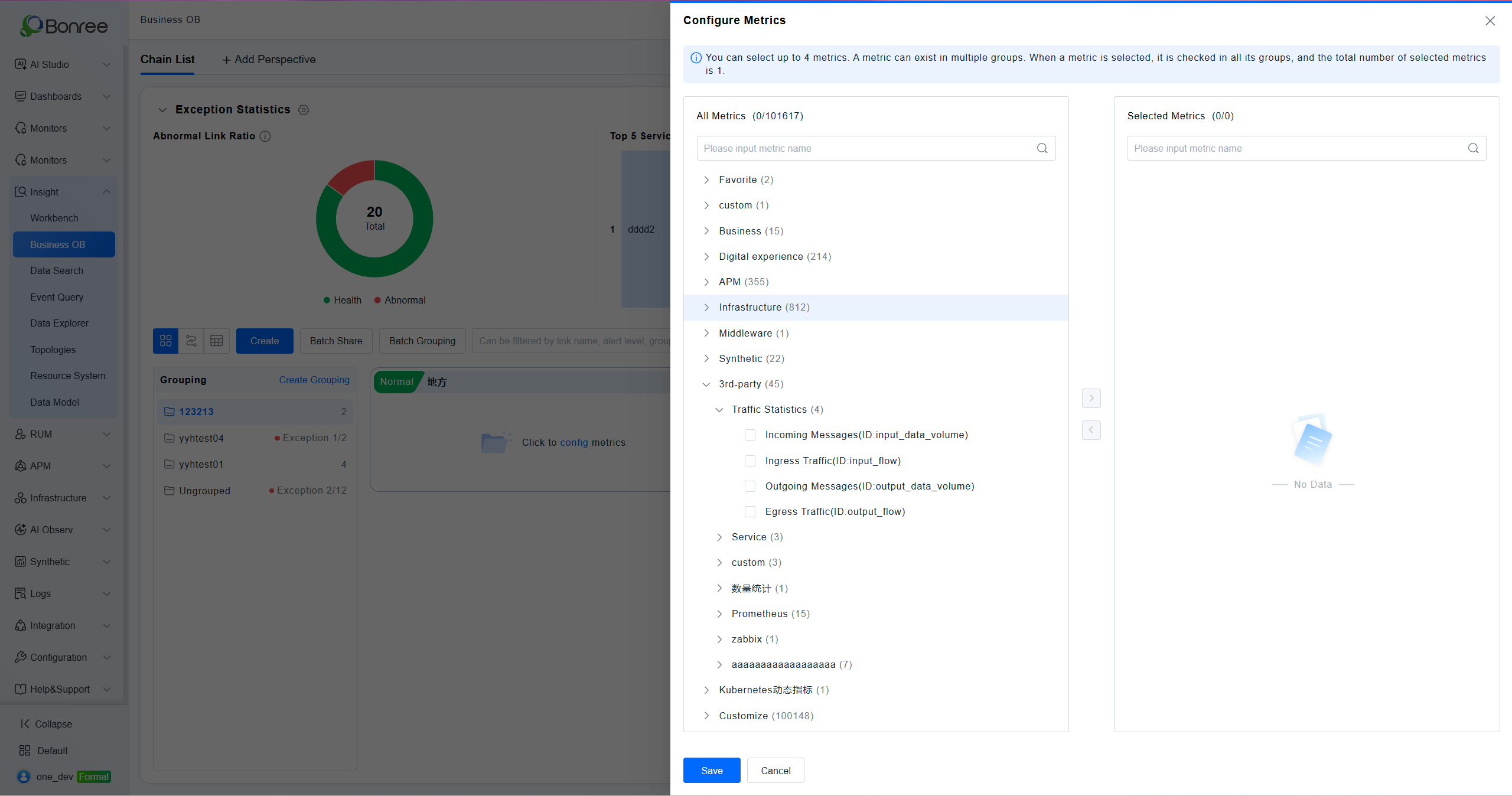
Full support for third-party metric selection and query adaptation is now available.
-
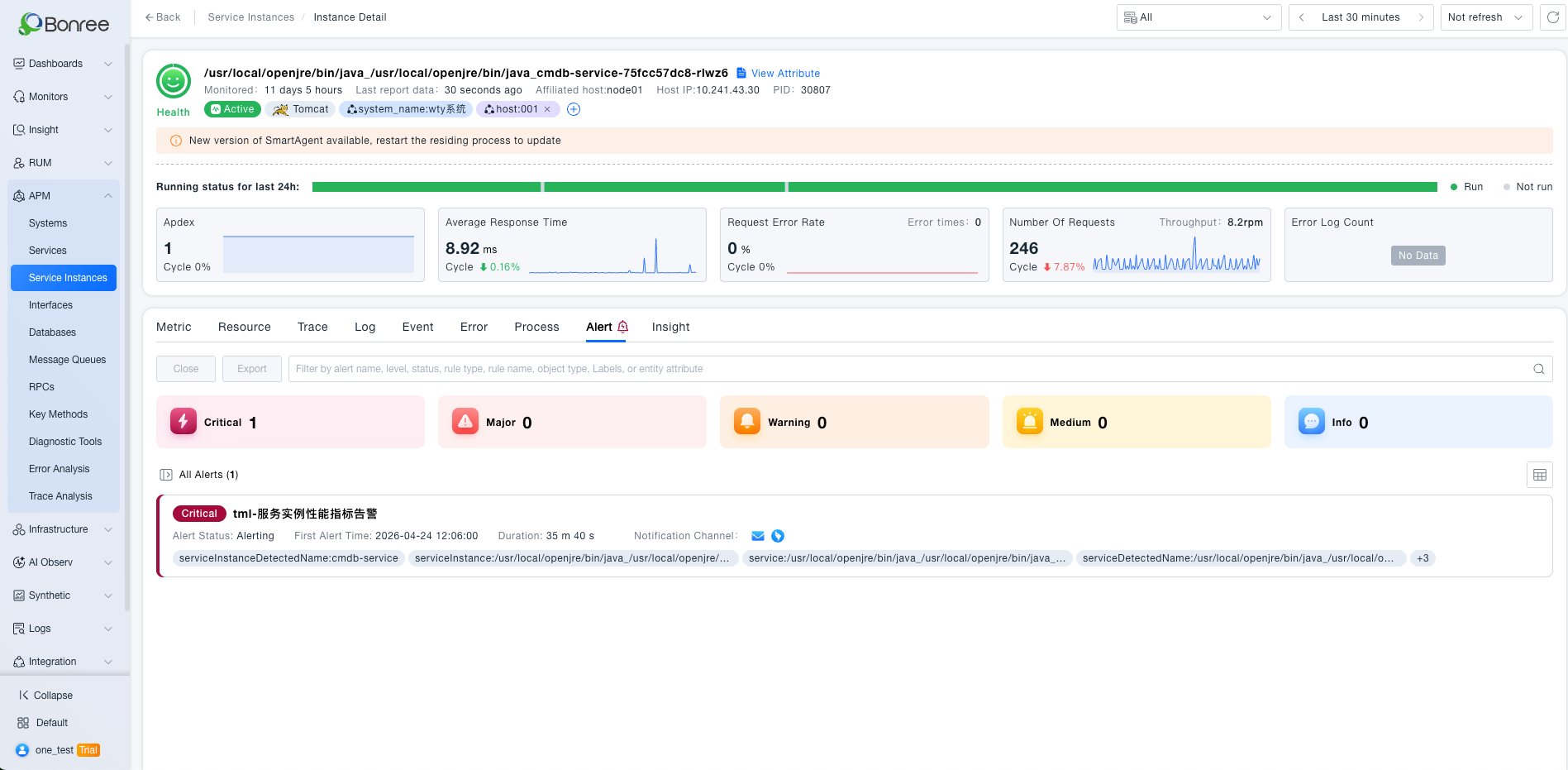
Alert Component Upgrade: Completed the new alert component adaptation, ensuring a smooth upgrade without impacting existing alert workflows.
-
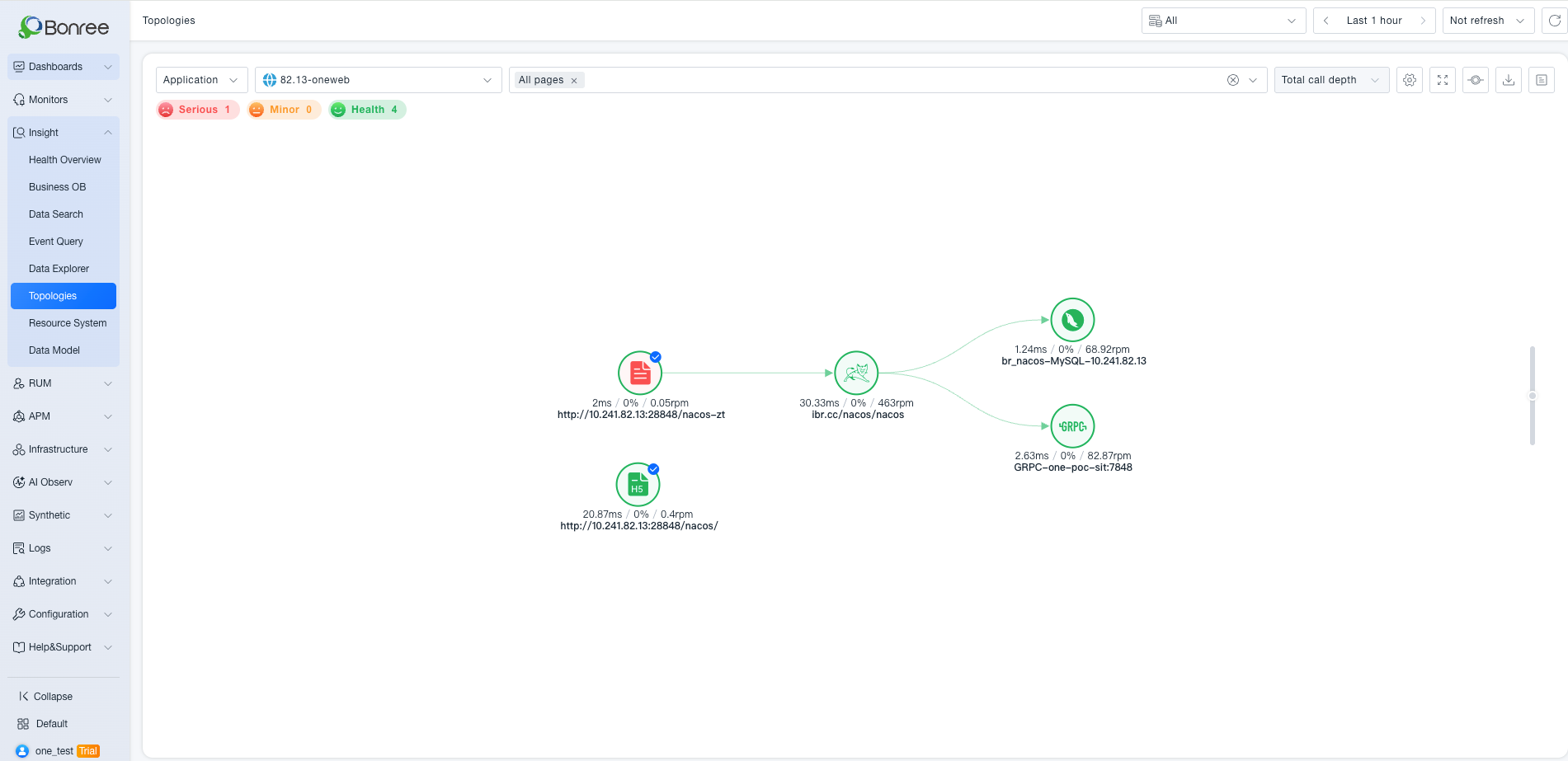
Global Topology: Page Dimension Added: Supports page-as-origin topology views to display complete front-to-back call chains, enabling full-link observability from the frontend perspective.
-
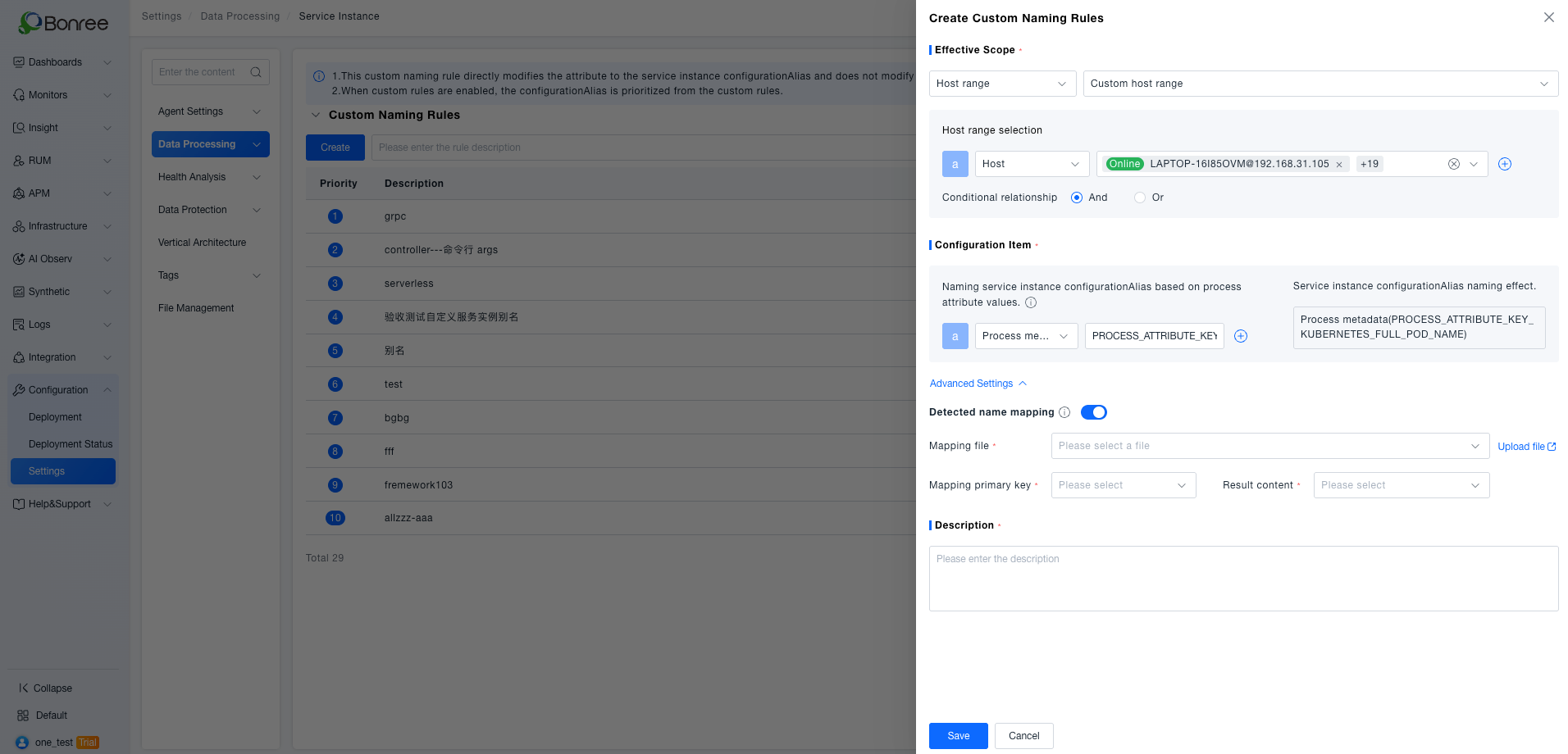
Custom Naming Rules for Service Instances: Supports configurable service instance identification naming rules, flexibly adapting to containerized deployment scenarios and improving instance recognition accuracy.
-
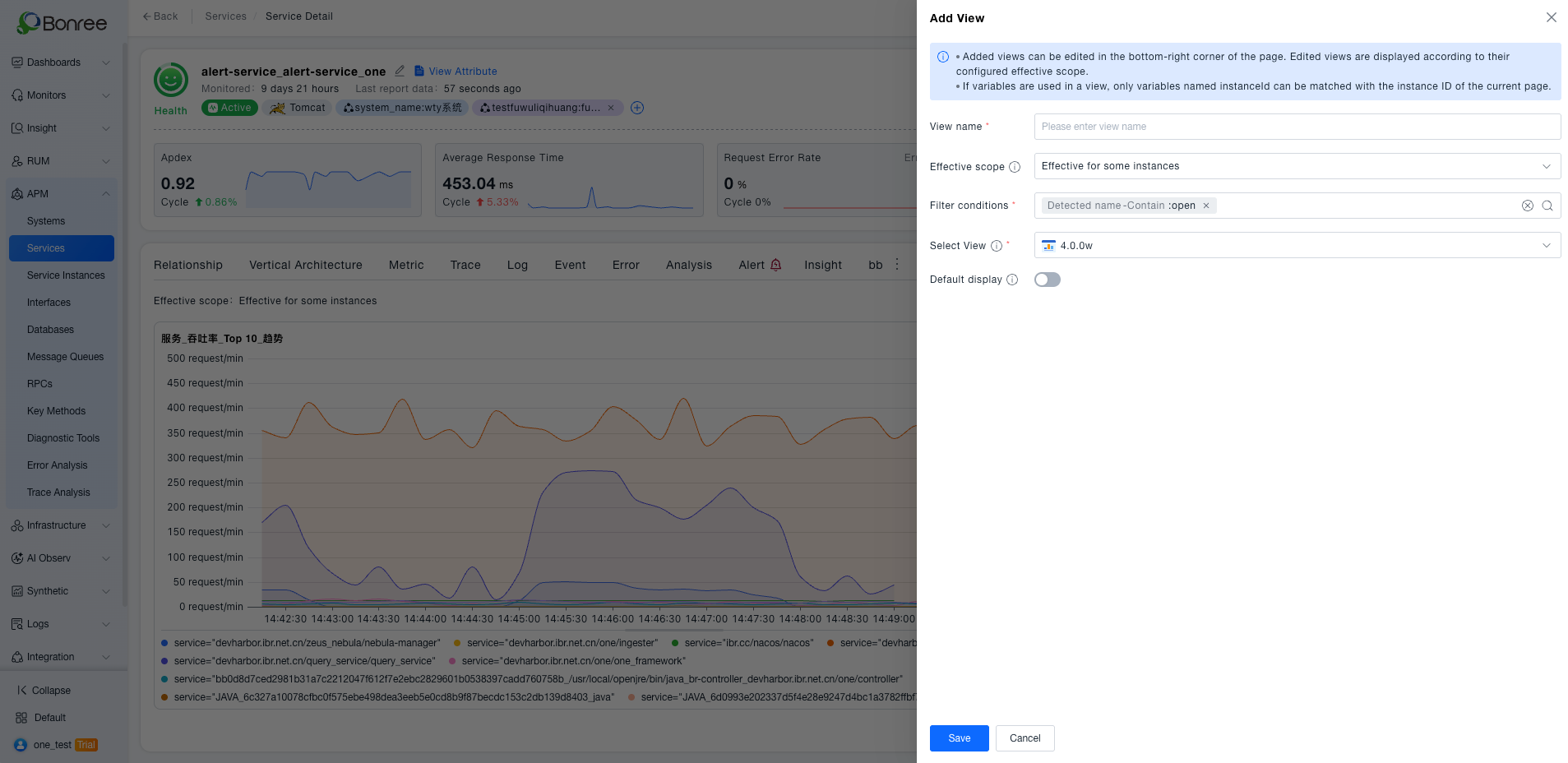
View Scope: "Partial Instance" Option Added: View configuration now supports targeting specific instances, enabling fine-grained and differentiated instance management for multi-instance group operations.
-
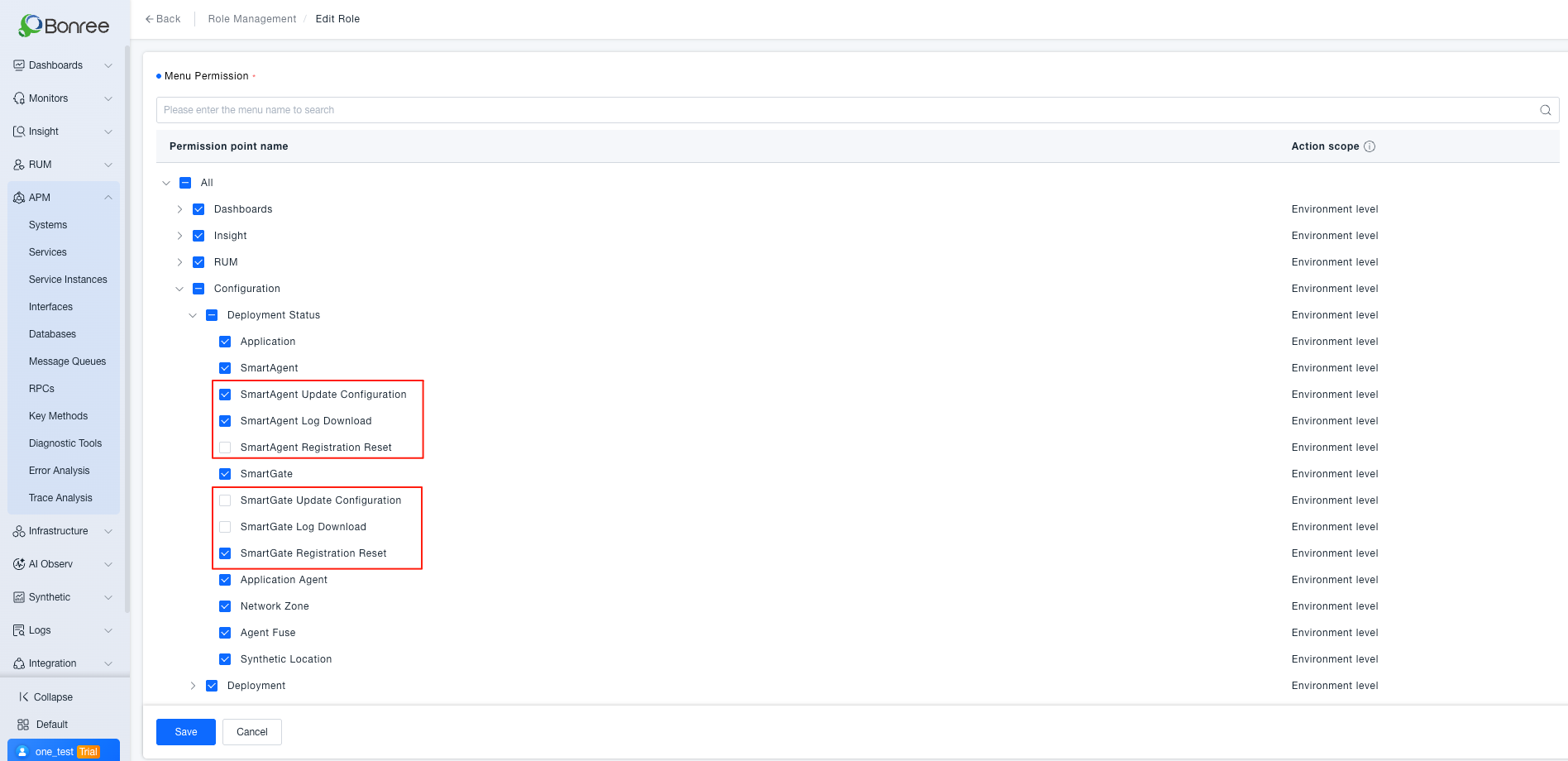
Probe Reset Permission Control: Role-based access control added for SmartAgent / SmartGate registration reset operations, preventing unauthorized actions from causing monitoring data interruptions.
-
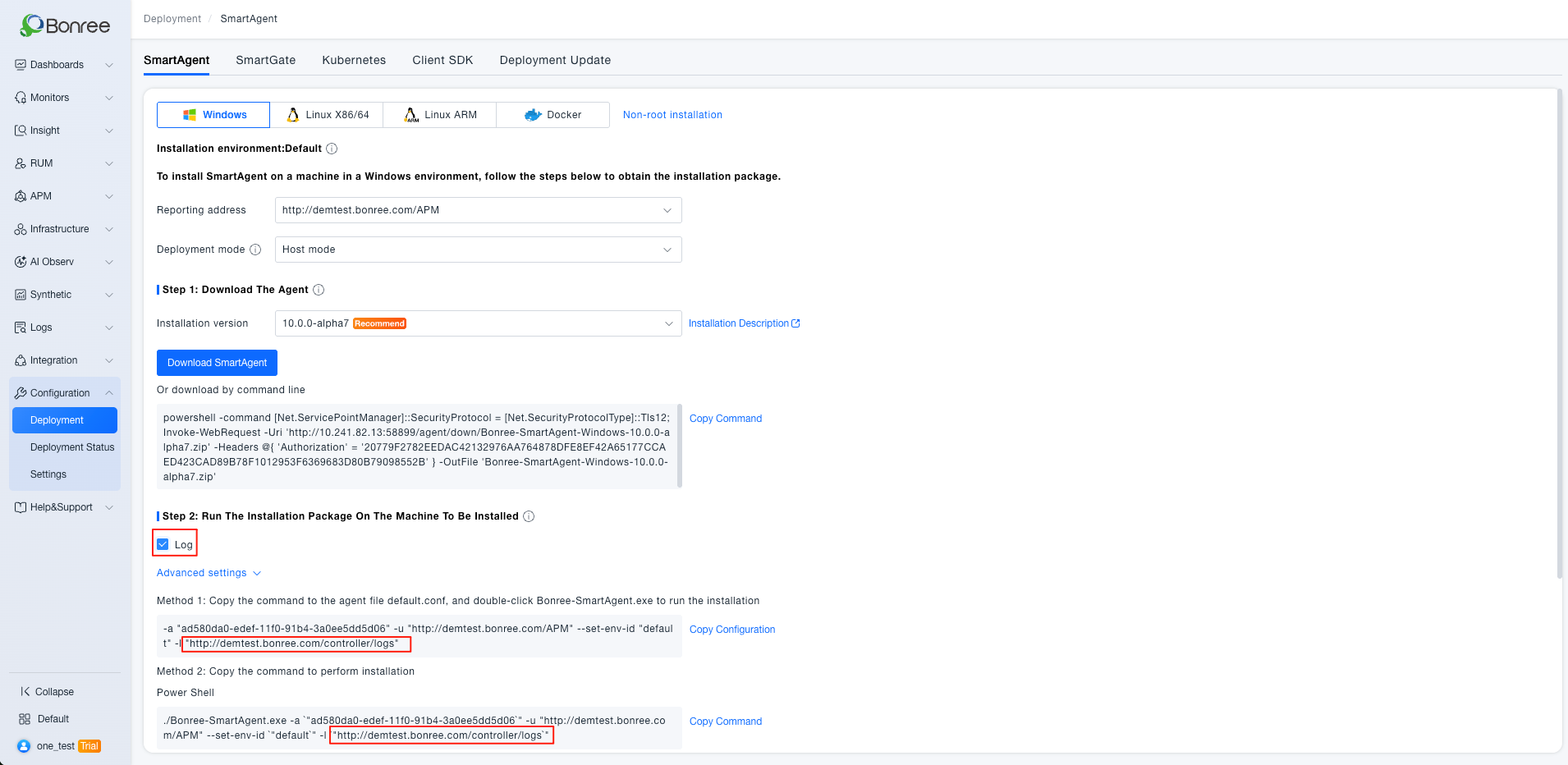
SmartAgent Windows Log Collection Configuration: A log collection toggle has been added to the Windows installation process, enabling convenient log ingestion in Windows environments.
-
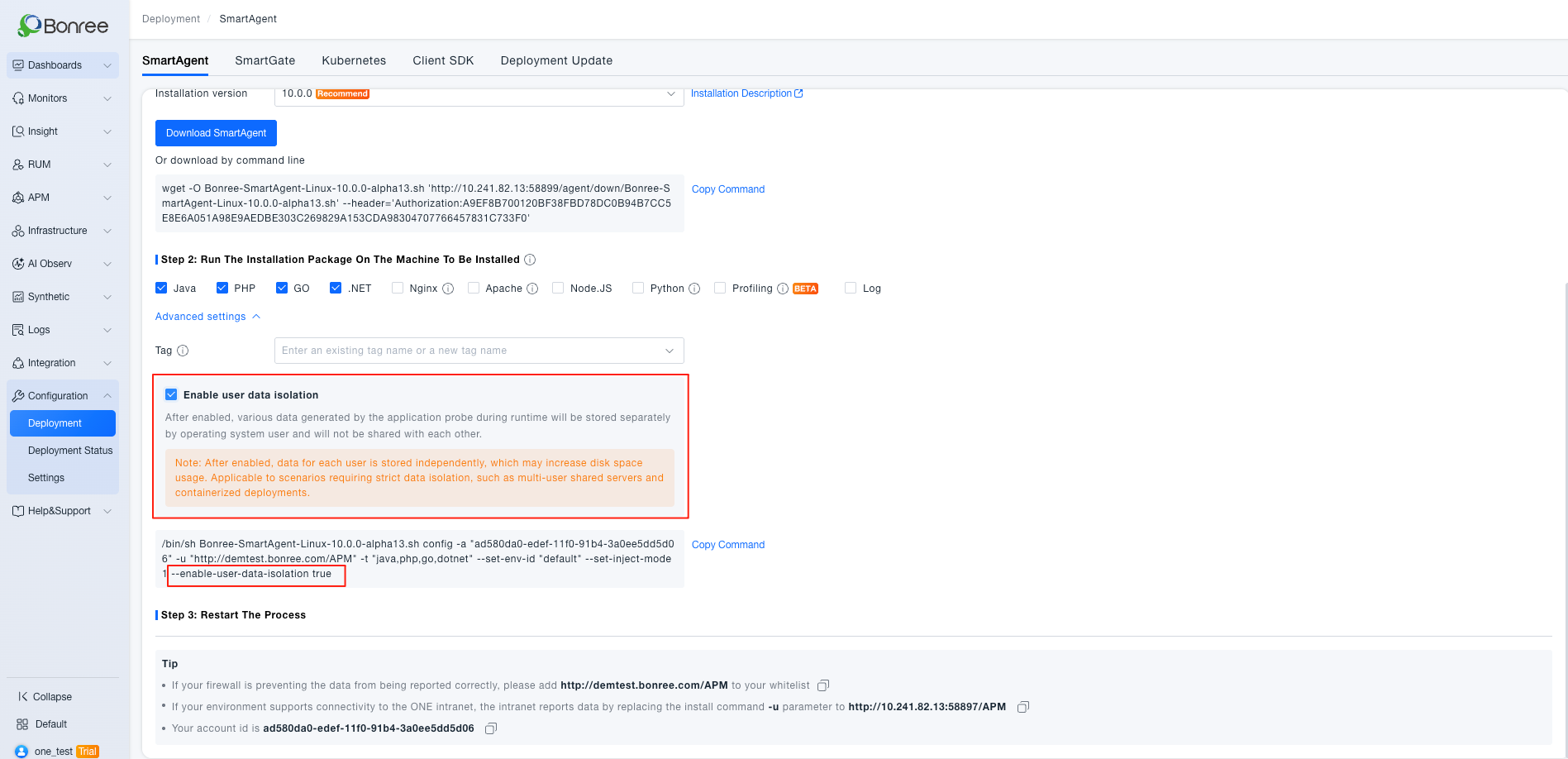
User Data Isolation Parameter for Probe Installation: A user data isolation startup parameter has been added to advanced settings, enabling probe runtime directory isolation for multi-user shared servers to meet data security and enterprise compliance audit requirements.
-
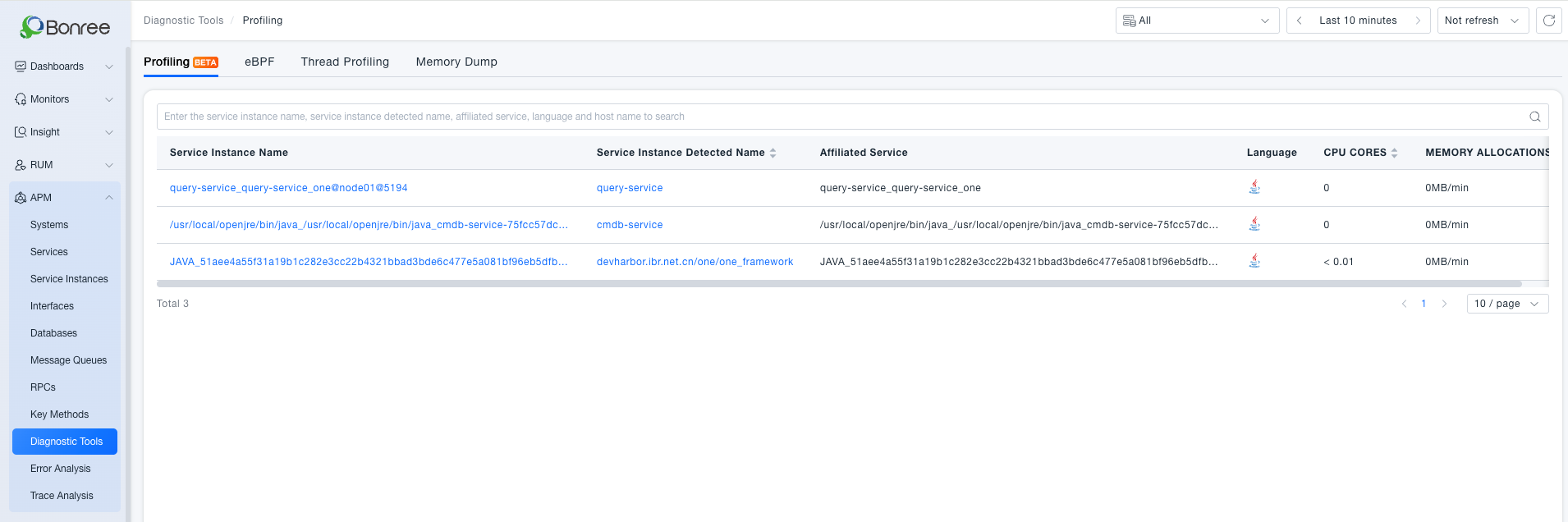
Profiling List Query Optimization: Profiling statistics upgraded to service instance level, breaking through query count limitations and improving the completeness and accuracy of performance profiling data.
-
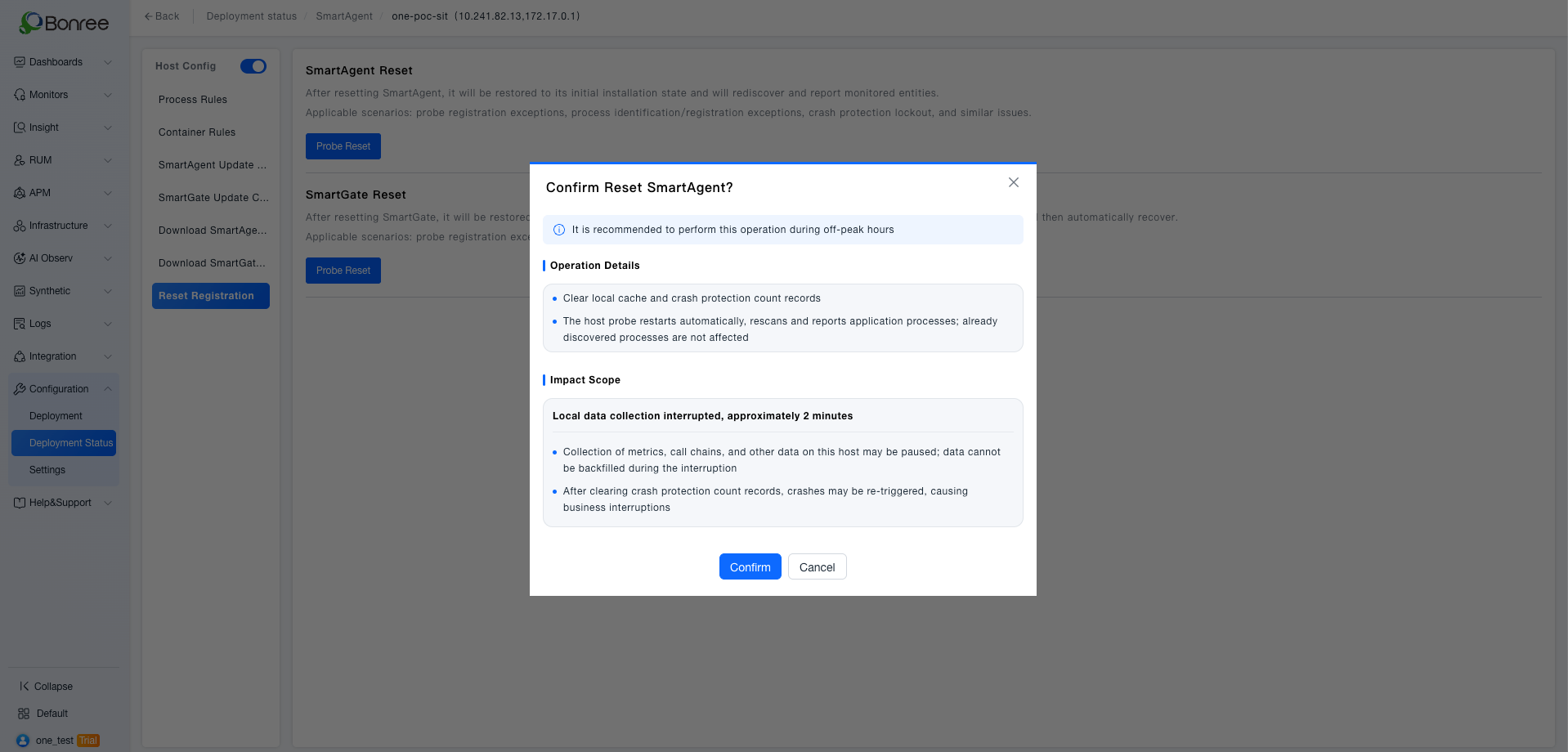
Registration Reset Dialog Optimization: The reset dialog now includes operation instructions and risk warnings, enabling informed decision-making and reducing the risk of accidental operations.
-
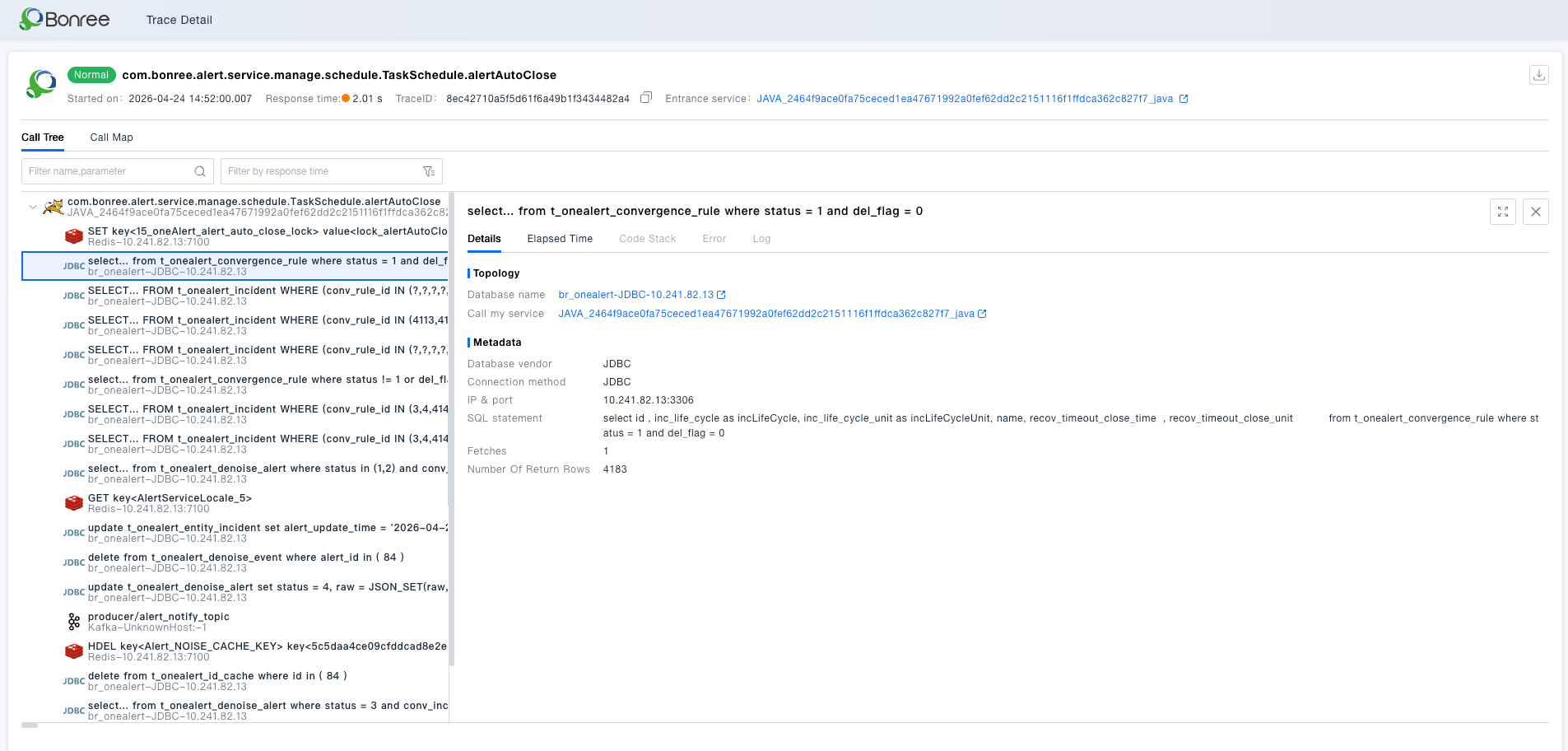
Trace Detail: SQL Return Row Info Added: Database call nodes now display return row count, Fetches, and other data, enriching SQL observability dimensions for faster identification of slow queries and abnormal access patterns.
-
Entity Detail: Alert and Insight Tabs Separated: Alerts and insights in the entity detail page are now displayed in separate tabs, optimizing information hierarchy for a cleaner interface and improved troubleshooting efficiency.
-
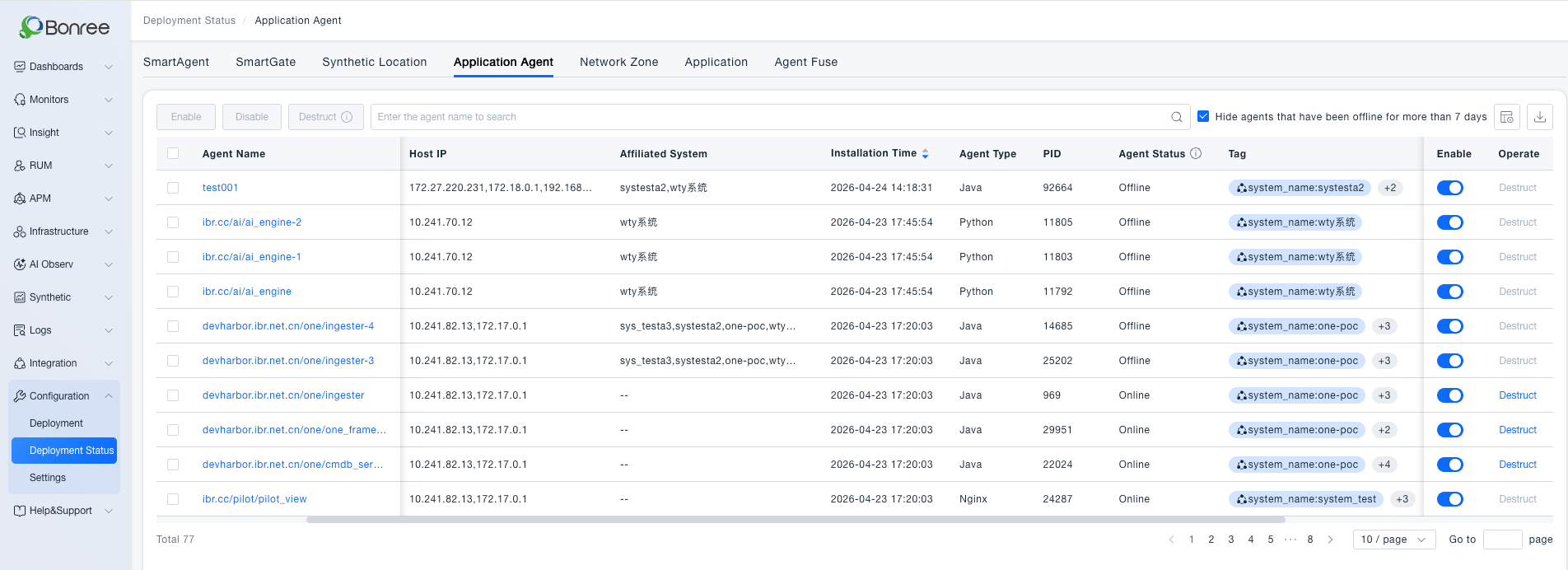
APM Probe Quota Fine-Grained Control: Optimized quota management logic and upgraded the probe management page to prevent over-limit access and improve large-scale probe management efficiency.
-
Call Chain Code Stack Depth Limit: Code stacks exceeding 500 layers are automatically truncated with a prompt, preventing excessive stack depth from causing page lag or crashes.
-
Trace Analysis Filter Async Loading: Filter entity data now loads on demand asynchronously, resolving page crashes and timeout issues in environments with massive entity volumes.
【RUM】
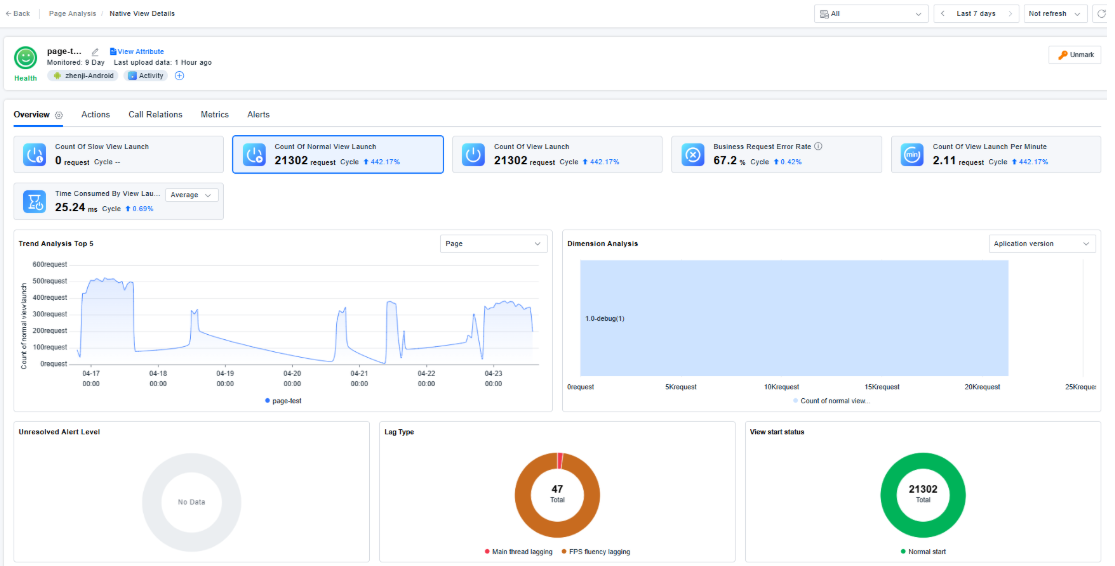
- Supports observing application runtime status from a page perspective.
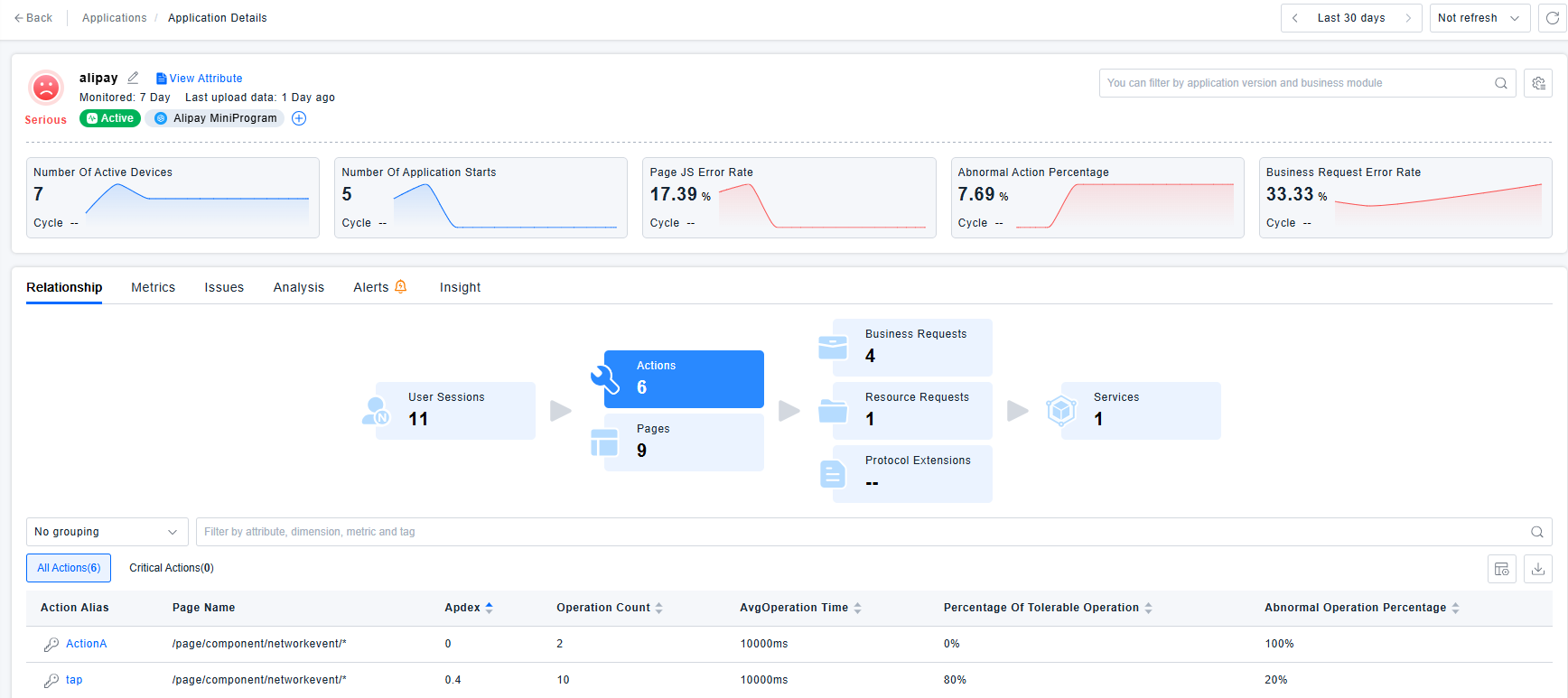
- Added observability capabilities for Alipay Mini Programs.
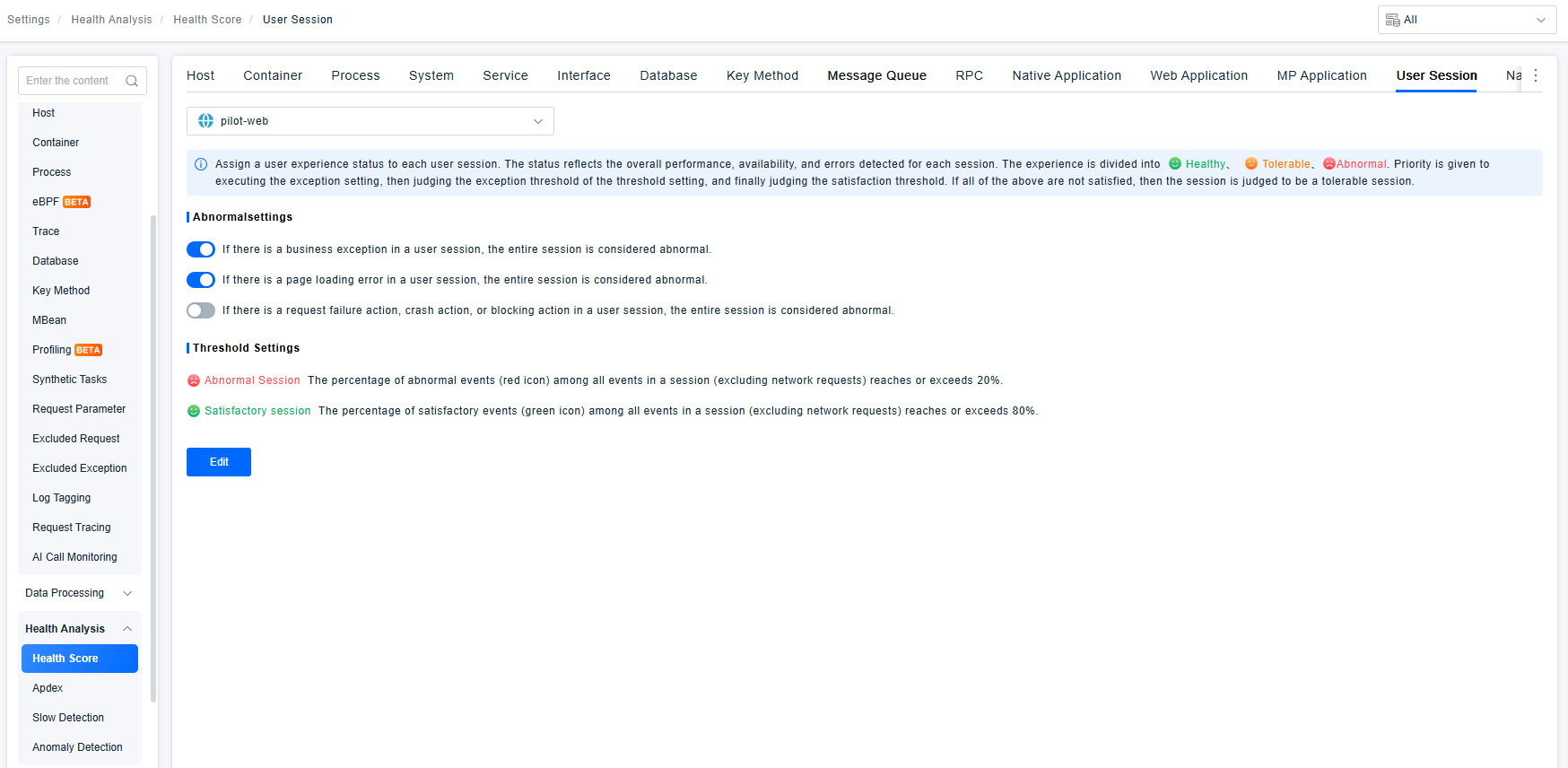
- Health score rules for web applications, native applications, mini-program applications, user sessions, pages, and views are now bound to the endpoint application. Entity recognition rules for business modules and user actions also support binding to the endpoint application, enabling configuration isolation per application.
- Metrics under the "Request Classification" category have been split into business requests and resource requests. The original request classification metrics are now hidden and can no longer be selected in dashboards or alerts. To ensure that previously configured request classification metrics can still query data correctly, the system automatically maps them to query only the values of business requests.
- HarmonyOS NEXT applications now support uploading multiple map symbol files and resolving stack traces.
- The RUM agents for Android, HarmonyOS NEXT, and iOS have added three new session creation logics: create a new session when an API is called; create a new session when no events occur for a default duration (10 minutes); automatically create a new session when the session duration exceeds the default maximum (8 hours). Nacos provides corresponding configurations: enabling/disabling the logics for "new session on no events for a certain duration" and "new session on exceeding max session duration" (both enabled by default); modifying the default values for the idle timeout and maximum session duration; and specifying specific applications to which these two logics do not apply.
- The auto-instrumentation wizard now supports the English version.
- Added dark theme.
- Refined menu permission control.
- Overall performance optimization.
- Corresponding adaptations made for dashboard sharing functionality.
- Completed adaptation for the new alerting component.
- Adapted disaster recovery solution: added support for hot configuration updates in the secondary center; the secondary center service is read-only for the MariaDB database.
- Fixed the issue where after adding
zt:1for an application in the "All Resource Domains" view, the application could not be seen immediately after switching to the "zt" resource domain; the related cache time has been reduced from 5 minutes to 3 minutes. - Fixed the definition text for user session health scores across various application types.
- In slow detection for application startup, view startup, page load, user action / slow action, and network requests, the original term "tolerable threshold" has been uniformly changed to "slow detection".
- For manually instrumented applications, modifying the configuration changes the instrumentation script; a re-instrumentation prompt has been added.
- Self‑requests are now explicitly noted to apply only to business requests and resource requests.
- Added a hint for page entity recognition: only takes effect for page addresses starting with the
http(s)://orfile://protocol. - Added a hint for network request entity recognition: only takes effect for business requests and resource requests.
- Fixed known vulnerabilities in open‑source components and third‑party dependency libraries.
- Fixed the issue where searching by user additional information in "Query Center – User Session" did not work.
- Fixed the issue where a TraceID empty string was displayed as a space in the network request record list.
- Fixed an error that occurred when searching on the user management page.
- Fixed the issue where, in the crash snapshot, the thread name displayed in the first line of the resolved stack trace did not match the original stack trace.
- Fixed the issue where, in session analysis – session details, the exported file name was displayed in English under Chinese mode.
【Alert】
-
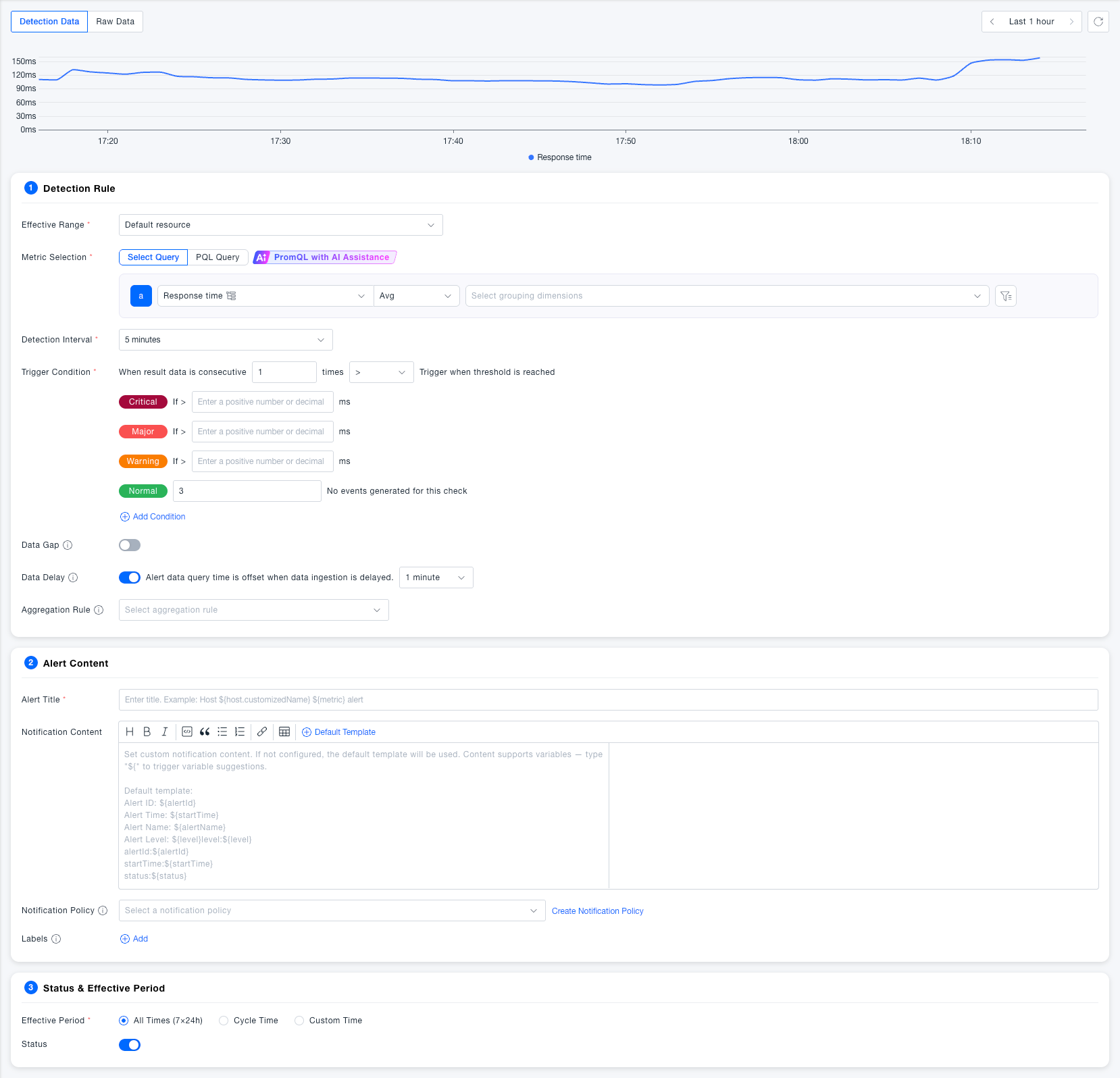
Brand-new interaction experience upgrade, simplifying the alert configuration process.
-
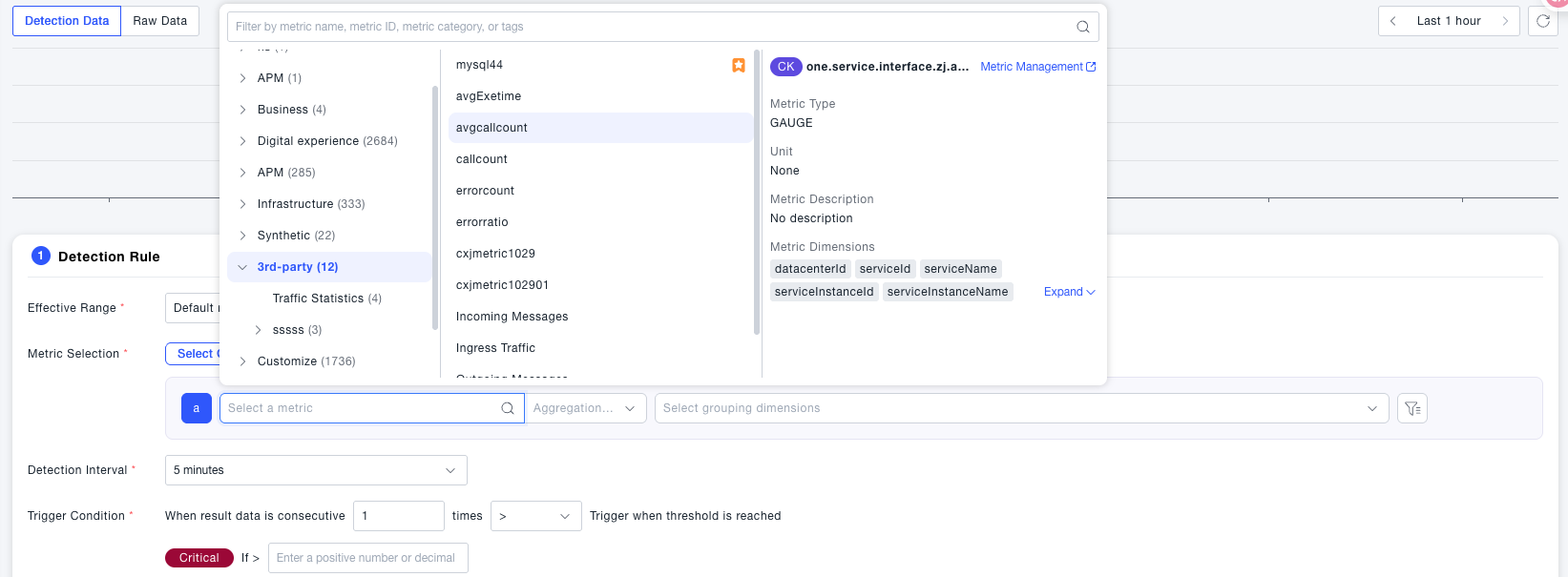
Adapted to the new query engine Titan, metric selection ignores data discrepancies, with full compatibility for CK and VM metric models.
-
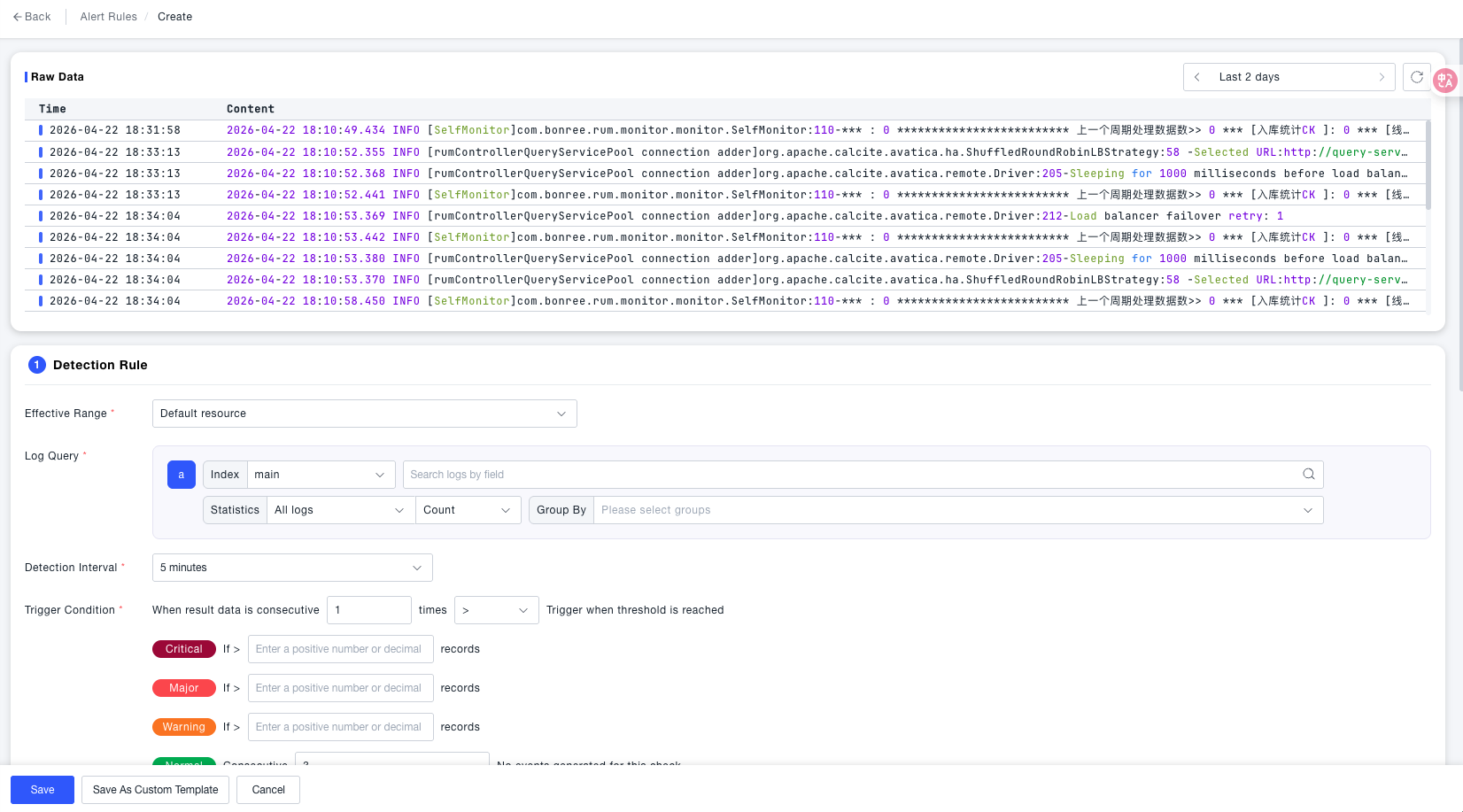
Log-based alerting now supported — trigger alerts by matching specified logs through log detection rules.
-
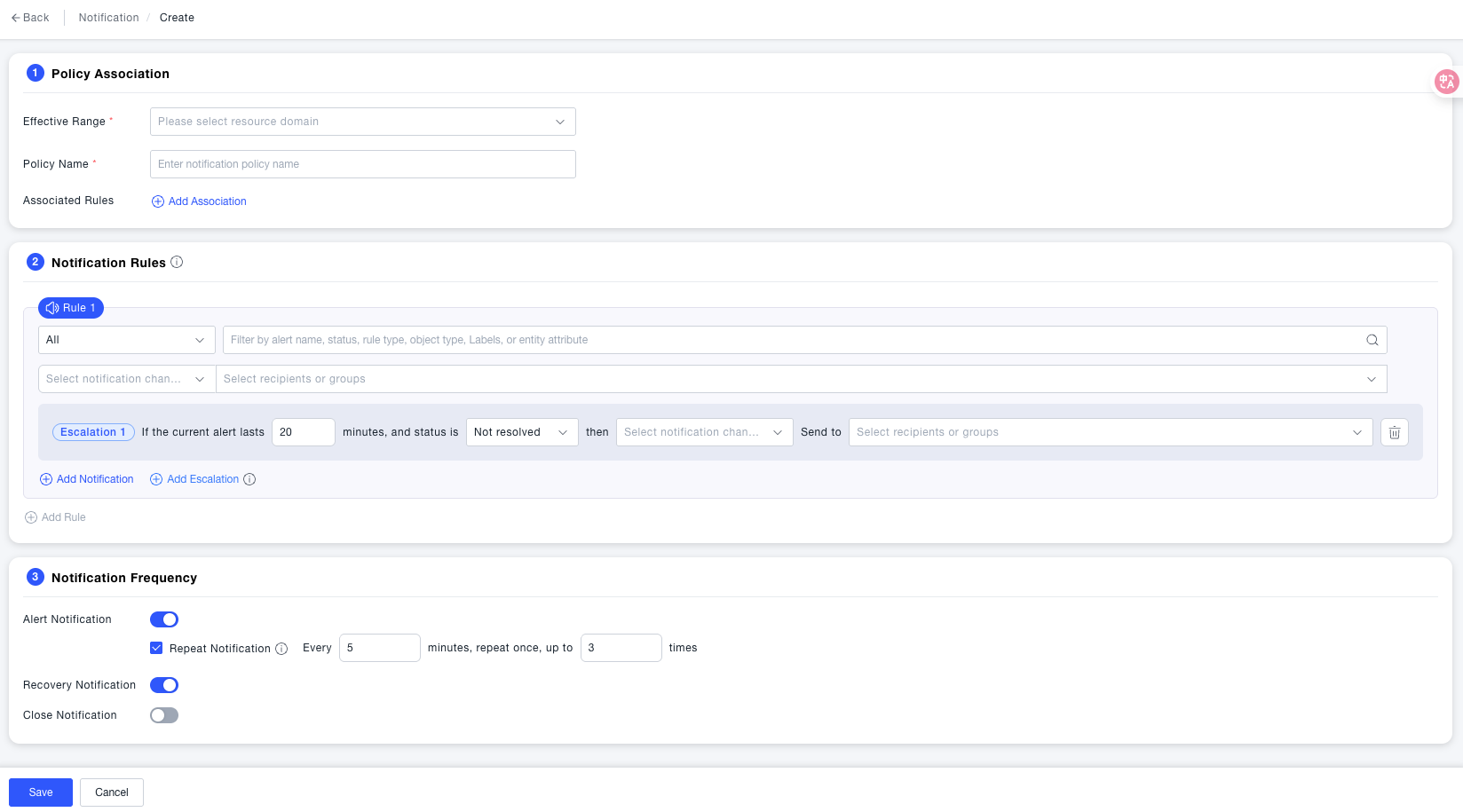
Notification policy redesigned, supporting dispatch by severity level and matching conditions. Escalation policy configuration is also supported.
-
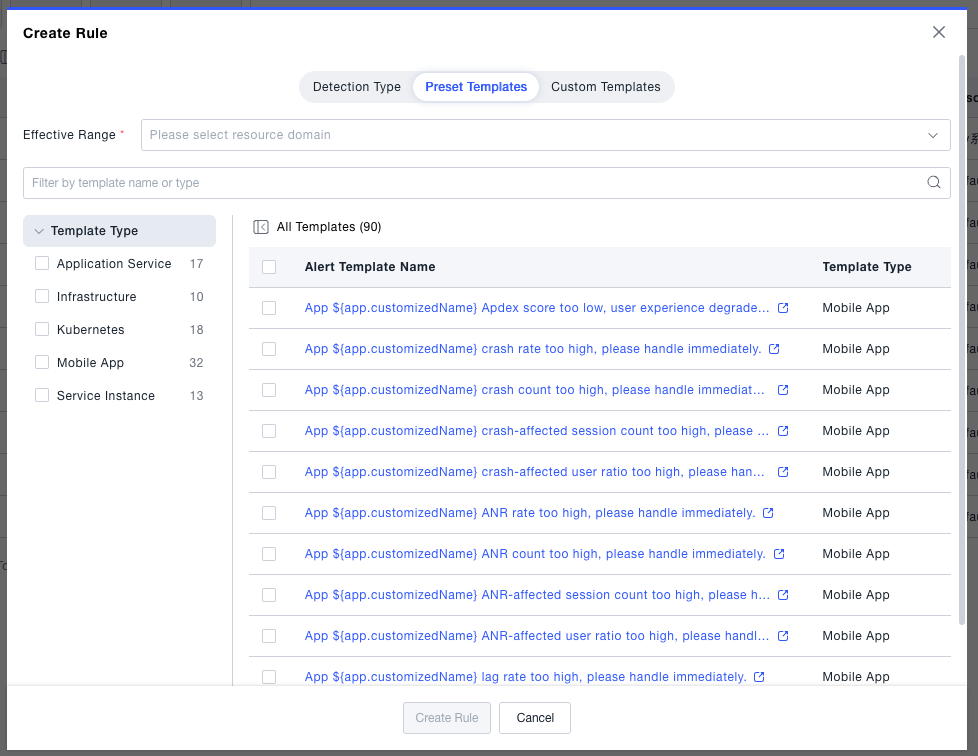
Preset templates available out of the box; custom templates make it faster to establish O&M standards.
【ANALYSIS】
- Metric, entity, and event queries have been migrated to Titan. All metrics now support querying via PQL.
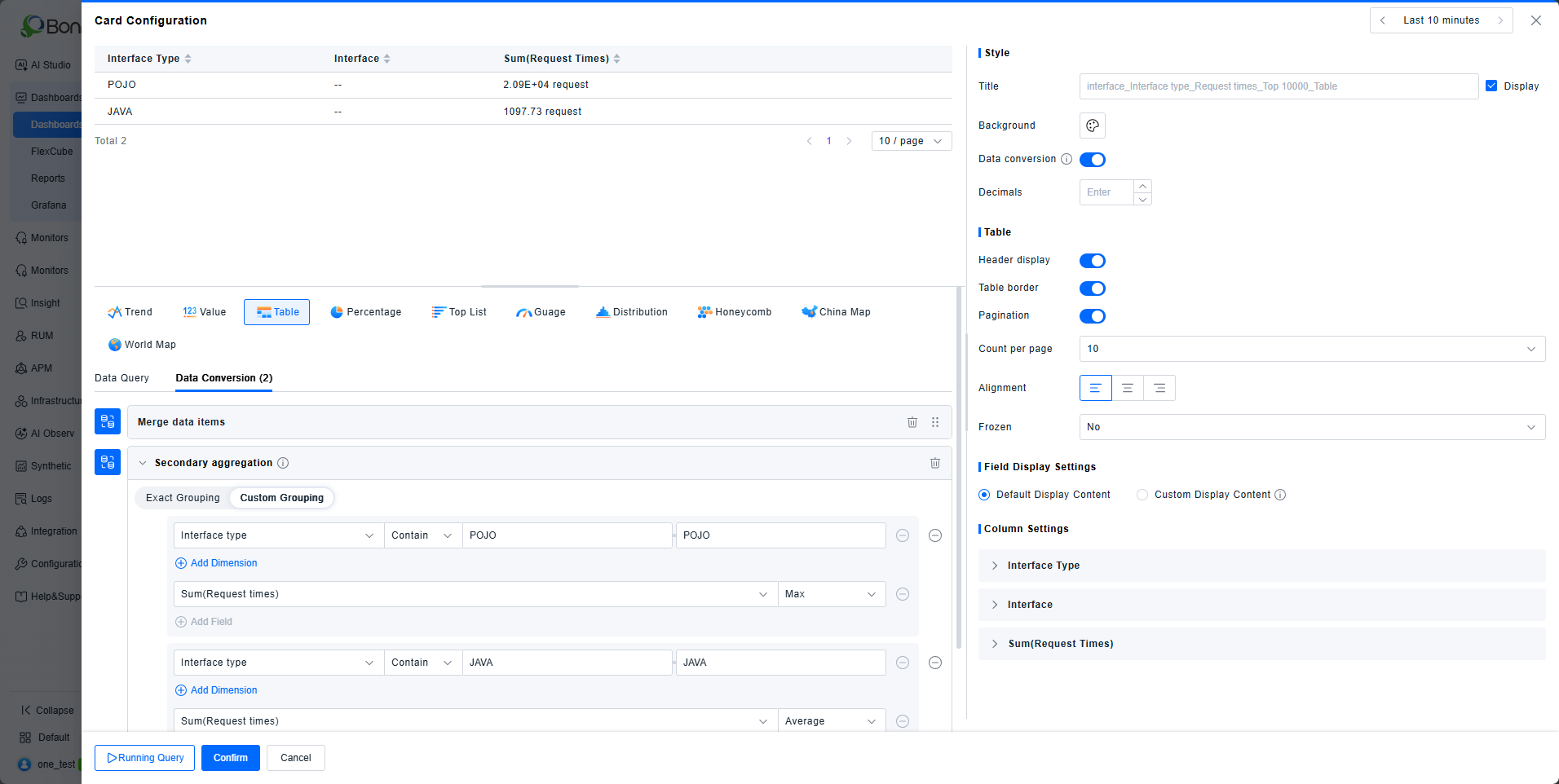
- Added post-aggregation support, enabling secondary grouping and calculation on query results by specifying dimensions or conditions.
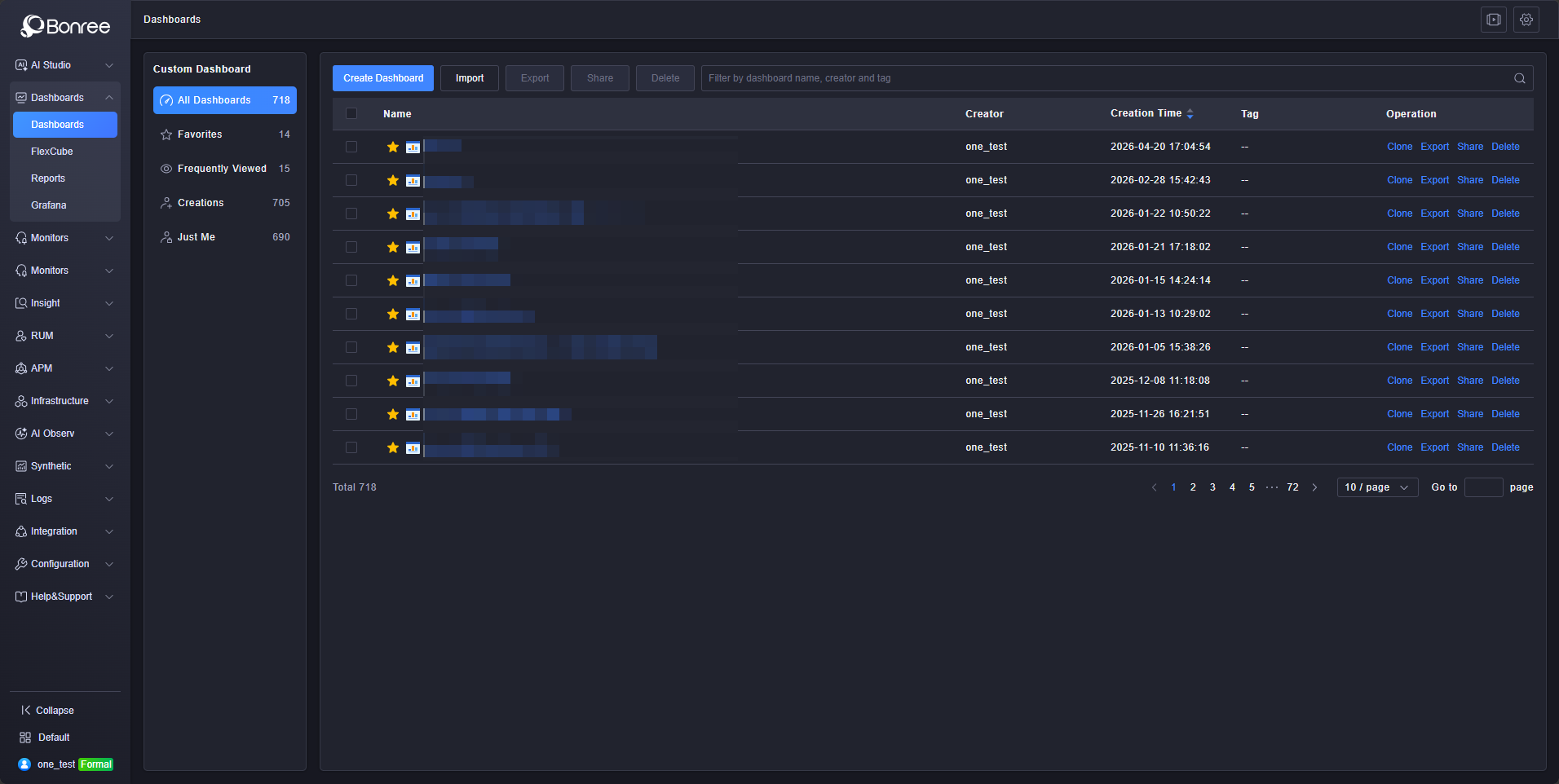
- Added dark theme support for the One platform.
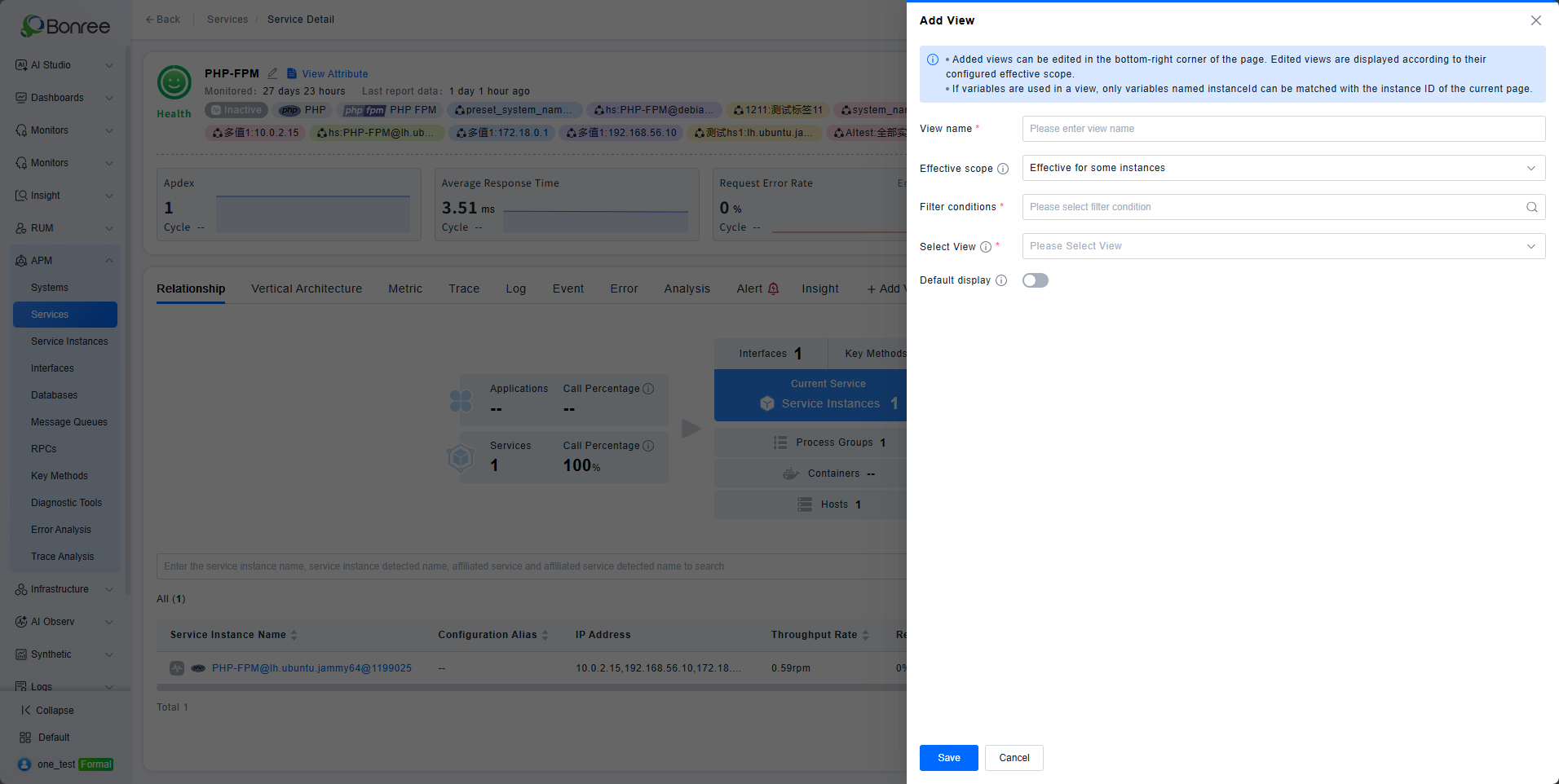
- View components now support scoping to selected instances, in addition to global and single-instance levels.
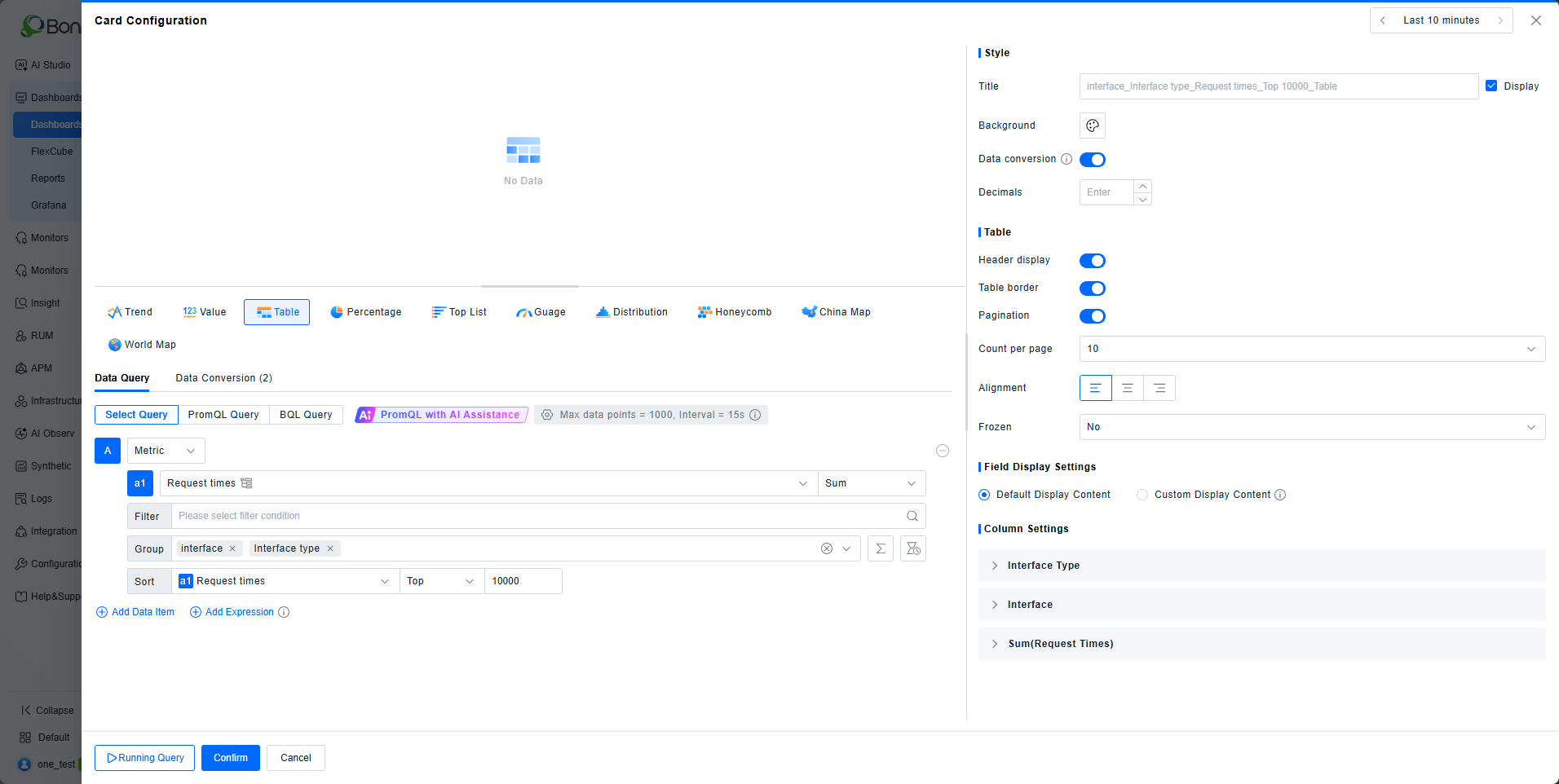
- List cards now default to querying the top 10,000 records, displaying the full query result set.
- The metric common component now determines the metric scope based on the primary entity and adapts to the metric system in effect for the current resource domain.
- Filter inputs now support inline suggestions for quick selection; data queries in dropdown lists no longer interfere with custom option selection.
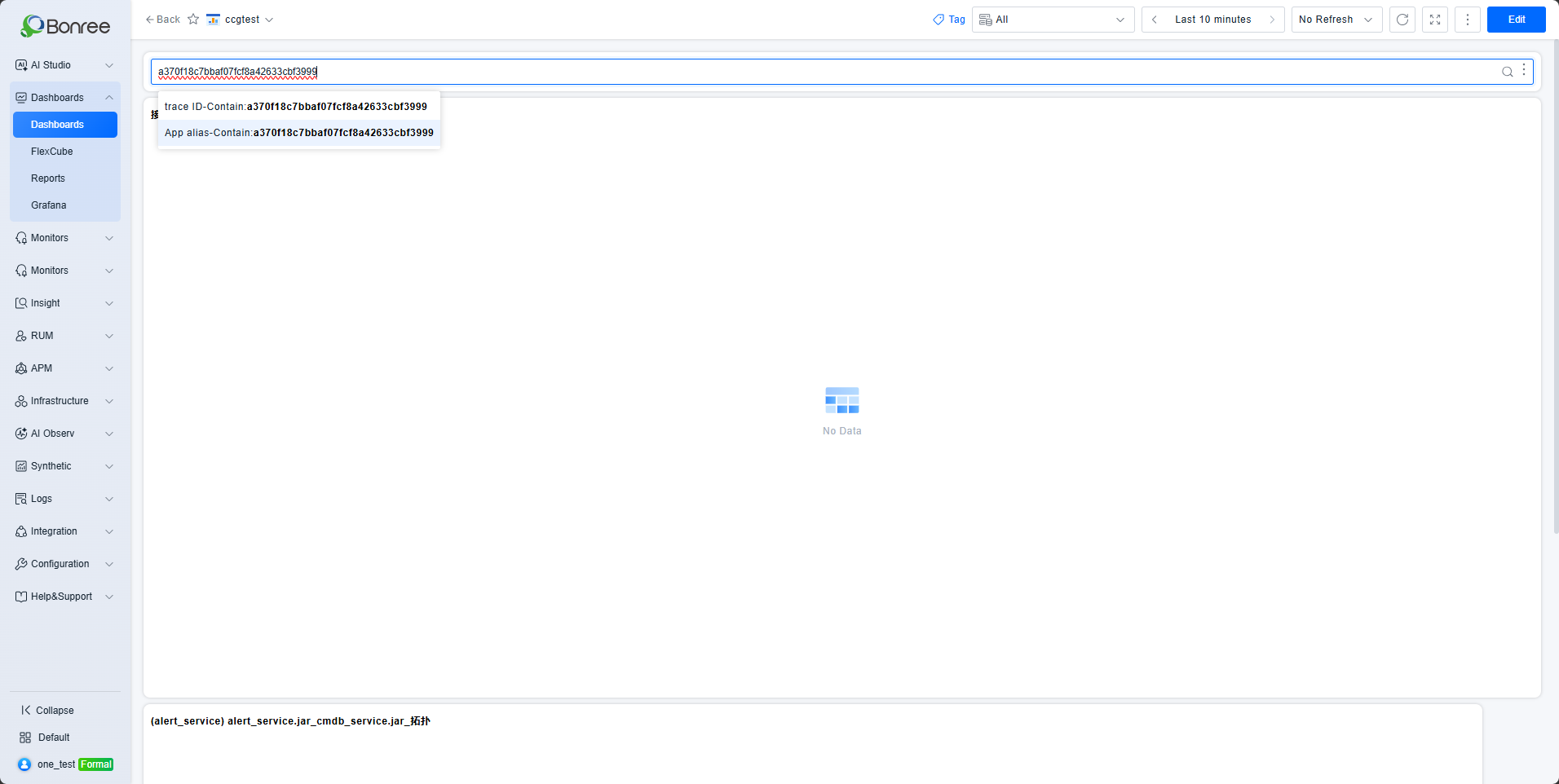
- Workbench now supports Alipay Mini Program icons.
- Automated report configuration has been updated to support users and user groups.
- Unavailable interactions in default interaction mode are now hidden.
- DataCube pages configured as external pages will now reload the configured URL when re-selected from the DataCube menu.
- Fixed an issue where the modified time and refresh interval of dashboards shared with sub-accounts were not saved.
- Fixed an issue where sharing a dashboard or DataCube with both a specific user and "All Groups" caused individual user permissions to be overridden.
【LOG】
- Added support for disaster recovery architecture adaptation. Added log collection support for Windows probes.
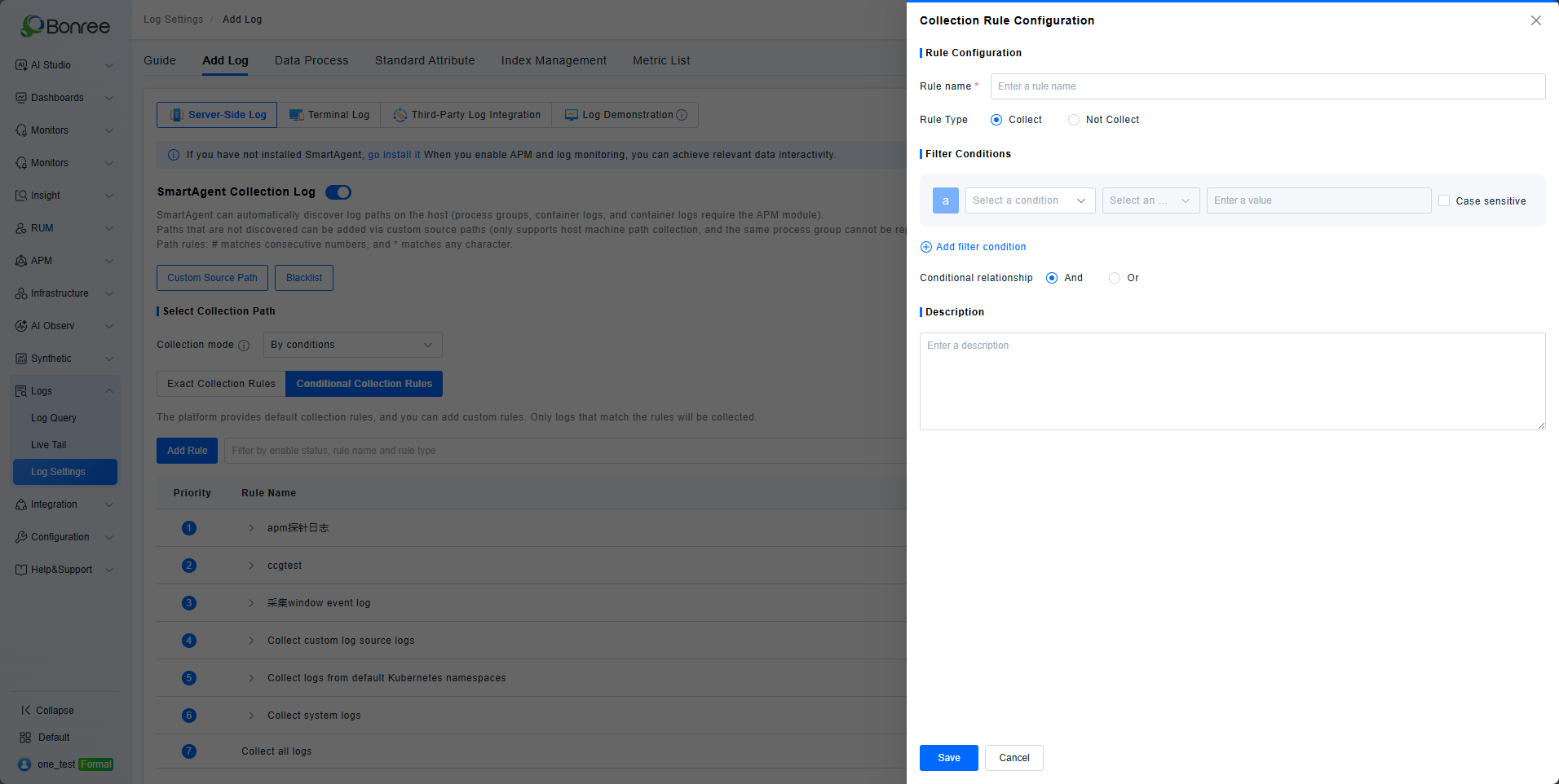
- Introduced conditional collection mode, where only paths matching user-defined configuration rules will be collected.
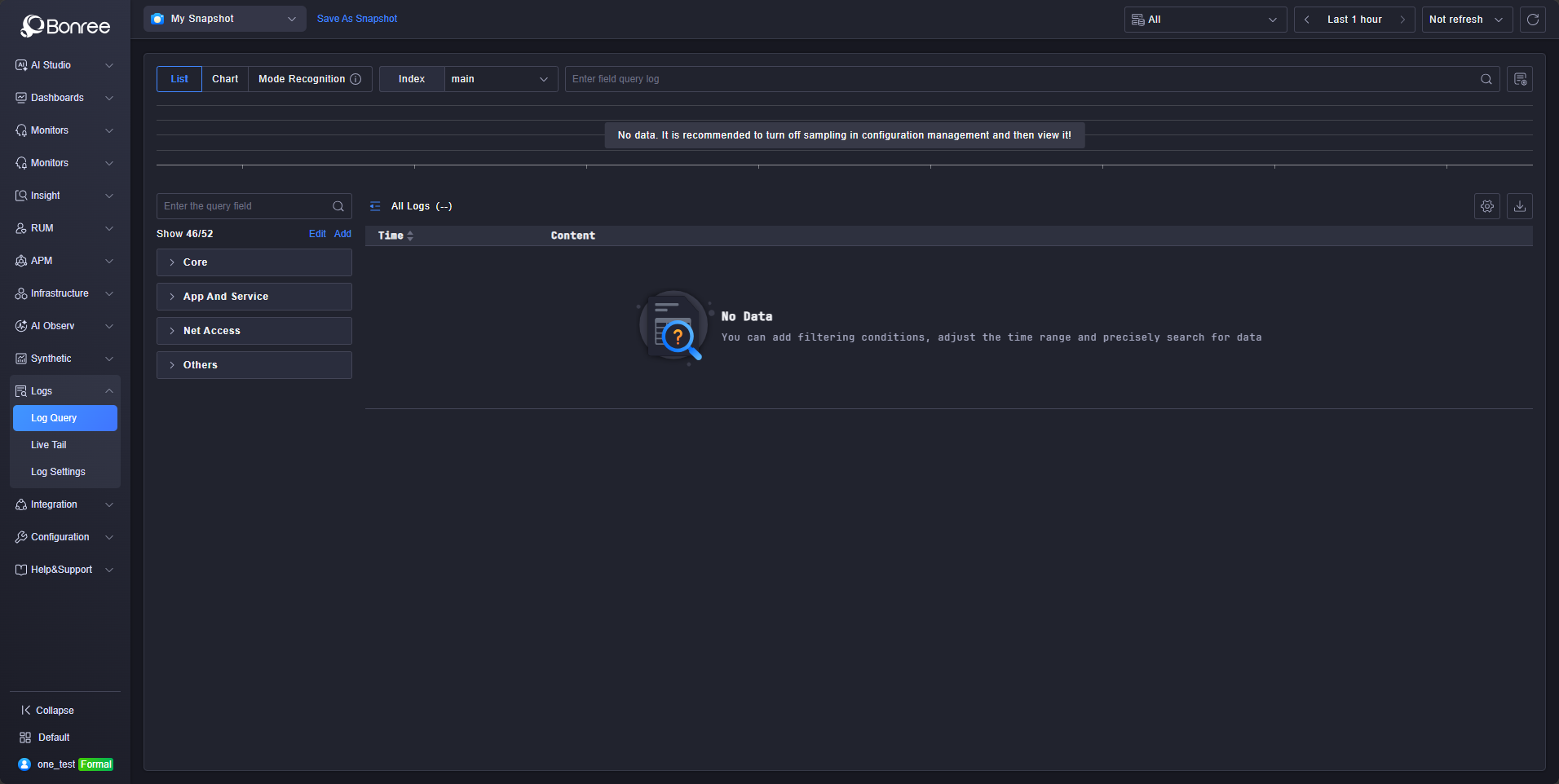
- Added dark theme support for the platform.
- Added support for a new billing type based on daily log ingestion volume.
- The maximum display row count configuration is now persisted, eliminating the need to reconfigure after each modification.
- The query button has been removed; queries are now automatically triggered whenever filter conditions are modified.
- Fixed an issue where custom source path association with process groups did not support container stdout log association with process groups.
- Fixed an issue where the blocklist configuration option was set to process name but was actually applied based on executable name.
【ETL】
- Added dark theme support for the One platform.
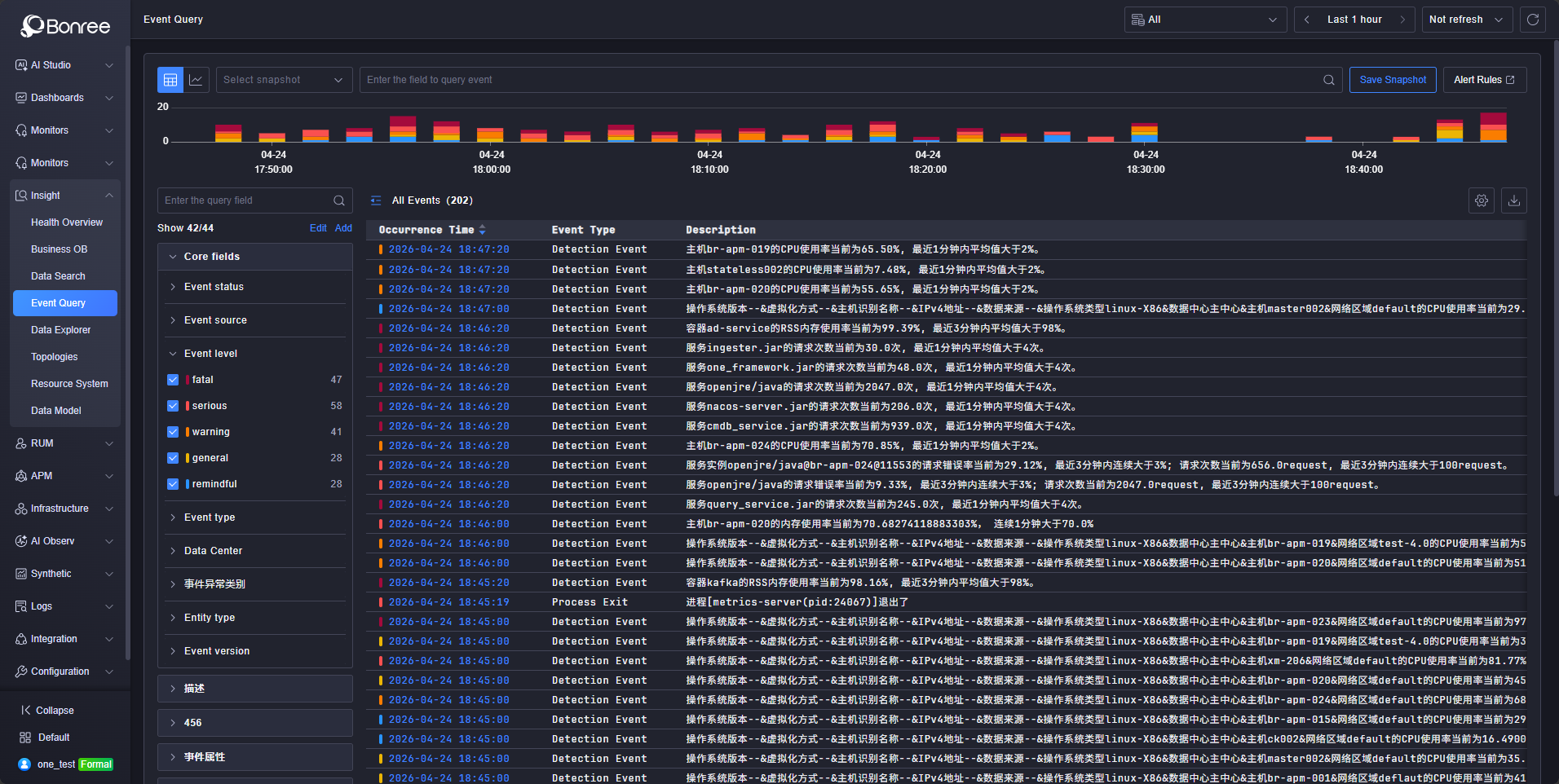
- Adjusted the snapshot layout in the Event Center.
- When an event attribute value is empty, quick filter now automatically applies "is empty" / "is not empty" conditions.
- Event Center interactions have been updated to support the new alerting system, with navigation redirecting to the corresponding rule page.
- Fixed an issue where query interface errors still returned HTTP status code 200.
- Fixed duplicate entries appearing in condition quick filter options.
- Fixed a data center field display issue where the data center condition was shared between event attributes and card-level filters, causing conflicts.
【STM】
- Performance optimization
- Adapted dark theme support
- Adapted disaster recovery solution
- Incremental scripts corrected according to CMDB specifications
【IAM】
- Added new billing item logic
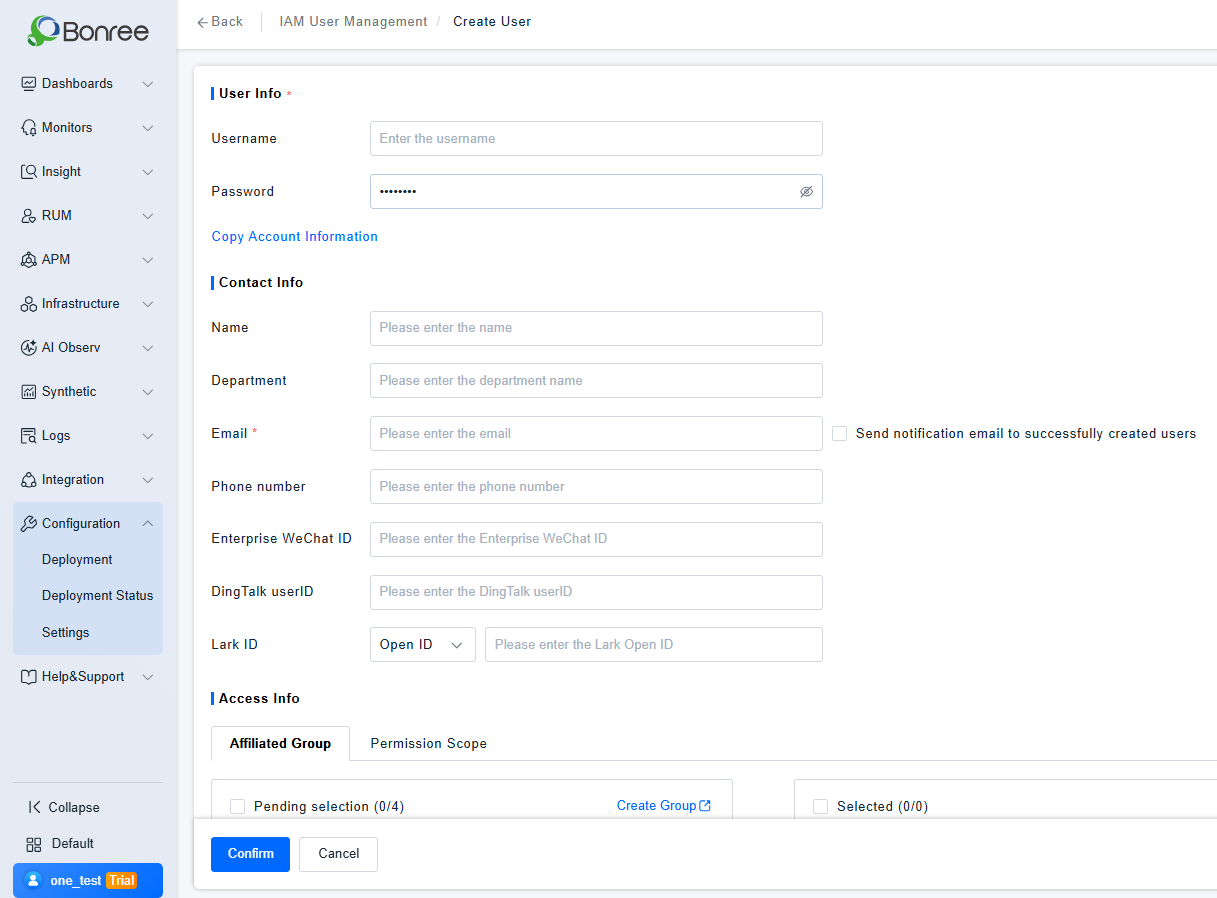
- Recipient capabilities merged into primary account and IAM user management; receiving group capabilities merged into IAM group management; added WeChat Work ID, DingTalk user ID, and Feishu ID to primary account and IAM users.
- License types displayed on ONE platform: Normal, Trial.
- Differentiated access URLs: URLs that display only IAM user login, URLs that display only primary account login, URLs that display only SSO login, and URLs that support login switching between IAM users and primary account.
- Added Alipay Mini Program to client agent management.
- Adapted dark theme support.
- Adapted disaster recovery solution: ONE platform disaster recovery is governed by a single license; at any given time, only one of the active or standby instances can be active.
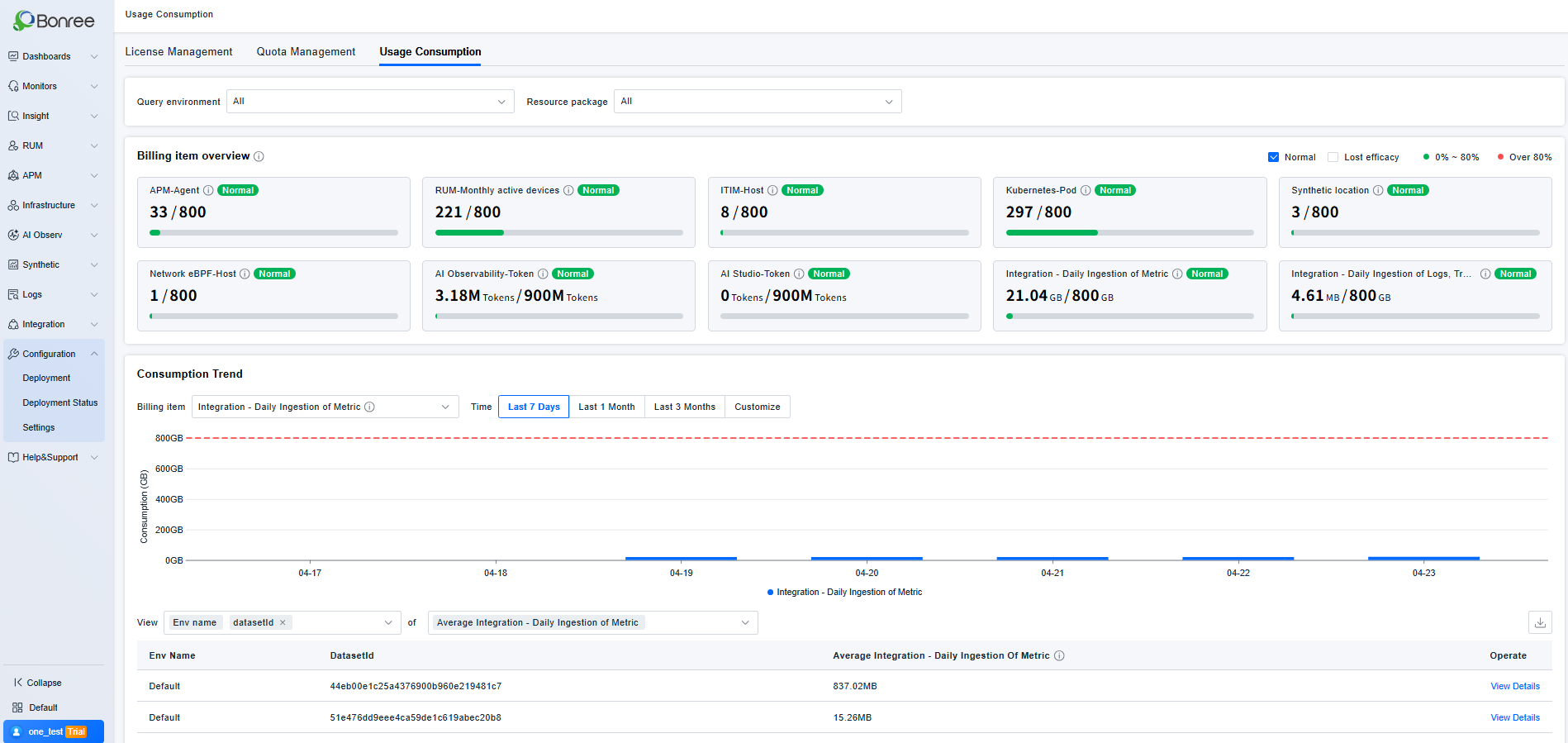
- Billing item units now support dynamic conversion.
- Billing items belonging to the same module are displayed adjacently.
- Optimized the interaction between license status and billing item status.
- Usage consumption: Added identification for normally used licenses.
- Fixed the inconsistency between the billing item overview and the consumption list.
- Fixed the inconsistency in the number of displayed node name entries.
- Corrected the usage consumption copy for the admin account.
【SmartAgent】
【SmartGate】
【SDK】
- HarmonyOS NEXT applications now support uploading multiple map symbol files and resolving stack traces.
- The RUM agents for Android, HarmonyOS NEXT, and iOS have added three new session creation logics: create a new session when an API is called; create a new session when no events occur for a default duration (10 minutes); automatically create a new session when the session duration exceeds the default maximum (8 hours). Nacos provides corresponding configurations: enabling/disabling the logics for "new session on no events for a certain duration" and "new session on exceeding max session duration" (both enabled by default); modifying the default values for the idle timeout and maximum session duration; and specifying specific applications to which these two logics do not apply.
- The auto-instrumentation wizard now supports the English version.
- Android SDK: adapted for Kotlin lambda.
- Android SDK: compatibility adaptation with Ruishu security SDK.
- Web application instrumentation: supports npm import.
【AI Observability】
- Added the AI Observability module for monitoring AI Agent performance, providing multi-dimensional analysis across sessions, traces, metrics, models, token consumption, alerts, and more.
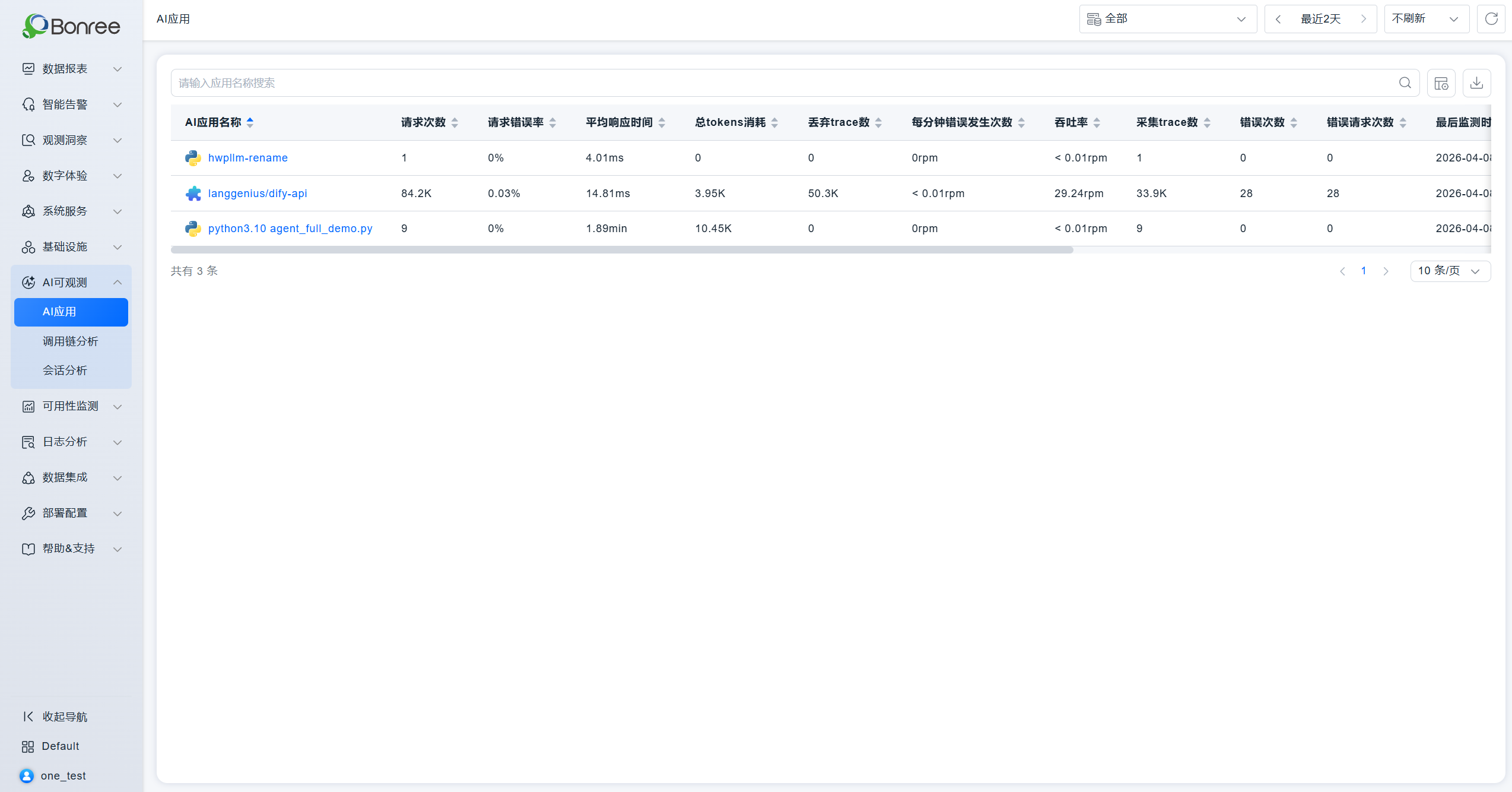
- Added the AI Application management module for multi-dimensional analysis of AI application performance.
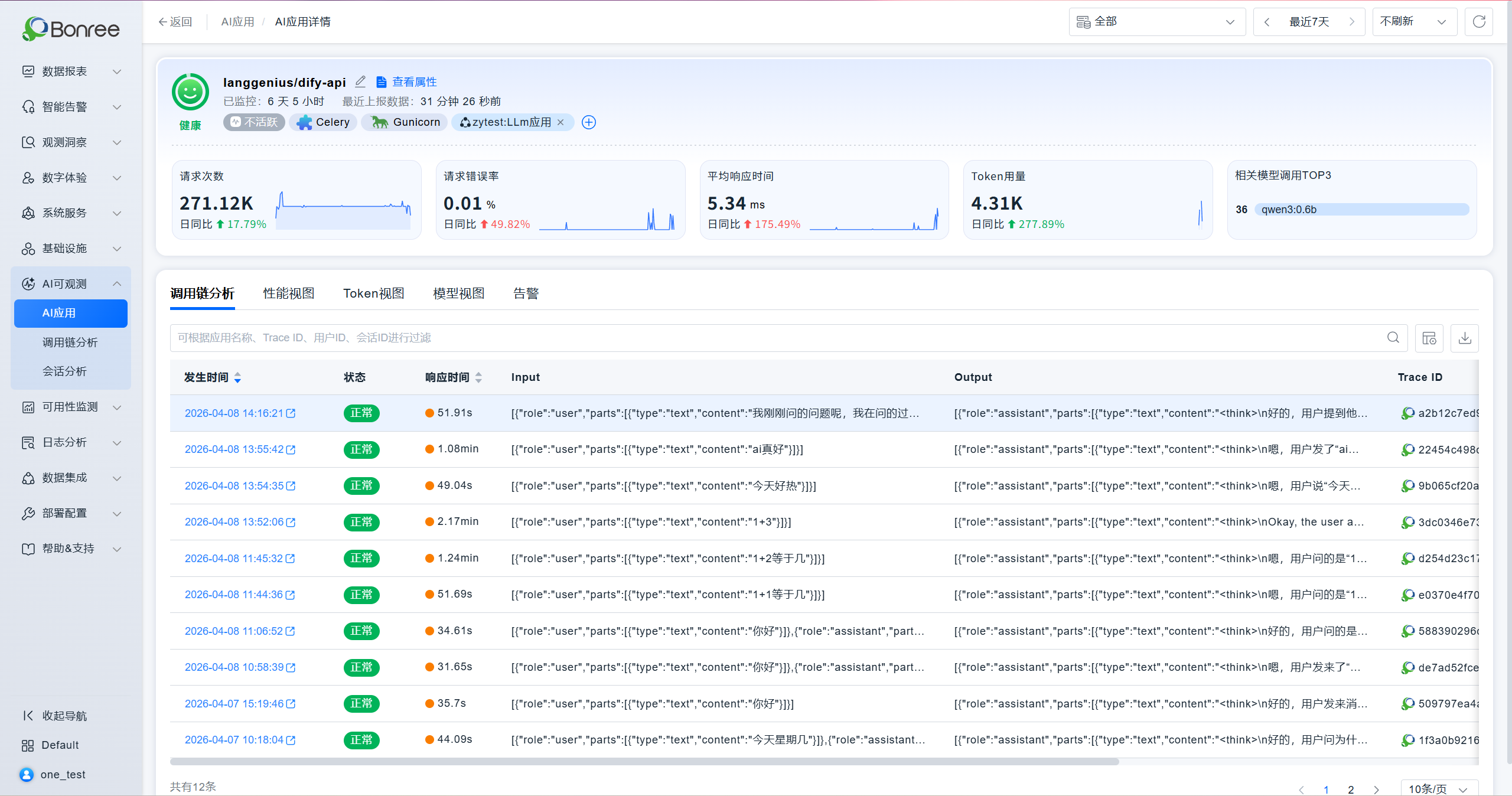
- Added the Trace Analysis module to help users analyze AI performance and token consumption within end-to-end business link scenarios.
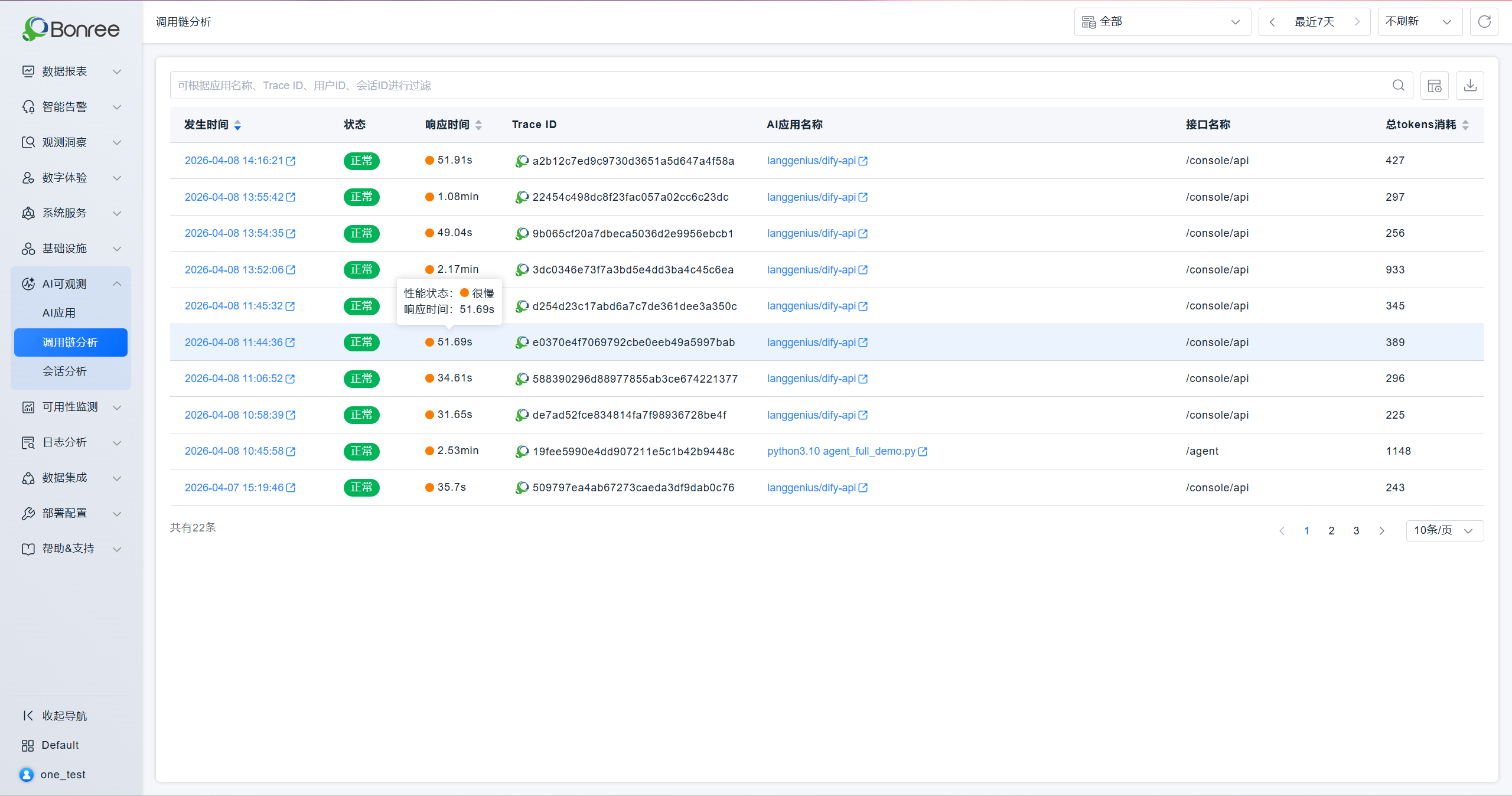
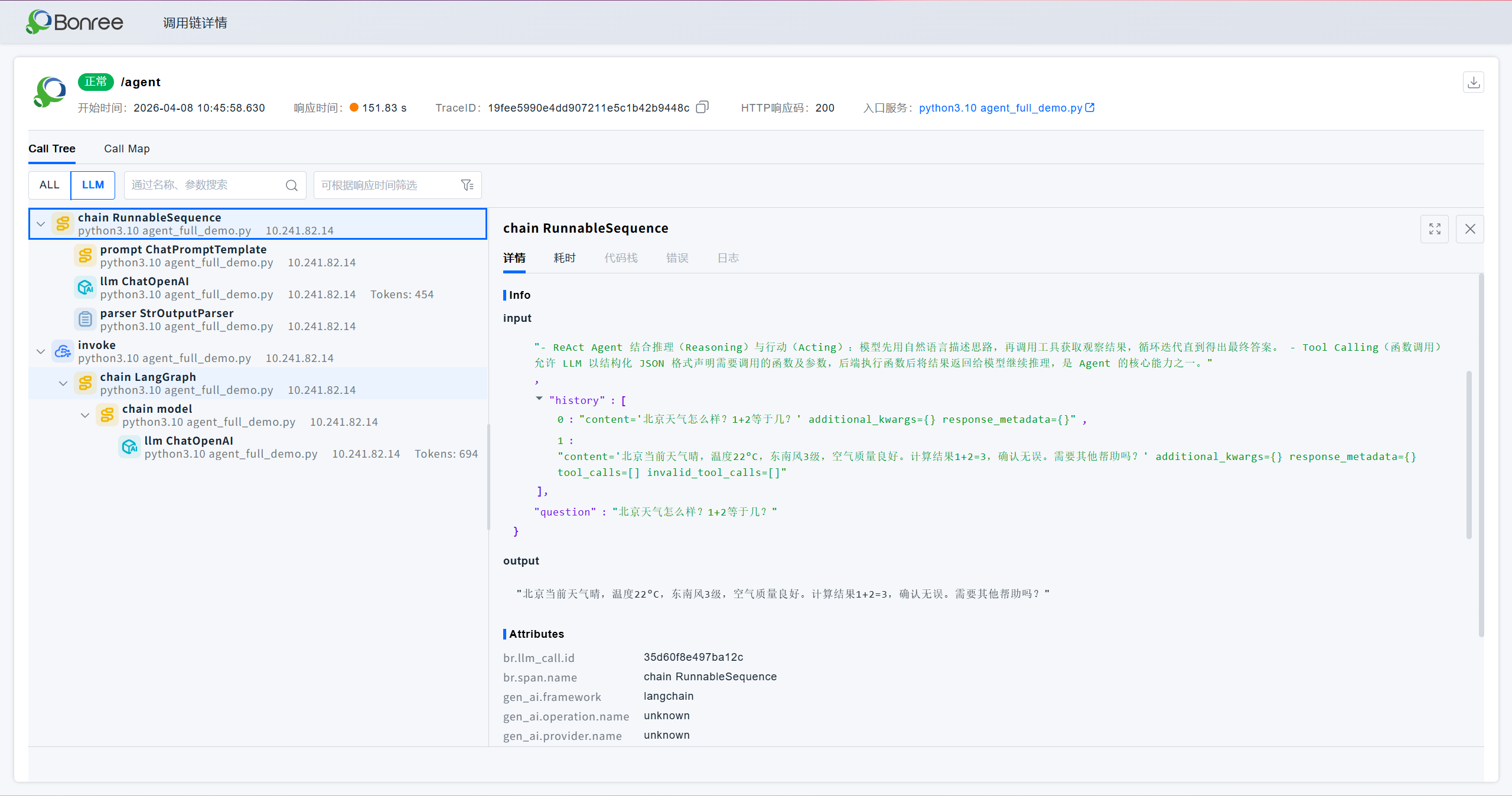
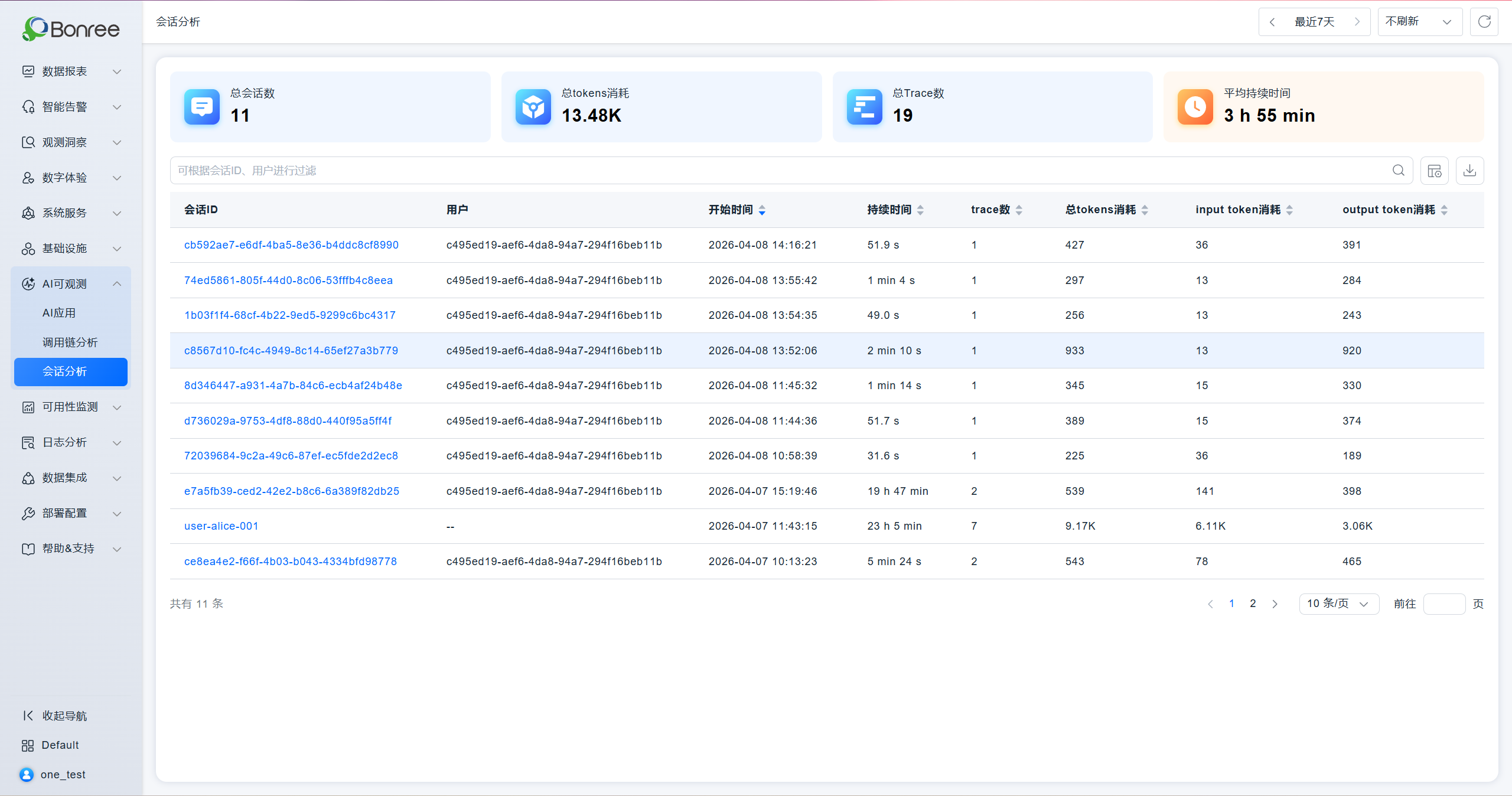
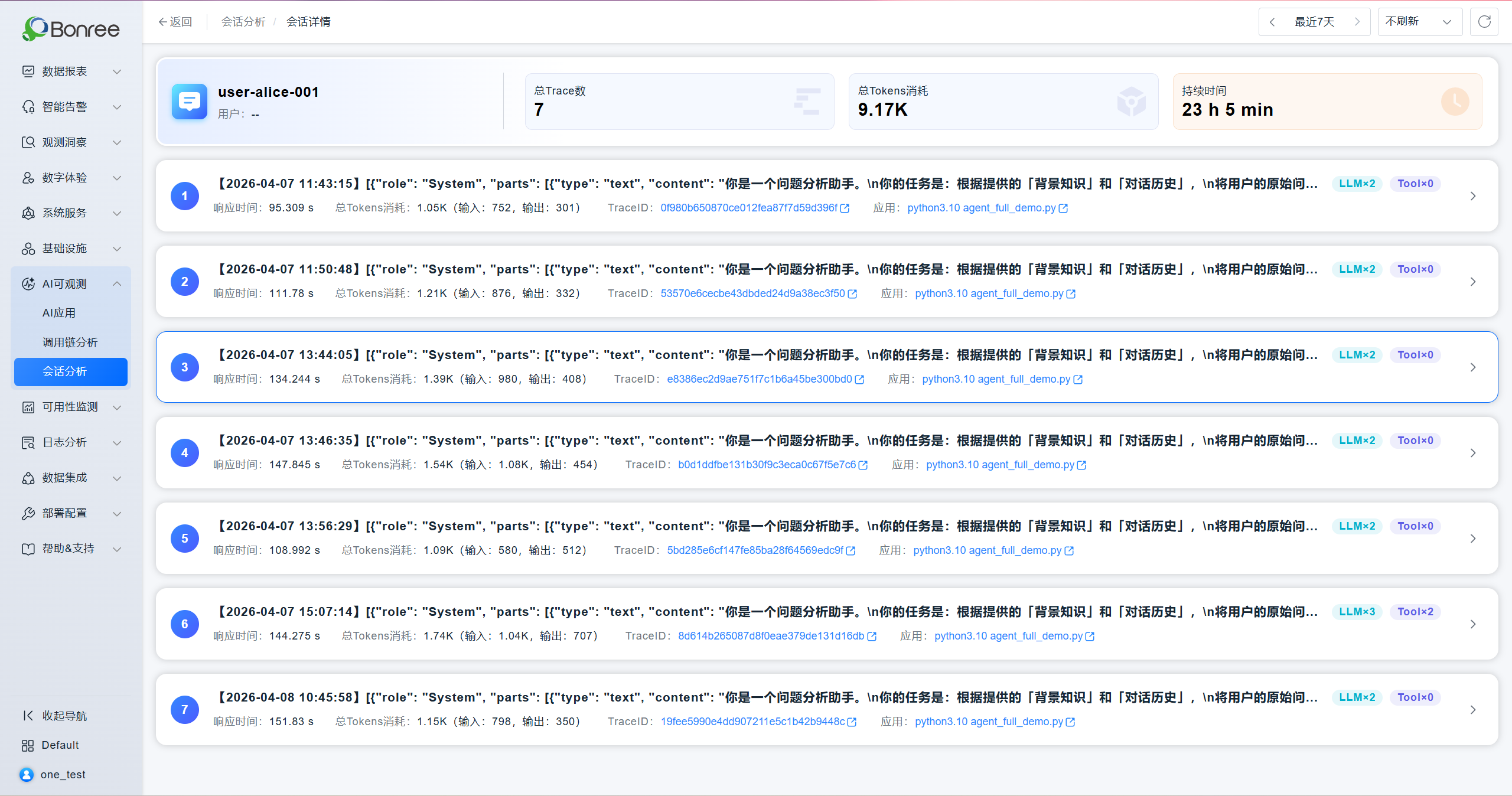
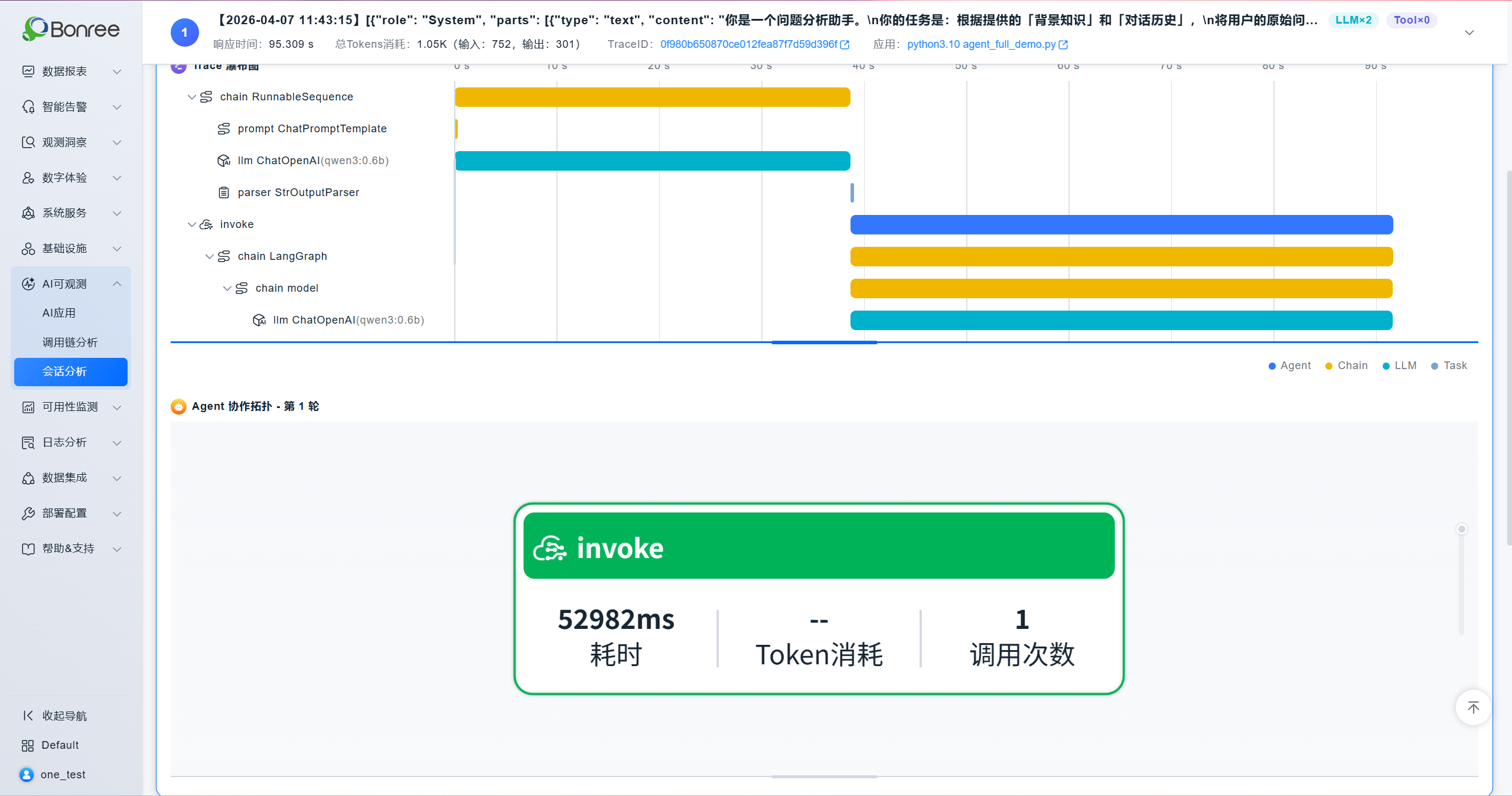
- Added the Session Analysis module, providing detailed session analysis to support in-depth investigation of Agent collaboration workflows, model token consumption, latency, tool calls, and more.
【SmartAgent】
New Features
Runtime Data Isolation Mode (Linux / ARM)
- Added installation parameter
--enable-user-data-isolation(only supports Linux Root installation scenarios). - Application agent runtime data (logs / cache) supports user-isolated storage.
- Upgrade Note: When upgrading from an older version or non-isolation mode to isolation mode, processes with injected agents need to be restarted to ensure normal data collection.
LLM Large Model Monitoring (PythonAgent 8.7.0 / SDKAgent 5.15.0)
- PythonAgent now supports monitoring of mainstream large model frameworks:
- OpenAI 2.26.0, 2.31.0
- LangChain 1.2.10, 1.2.15
- Dify 1.4.3, 1.11.0, 1.11.2
- MCP 1.5.0, 1.27.0
- SDKAgent also supports LLM large model monitoring.
DotnetAgent 6.16.0 — TopShelf Support
-
Added TopShelf scenario support (module version: TopShelf 4.3.0).
-
Supported framework versions:
- Linux / ARM: .NET 5.0 / 6.0 / 7.0 / 8.0
- Windows: NetFramework 4.5.2 / 4.6 / 4.6.1 / 4.7 / 4.8 · .NET 5.0 / 6.0 / 7.0 / 8.0
Windows Platform Observability Enhancement (logsAgent 3.0.0)
-
Supports collecting Windows Event Logs.
-
Supports automatic log file encoding detection (UTF-8, GBK).
-
Integrated Windows version of logsAgent to complete the Windows platform observability chain.
Runtime Data Isolation Mode Support for All Agents
PHPAgent 8.6.0 · PythonAgent 8.7.0 · NginxAgent 3.9.0 · NodejsAgent 7.2.0 · SDKAgent 5.15.0 all now support runtime data isolation mode.
Enhancements
JavaAgent 9.13.0
- Optimized JFR temporary directory default to
java.io.tmpdirto avoid JFR runtime issues caused by directory deletion. - Optimized UEM HTML injection boundary scenarios (skip injection when scripts already exist, control injection based on response headers).
- Adjusted log file permissions to
640and directory permissions to750; log file naming suffix adjusted to_{pid}_{uid}.log. - Fixed known vulnerabilities in open-source component libraries.
- Optimized dubbo 2.7.0~3.3.6 async identification and latency statistics.
- Optimized jedis 4.x latency statistics.
- Optimized HBase collection count statistics.
DotnetAgent 6.16.0
- Adjusted log file permissions from
0666to0640, and directory permissions from0777to0750.
Nginx Agent Automatic Injection Version Blocking Adjustment
- Blocked versions > v1.29.3.
- Blocked versions >= v1.28.1 and < v1.29.0.
Image Update (v1.1.5)
- Prohibited specifying installation directory or runtime directory under
/tmp.
ARM Platform
- Temporarily blocked PythonAgent profiling capability on aarch64 platform (due to defects that may trigger uncaught exceptions causing application exit).
Bug Fixes
JavaAgent 9.13.0 (Linux / ARM / Windows)
| # | Issue Description | Impact Scope |
|---|---|---|
| 1 | Fixed downstream HTTP header invalidation caused by thrift header pollution | JavaAgent 8.0.0~9.12.4 (SmartAgent 6.0.0~9.12.6) |
| 2 | Fixed ejb.MessageDriven compatibility issue | JavaAgent 8.0.0~9.12.4 (SmartAgent 6.0.0~9.12.6) |
| 3 | Fixed compatibility issues with classes generated by Allatori obfuscator | JavaAgent 8.0.0~9.12.4 (SmartAgent 6.0.0~9.12.6) |
SmartAgent (Linux / ARM)
| # | Issue Description | Impact Scope |
|---|---|---|
| 4 | Fixed issue where non-root podman containers could not be injected / monitored | SmartAgent 7.5.0~9.12.* (only supported in non-isolation mode) |
| 5 | Fixed issue where probe could not correctly identify the reason for entering forbidden monitoring state when processes crashed frequently | — |
SmartAgent (Windows)
| # | Issue Description | Impact Scope |
|---|---|---|
| 6 | Fixed Windows Nodejs process group identification error | — |
【SmartGate】
New Features
- Gate Series Forwarding: Supports gate series forwarding of data, enhancing the flexibility of multi-node data links.
- Added Exporter Integration:
- Integrated DB2 (only supports x86_64 systems)
- Integrated MSSQL
Enhancements
- Monitoring Point Plugin (v1.5.0.0.04.07.01):
- Compatible with environment variable multi-key-value pair format scenarios to avoid interception exceptions.
- Added log printing for heartbeat and result reporting response parsing failures to facilitate problem troubleshooting.
ONE 3.11.0.0 2026/03/11
APM
New Features
- Remote interface page adjustment, support quick query of remote interfaces

- Core Link supports selection of third-party entities and technical component entities.

Enhancements
- Added name sorting function in the name column of the instance list
- When the system has no data, the card should display "No Data" instead of "Normal"
- When creating/editing a system, the shared tags dropdown list only shows shared tags under the current resource domain
- Adapt to CMDB instance ID adjustment
- Optimized exception entity statistics logic: cloned entities are no longer counted as multiple exception entities
- Expanded the selection range of starting nodes in vertical architecture to include third-party entities and technical components
- Optimized vertical architecture aggregation logic
Bug Fixes
- 103-4095 [Sinochem Information] OpenAPI: Unauthorized query of interface data under application performance tags
- 103-3675 [China Mobile Internet] After agent deployment, the displayed enable status is false (actual is true)
- [ENN Gas] Implement new pod memory usage and CPU usage metrics for newly registered pods
- System Details - Relationships - Service Metrics Display (Request Error Rate, Response Time, Throughput): Optimize the issue of missing services when there are duplicate service aliases
RUM
New Features
- Android, iOS, Web: SDK supports automatic code embedding wizard

- JS Errors, H5 Page Load: Support extraction of business module dimensions

- Added OpenAPI for network requests and page load records

Enhancements
- Interface performance optimization
- Entity Identification/Business Modules, Network Requests: Maximum creation count changed to nacos configuration, effective for all environments of all master accounts.
- Entity Identification/Business Modules: Default 10, Entity Identification/Network Requests: Default 50, when nacos configuration exceeds 100, still limited to 100. When nacos configuration is below 10, still limited to 10.
- Adapt to CMDB instance ID adjustment
- Health score calculation formula supports input of 6 decimal places

- Added alert level description in the hover information of alert icons in the terminal application and page analysis lists
- Added packaging instruction jump link for symbol files

- Entity Identification/Network Request/Domain Type added prompt: The platform will not display H5 page loads under CDN domains

- Data Collection/Terminal Applications/Collection Limits: Filter out Web from the application dropdown
- Changed "Admin resources" text to "Default resources"
- Fixed issue: When deleting a SourceMap file, other files with the same name were also deleted
ALERT
New Features
- Alert script added shell JQ toolkit
Enhancements
- Fixed abnormal issue with alert rule filtering conditions (attributes & tags)
- Fixed abnormal issue with is_no_data field in no-data state
- Fixed abnormal issue with alert notifications after manually closing alerts
- Fixed issue where no new alert was generated after an event alert was closed
- Adapted to synchronize metric name display in alerts after metric unit modification in the metrics system
Bug Fixes
- 103-3924 [ICBC] Abnormal region filtering condition in alert rules
- 103-4064 [Sheng Yin Consumer Finance] -- The host address in alert notification content displayed the host instance ID
- 103-4067 [Sheng Yin Consumer Finance] -- No notification when manually closing alerts in the alert list
- 103-4010 [CSC Operations] Alert rule - No-data异常 alert for metrics not生效
- 103-4091 [CNBM] After closing third-party接入 alerts, triggering the same alert again did not generate a new alert.
- 130-249 [alert][historical bug] Alert rule - When selecting "contains any" in tag filtering and entering specific tags, the tag data could not be selected
- 103-4294 [ENN Group] After configuring filtering conditions for event alerts, the conditions were not saved
- 103-4282 [Onewo] Alert list displays 100 rows of data without showing
ANALYSIS
New Features
- Dashboard supports carousel playback, allowing custom addition of dashboards and automatic playback at specified frequencies

Enhancements
- Workspace application score adapts to mpass type icons
- datetime type fields participating in filtering grouping can be filtered via time components; date type fields are displayed in date format; all number type fields can have units added through custom display items
- Adapt to cmdb modifying metric types and deleting custom metrics: after modifying metric types, the dashboard will verify if historical configurations can be queried normally; when deleting custom metrics, the dashboard will verify and prompt
- Breadcrumb not displayed when Cube menu is set to other pages
- When configuring card filtering conditions in the dashboard, some field types support "is empty" and "is not empty" operators
- Metric selector supports displaying extended attributes of metrics
Bug Fixes
- 103-4266 [J&T Express] Abnormal sorting logic for heatmap in Dashboard & Cube
- 103-4344 [Hytera] -- Dashboard loading error
- 53-1555 Early warning events - Public cloud infrastructure technical component access status异常 and显示 no data
LOG
Enhancements
- Log query list supports displaying full log text without truncation
- Adapt to CMDB instance ID adaptation
- Blacklist process name changed to exe name
- Custom source path process group retrieval adds container stdout process group
- Log query supports regex search box
ETL
New Features
- Flink resource isolation
- RUM JS Errors, H5 Page Load: Support extraction of custom dimensions, assign identifiers by vendor
- Added task switch button in the ETL background management interface
- Page interaction adjustments, removal of sensitive information containing the word "Bonree"
- When sub-accounts are frozen or deleted, the tasks they created can still be viewed and managed on the platform
Enhancements
- Map type data parsed in pipelines is now stored in JSON format
- Fixed OOM issues caused by excessive data volume when fetching data via JDBC database connections, which could lead to page cards or services crashing. The limit for a single data fetch is now 10,000 records.
CMDB
Enhancements
- Custom metric meta-attributes now support editing, allowing modification of parameters such as metric type, unit, and maximum/minimum values.
- Custom metrics now support deletion. When異常 data exists, redundant data can be manually deleted without the need for scripts to clean the database.
STM
Enhancements
- If all monitoring points of a task are offline, "Execute Now" is grayed out, with hover提示 "All monitoring points bound to this task are offline, operation not possible"
- Adapt to CMDB instance ID adjustment
- English text corrections
IAM
Enhancements
- When IAM users authorize others, they can control whether to authorize only the environment resource domains they have权限 to or all environment resource domains

- Hide the left navigation in the canvas area when embedding Cube
- License for function verification of ONE modules applied via https://lic.bonree.com/trial, validity period adjusted to 7 days
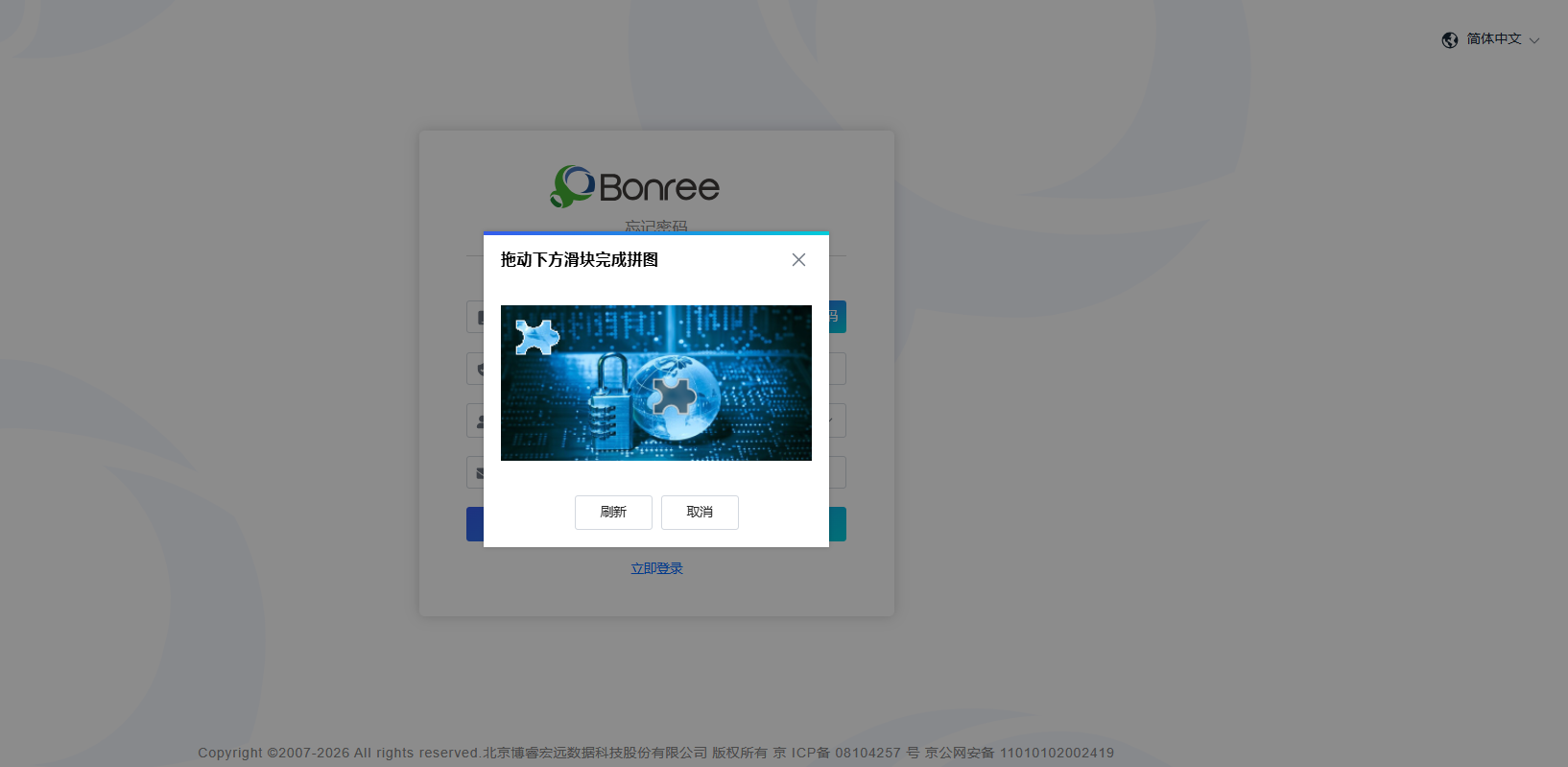
- Forgot password: captcha for获取验证码 changed to drag puzzle
- "Pilot Platform" menu made configurable, checked by default

- When the authorization button is grayed out, hover提示 the reason for graying out

- "Admin resource" text changed to: "Default resource"
- Group notifications: newly added ones displayed at the top
- Agent management route adjustment
- English text corrections
Bug Fixes
- 103-4434 [Shede] After deploying the platform and creating a master account, only the help support interface was found. The platform address uses domain mapping, no waf interception, need help troubleshooting.
SmartAgent
New Features
-
Support process collection whitelist and parent-child process metric splitting strategy:
Whitelist processes unconditionally collect metrics
Parent-child processes of whitelist processes collect metrics independently
Non-whitelist processes: child process metrics merged into parent process
Enhancements
-
JavaAgent 9.12.0 version changes:
Optimize consistency of error request and call chain error标识 in asynchronous thread scenarios;
Optimize JDK 17 adaptation, avoid Class.getGenericSignature0() exception.
-
DotnetAgent6.15.3 version changes:
Adapt to nms-ActiveMQ/AMQP interfaces (supported versions: Apache.NMS.ActiveMQ-2.2.0, .NET Core 2.0/2.1/2.2/3.0/3.1, .NET5.0/6.0/7.0/8.0; Apache.NMS.AMQP-2.4.0, .NET Core2.0/2.1/2.2/3.0/3.1, .NET5.0/6.0/7.0/8.0);
Fix GAC loading failure during installation caused by introducing third-party WebApi library.
-
Image updated to 1.1.4: --set-conf and --reset-conf configure YAML array fields with each element on a separate line;
-
Installation parameter optimization: --set-conf and --reset-conf configure YAML array fields with each element on a separate line;
-
dockerhelper infinite loop detection optimization: raise default检查阈值 to reduce false positive risk;
-
Optimize dockerhelper: check if mount target path is合法, skip if not; add reentrant injection check.
ONE 3.10.0.0 —— 2026/01/30
【APM】
New Features
- Batch Collection Rule Import/Export: The data collection module now supports batch import and export of custom collection rules for containers and processes via Excel templates, significantly improving rule configuration and management efficiency.


- Serverless Probe Automatic Dump: Supports automatic triggering of dumps for Serverless probes and saving the files to the local server.

- Host Probe Manual Upgrade: Supports immediate manual upgrade of single or multiple host probes to specified versions, making upgrade control more flexible.

Optimizations
- SQL Analysis Enhancement: In the database module, SQL execution analysis now supports more database types and provides user-friendly prompts for cases where execution plans are often empty.

- Menu Structure Streamlining: The Profiling function has been integrated into the 【Diagnostic Tools】 menu, simplifying navigation.

- Permission Tag Adaptation: The system predefines the
system_nametag. APM will automatically tag entities according to tag rules when passing through entities.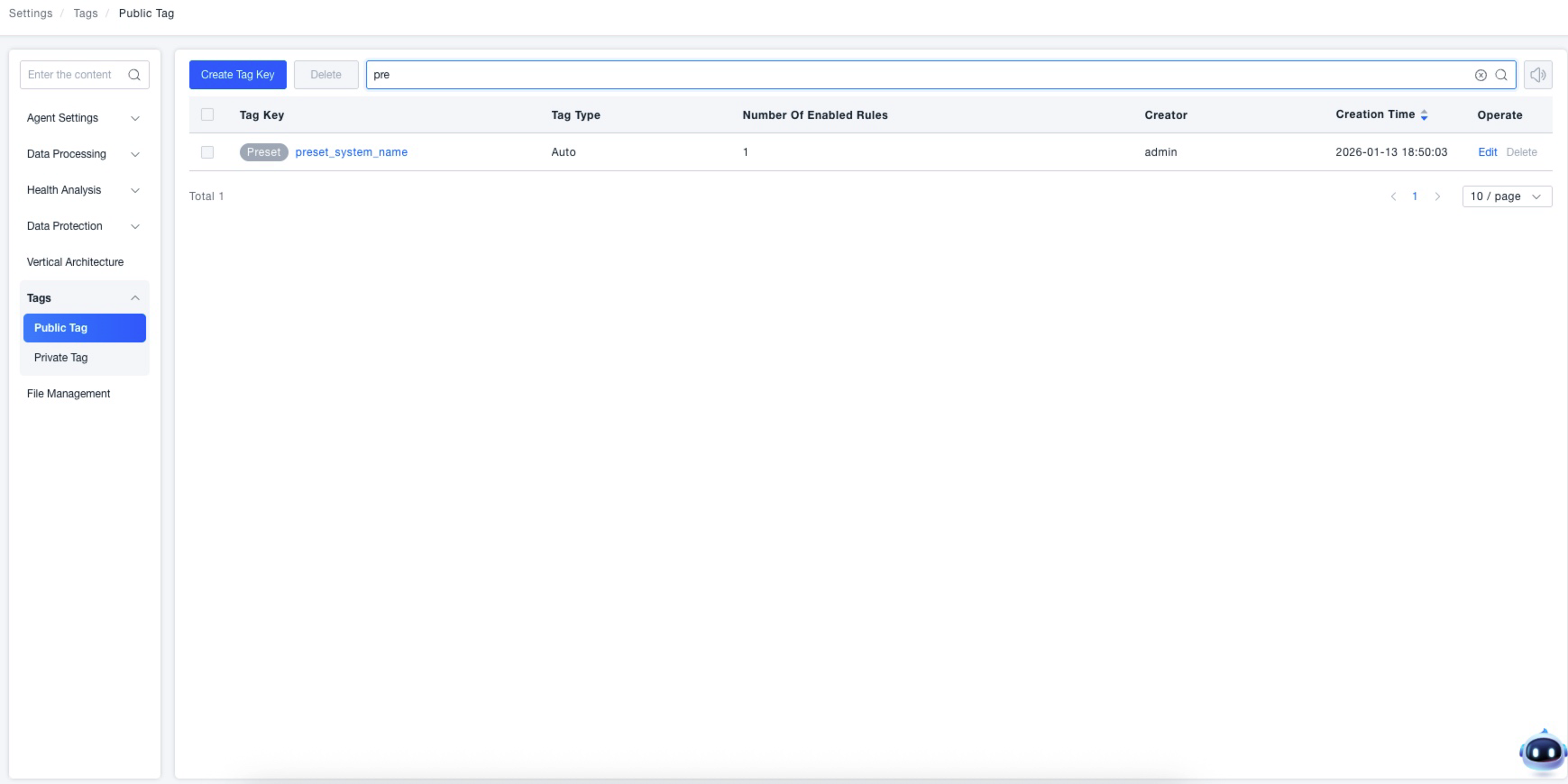
- K8S Resource Information Enhancement: Resource detail pages for Services, StatefulSets, etc., now display Kubernetes labels and annotation information.

- Disk Monitoring View Optimization: Disk monitoring metrics on the host detail page are now grouped by "Disk Partition" dimension by default for a more intuitive view. In CMDB, disk monitoring metrics have been bound to the partition model.

- Network Interface Monitoring View Optimization: Network interface monitoring metrics on the host detail page are now grouped by "Network Interface" dimension by default for clearer presentation.

- Global Topology Experience Upgrade: System filtering is optimized to cascading select boxes, and cross-system service call relationships are now displayed. Exporting supports selecting whether to include background colors.