Data Perspectives
The ONE platform is a data-driven integrated operations platform. The data used for analysis on the platform can originate from any scenario, such as: probe collection, ETL integration, page creation, page import (Excel, JSON, etc.). Due to differences in how this data is generated and processed, its credibility and user comprehension also vary. Therefore, the concept of Data Perspectives is introduced to manage this data, ensuring the data used for analysis on the ONE platform is trustworthy and understandable.
Concept Synchronization
Data Perspective: The ONE platform categorizes entity and relationship data integrated into the CMDB into different data sets based on their source, according to the user's level of trust and understanding of the data. These data sets are the Data Perspectives, representing the data obtained by users from different viewpoints.
The essence of data perspectives lies in differing user interpretations of data. Because different users may understand these differences differently, it could lead to unpredictable definitions of data perspectives. To avoid overcomplicating the feature and affecting user understanding and usage, the current version solidifies data perspectives into two types: Expected Planning Data and Real-time Monitoring Data.
- Expected Planning Perspective: Data in this perspective describes the user's expectations for resources, architecture, and operations within the system. This data is primarily constructed by the user themselves. Within the ONE platform, sources for this data may include: page creation, file imports, customer CMDB synchronization, etc.
- Real-time Monitoring Perspective: Data in this perspective describes the actual operational status of the system. This data is obtained by deploying probes to collect system runtime status. Within the ONE platform, sources for this data may include: probe collection, integration with monitoring systems like Zabbix, log parsing, etc.
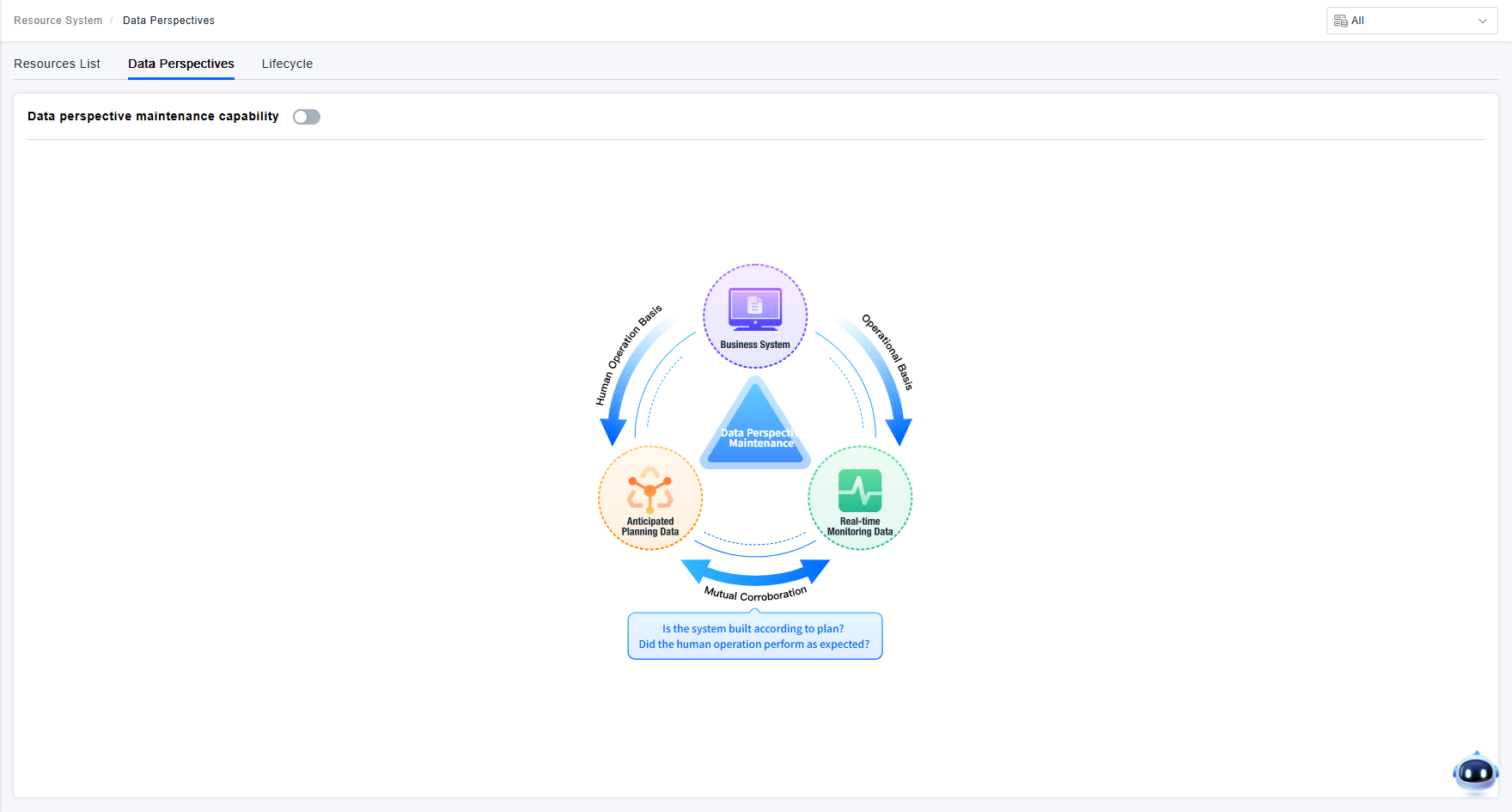
Data Perspectives Maintenance
Enabling/Disabling Data Perspectives Maintenance
Data Perspectives Maintenance is an advanced feature of entity management. Considering that some customers might only use real-time monitoring data on the ONE platform, an "Enable/Disable" switch is added to the "Data Perspectives Maintenance" page. Users can decide whether to enable this function based on their data management needs.
Enabling Data Perspectives Maintenance: Users can specify resources to enable the Data Perspectives Maintenance function. Once enabled, the platform will manage data from two perspectives, "Expected Planning" and "Real-time Monitoring", and will proactively discover and notify about discrepancy events between these perspectives.
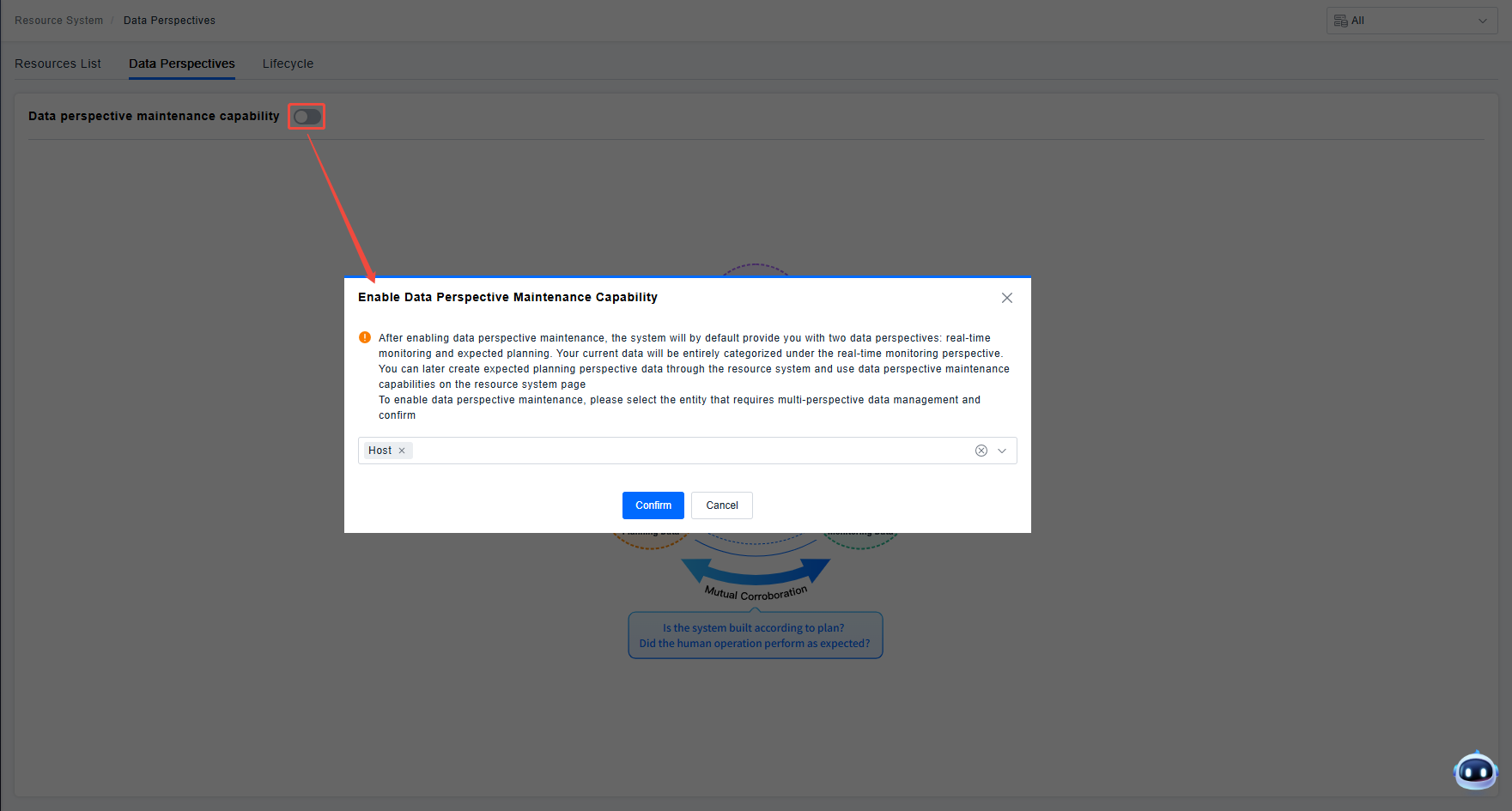
Data handling during enabling: Previously, user data that was not distinguished by perspective will all be considered as Real-time Monitoring Data after enabling this capability. Expected Planning Perspective data awaits user input and supplementation.
Disabling Data Perspectives Maintenance: After the user disables the Data Perspectives Maintenance capability, the platform will no longer manage the registered entity instance and relationship instance data according to data perspectives, and will no longer provide features related to displaying data perspective differences.
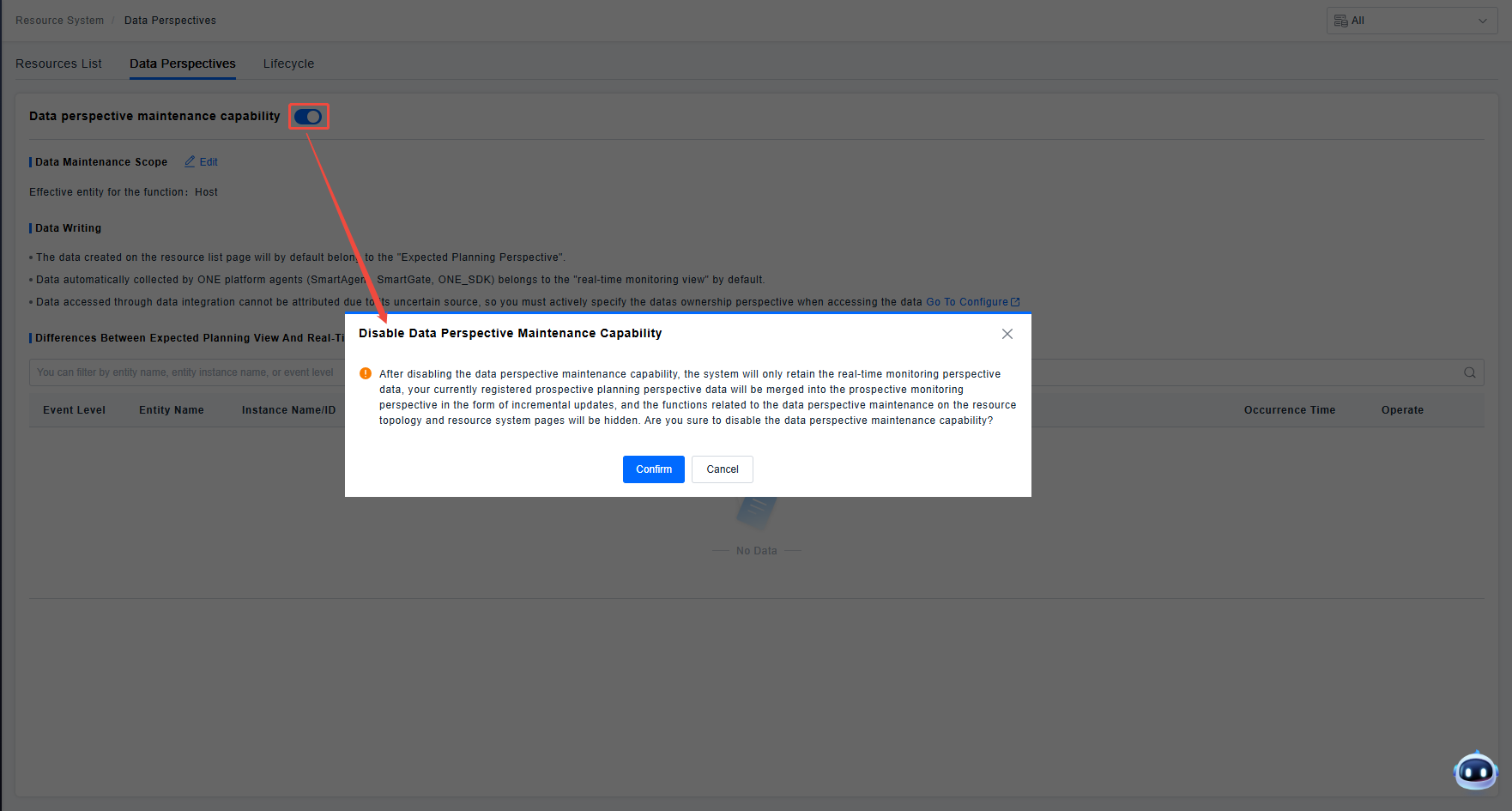
Data handling during disabling: The Expected Planning Perspective data will be used to update the Real-time Monitoring Perspective data based on an "incremental update strategy prioritizing the Real-time Monitoring Perspective data". After the update is complete, the "Expected Planning Perspective" data will be deleted.
Defining the Data Perspective for Data Sources
The sources of entity and relationship data in the ONE platform can be broadly categorized into the following three types:
- Created through platform functions (page creation or using the page's import function for data import);
- Automatically collected by ONE platform probes (APM-SmartAgent, RUM-ONE_SDK);
- Integrated into the platform through data integration capabilities (Zabbix, Prometheus, external CMDB, etc.).
According to the definitions of the "Expected Planning" and "Real-time Monitoring" perspectives, the above three sources are defined as follows:
- Data created by users through platform functions defaults to belonging to the "Expected Planning Perspective".
- Data automatically collected by users through ONE platform probes defaults to belonging to the "Real-time Monitoring Perspective".
- Data integrated by users through data integration requires the user to actively define its belonging perspective during data onboarding, as its actual source cannot be definitively determined. (Note: This capability is currently not supported by ETL in this version. ETL data defaults to the "Real-time Monitoring Perspective". After subsequent ETL function adjustments, users will be able to define the data perspective to which the data should belong based on practical situations.)
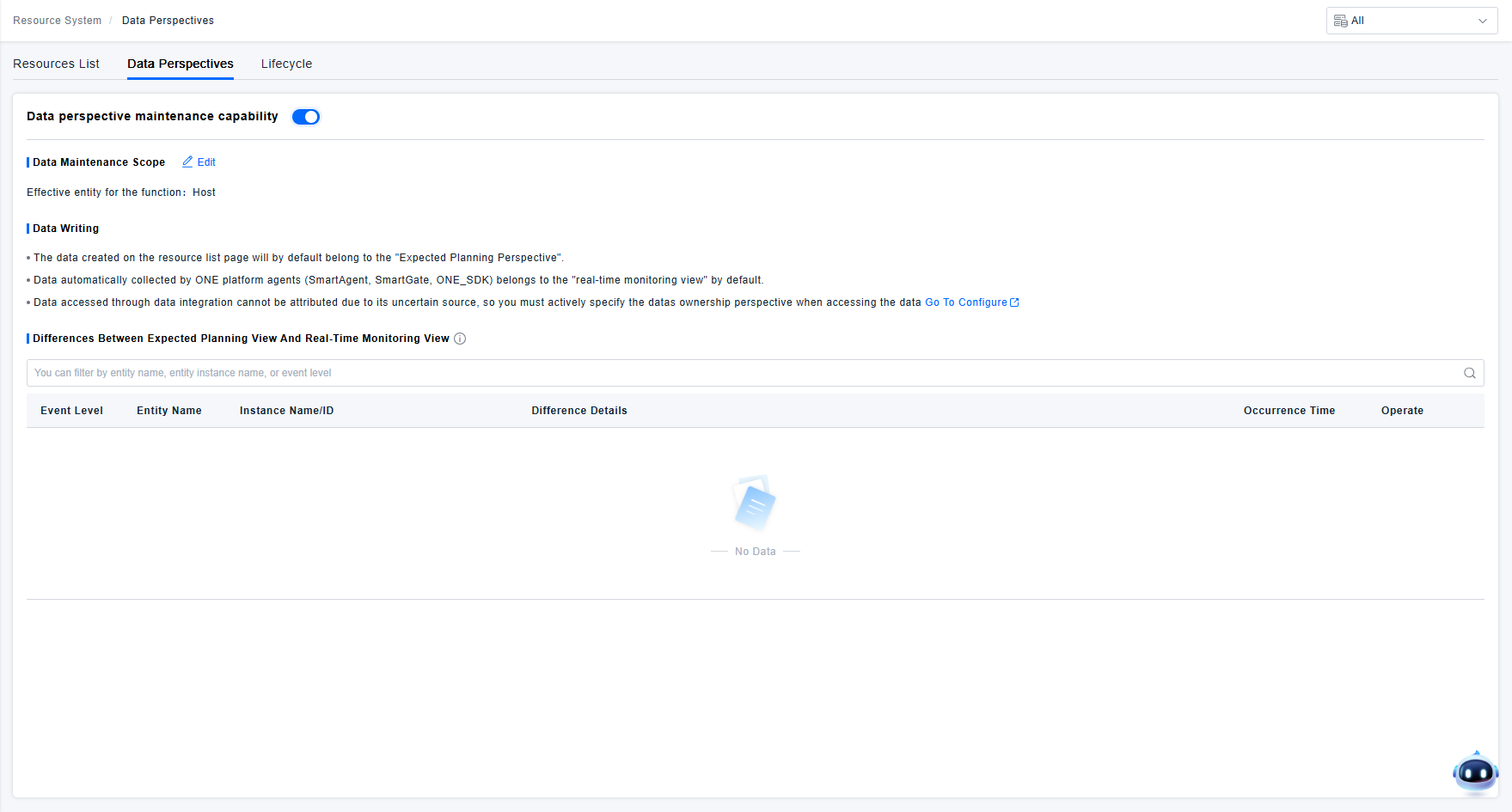
Discovery and Display of Data Discrepancies Between Perspectives
According to the content definition of data perspectives, discrepancies between perspectives mainly include:
- Presence or absence of instances, e.g., hosts that have monitoring data reported but do not exist in the system planning.
- Consistency of instance attributes, e.g., the management IP collected for a host is inconsistent with the planned assigned IP.
After the user enables the Data Perspectives Maintenance function, the platform will automatically discover the aforementioned two types of discrepancies between the "Expected Planning Perspective" and the "Real-time Monitoring Perspective" using predefined algorithms. A list of discrepancy events will be displayed on the Data Perspectives Maintenance page. Users can review the details of the discrepancies to determine if they are caused by underlying system issues. If system issues exist, they can be repaired promptly to avoid broader impacts.

In addition to the discrepancy event list mentioned above, the resource list for which the user has enabled the Data Perspectives Maintenance function will also reflect data discrepancies between perspectives. Users can click to quickly filter instance data under each perspective or instance data with discrepancies in the list.
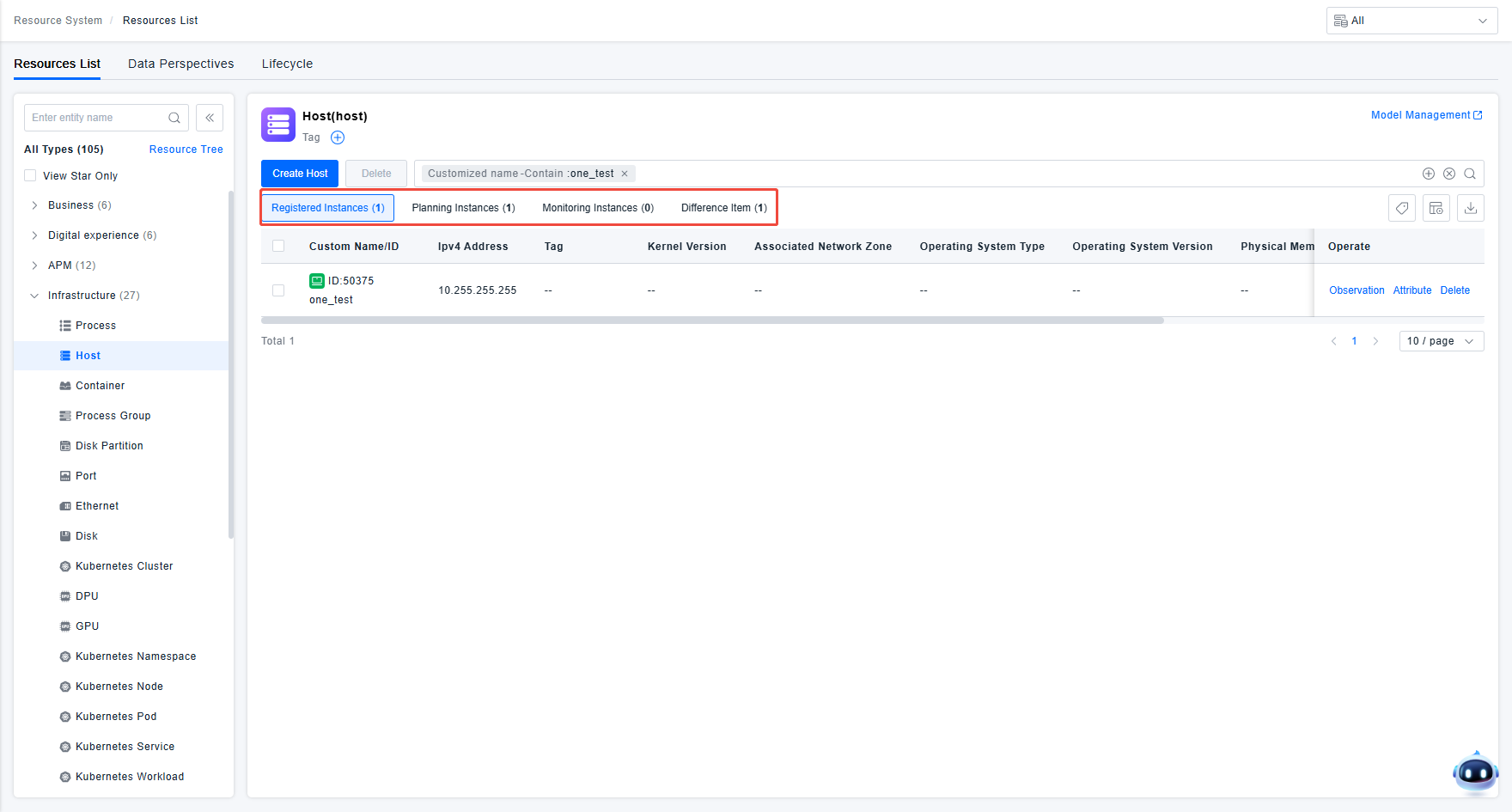
Adjusting Data Discrepancies Between Perspectives
When discrepancies arise between Expected Planning perspective data and Real-time Monitoring perspective data, users need to perform manual maintenance to align the data from both perspectives. This manual intervention can be divided into two scenarios:
- The Real-time Monitoring data is incorrect. The user modifies resource configurations, etc., to align the monitoring data with expectations. The probe will actively collect the modified configurations and update the old data.
- The Expected Planning data is incorrect due to human error (e.g., typos). The user directly modifies the Expected Planning data content to align it with the monitoring data.
To facilitate quick management of data discrepancies, the discrepancies list provides three operations: Change Traceability, Sync Discrepancy, and Ignore Discrepancy.
- Change Traceability: View the change status and history of instance attributes to understand when and from which source the discrepancy originated.
- Ignore Discrepancy: Temporarily suppress the discovery and display of this discrepant data.
- Sync Discrepancy: When the user confirms that the Real-time Monitoring data is completely accurate, they can use the Sync Discrepancy function to modify the Expected Perspective data to be completely consistent with the Real-time Monitoring Perspective data. (The Sync Discrepancy function is only available for use when there are attribute conflicts.)