Process Monitoring Configuration
Configure APM agent auto-injection strategies for processes to enable service identification and deep monitoring at the call chain level. Supports manual creation, batch import, and export. Custom monitoring rules have higher priority than preset monitoring rules.
Core Capabilities
- Custom Monitoring Rules: Flexibly configure whitelist and blacklist rules for monitoring or non-monitoring based on process attributes (command line args, EXE name, container ID, Kubernetes attributes, etc.) to precisely control the collection scope.
- Preset Monitoring Rules: System-built rules help you automatically exclude unnecessary processes (such as filebeat, heartbeat and other basic components) to reduce interference from invalid collection on key process lookup.
- Default Monitoring Rules: A fallback strategy that monitors all processes by default, which can be disabled as needed.
- Batch Import / Export: Batch import rules through standard Excel templates; existing rules support one-click export to solve repeated configuration problems for a large number of rules.
Use Cases
Scenario 1: Shield infrastructure process monitoring. A large number of collection components such as filebeat and metricbeat run in the production environment and do not need to be included in business monitoring. Just enable the corresponding preset rules to exclude them with one click.
Scenario 2: Batch initialize process rules. When connecting to a new environment, it is necessary to configure monitoring whitelists for dozens of business processes. Download the template, fill it in, and directly import it to avoid manual creation one by one.
Scenario 3: Multi-environment rule synchronization. Export existing process collection rules from the production environment as Excel and quickly reuse them in the test environment or new cluster to maintain rule consistency.
Getting Started
Navigate to Deployment Configuration → Rule Configuration → Data Collection → Process to view the global configuration page for process collection rules.
Custom Monitoring Rules
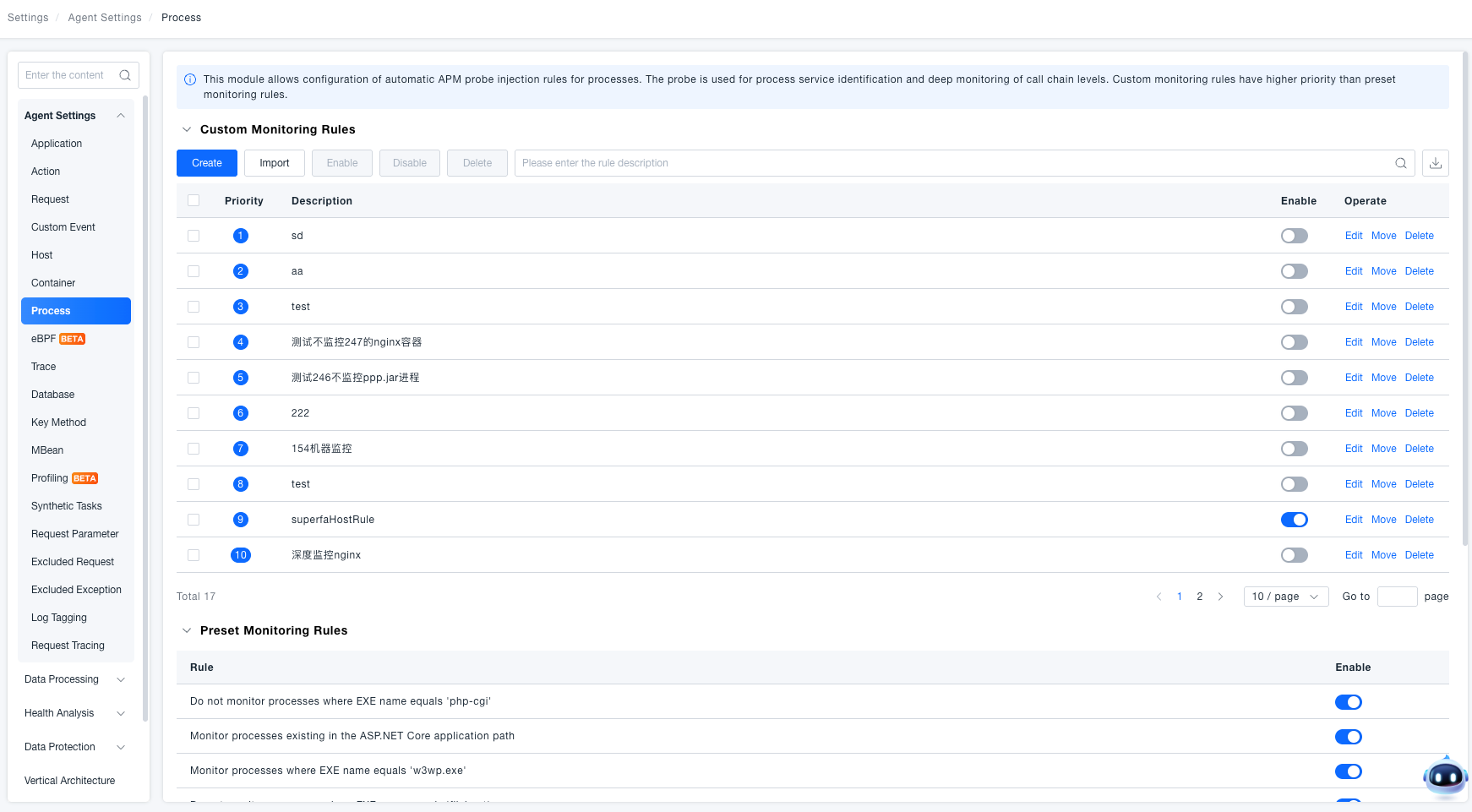
The rule list displays the priority and description of all configured rules, supporting search by description keywords. The list is sorted by priority by default (smaller numbers indicate higher priority).
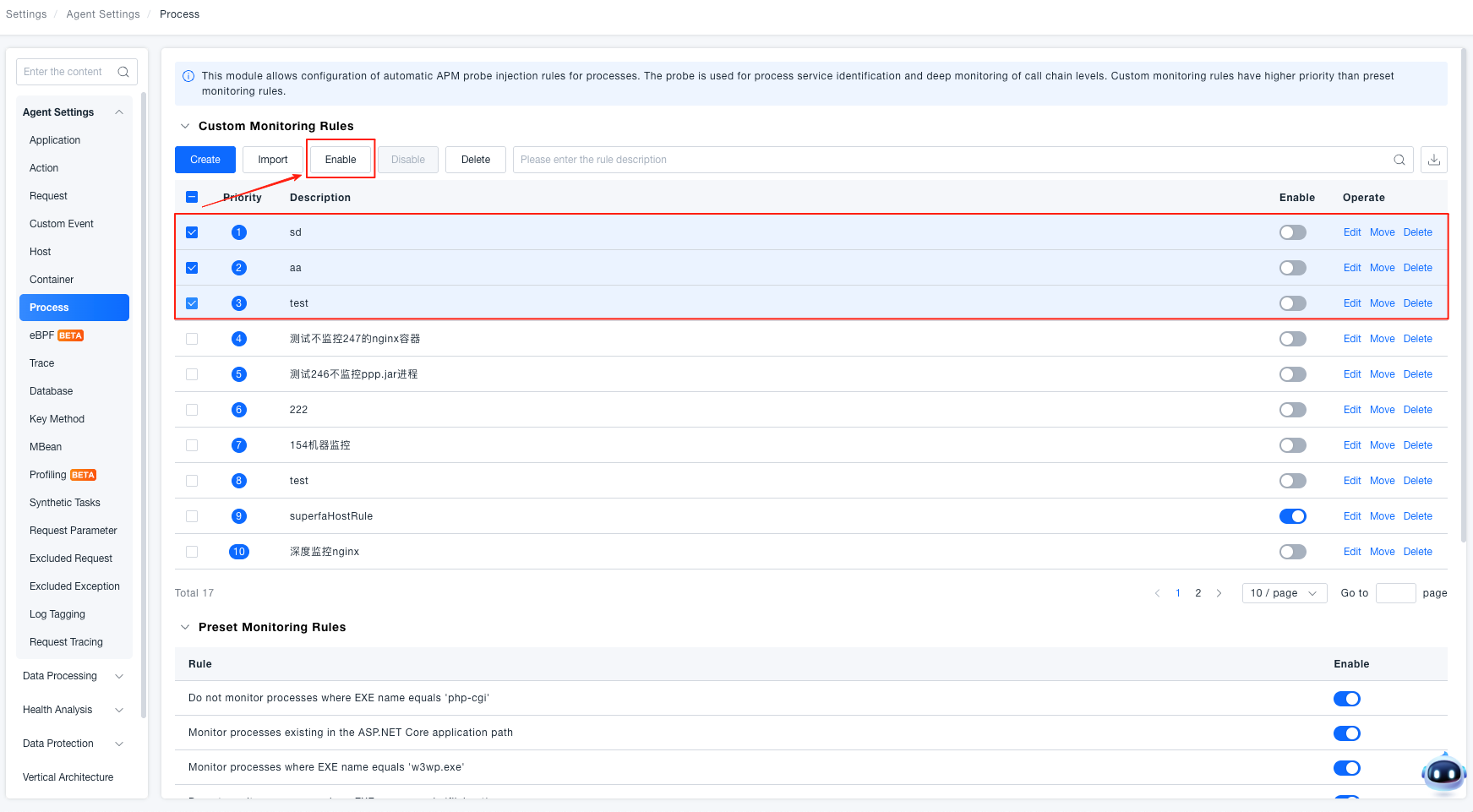
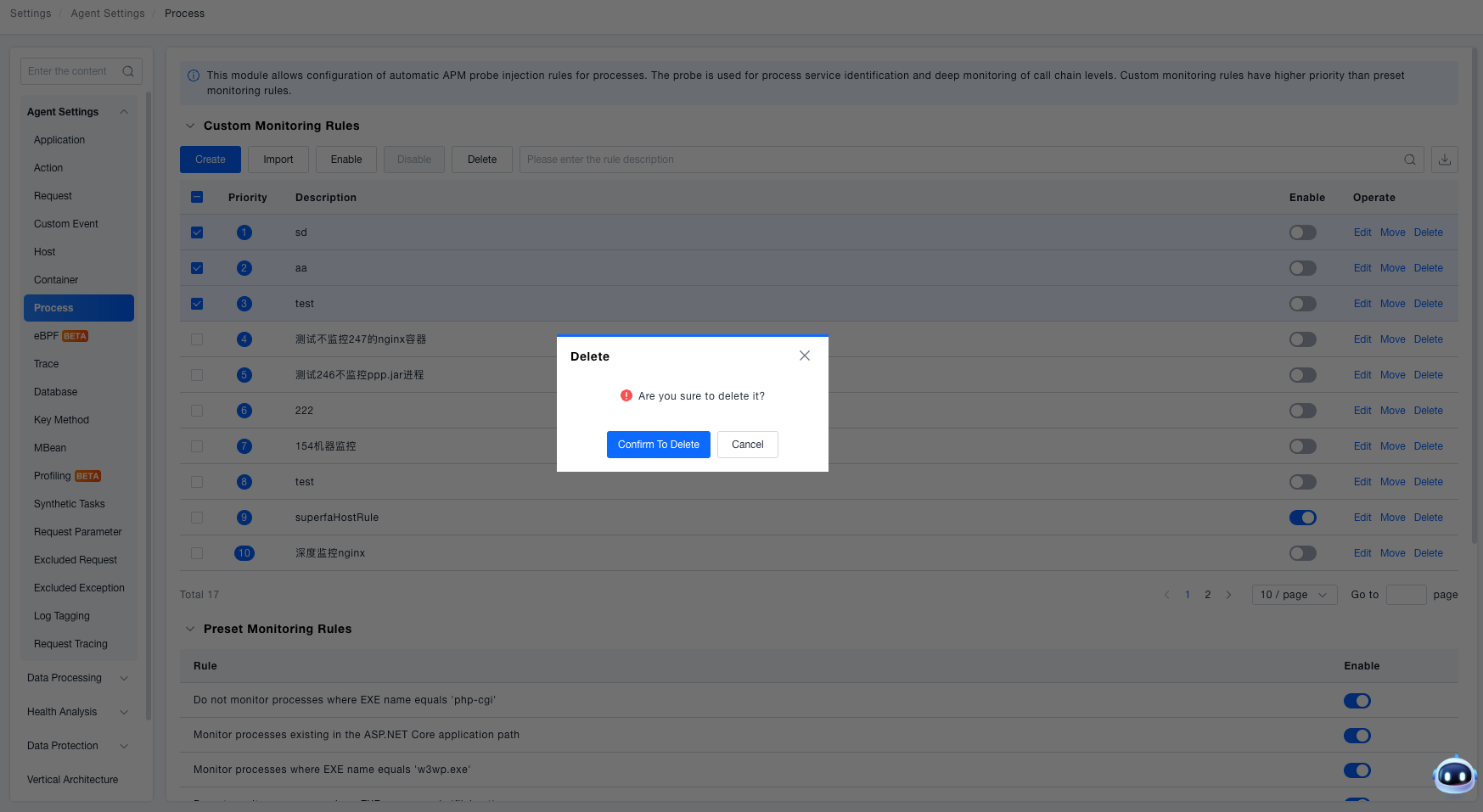
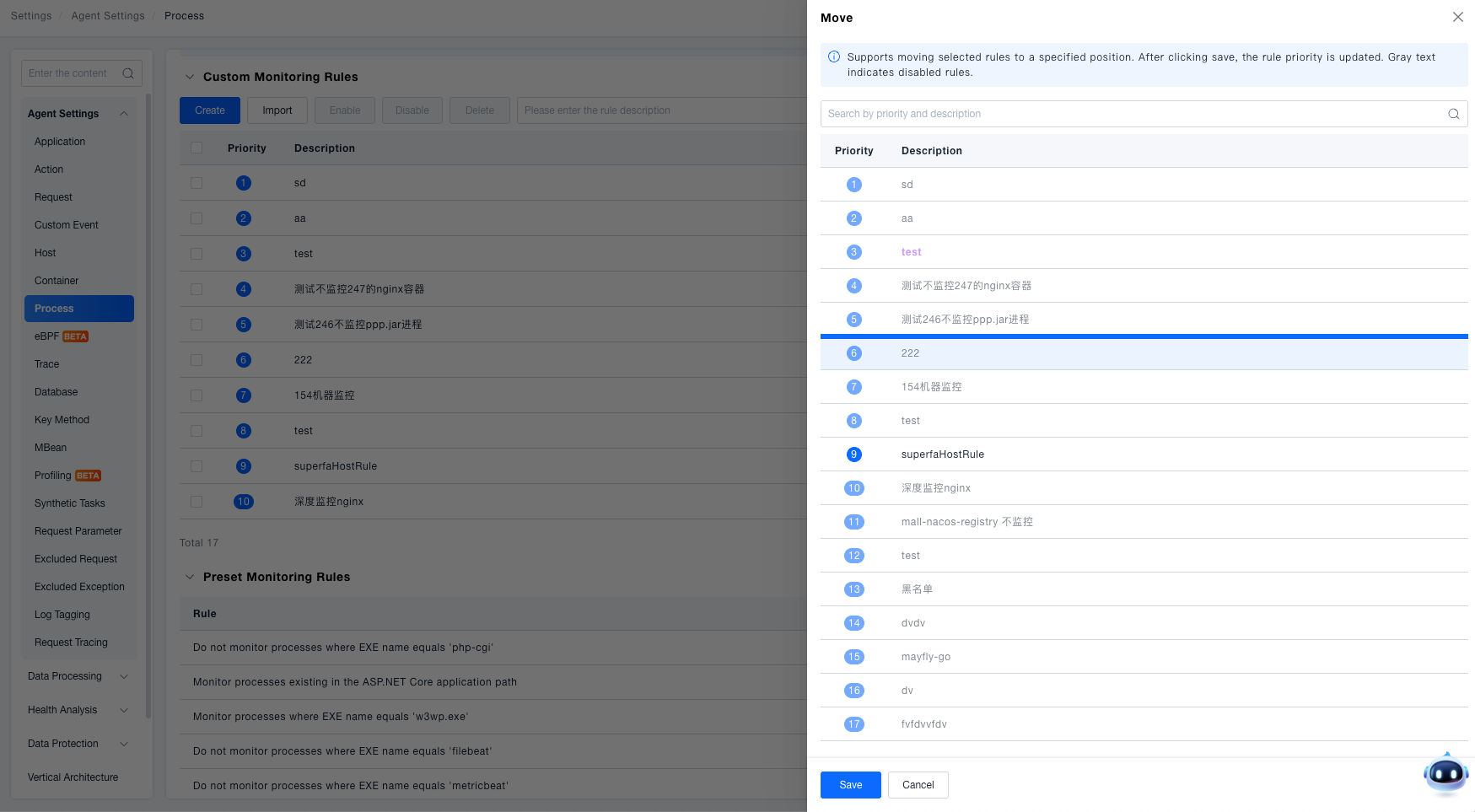
Batch Operations: After selecting multiple rules, you can perform batch enable, disable, and delete operations; you can manually adjust rule priority order through [Move].
Create Rule
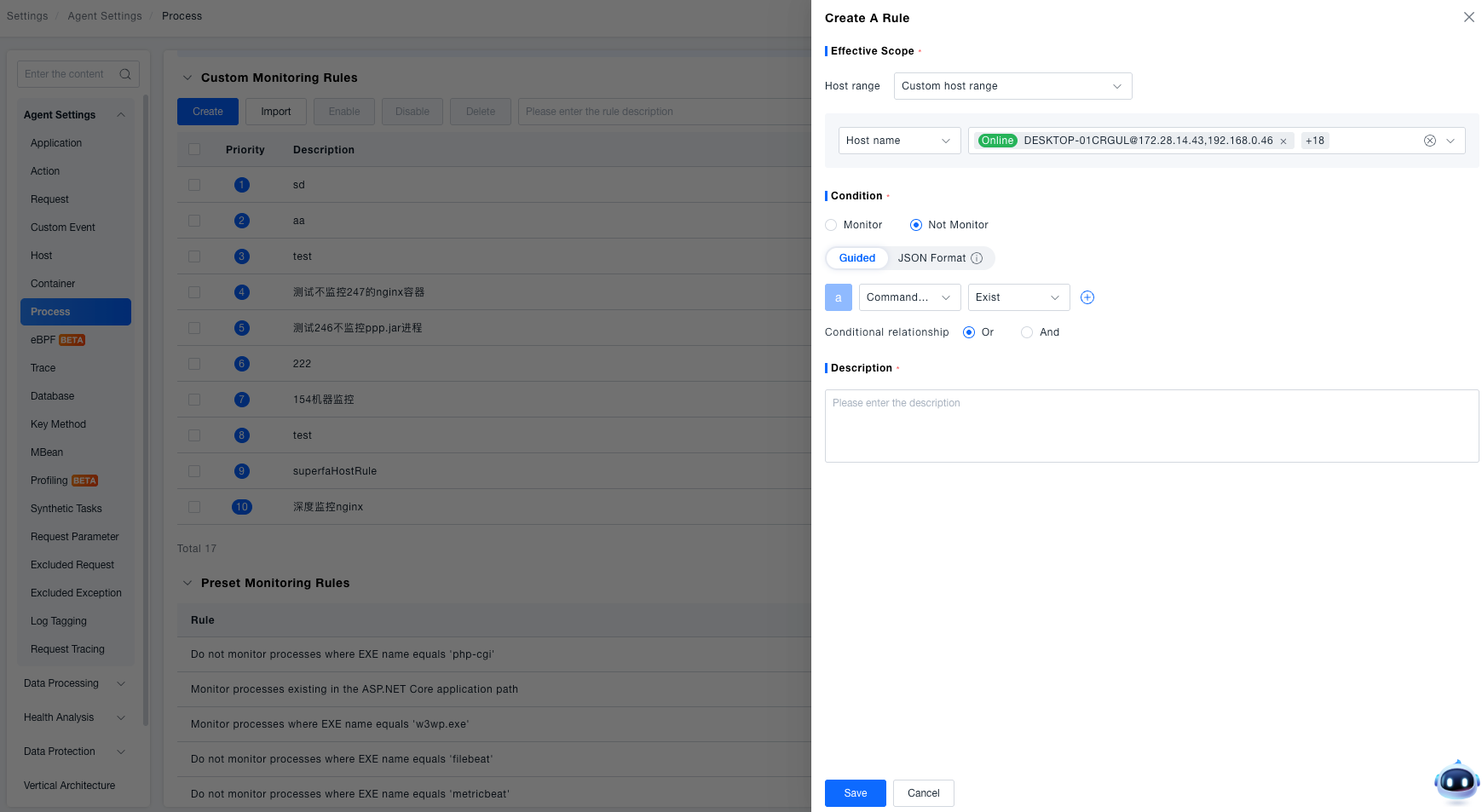
- Click [Create] to open the "Create Rule" panel.
- Set Effective Scope: Host scope select "All Hosts" or "Custom Host Scope" (when customizing, filter specified hosts by host name or IP).
- Configure Conditions:
- Select monitoring status: "Monitor" or "Do Not Monitor".
- Condition configuration supports two modes:
- Guided Mode: Visually configure by selecting condition fields (command line args, EXE name, EXE path, container ID, Kubernetes attributes, etc.), operators, and values from dropdown menus, supporting multiple conditions.
- JSON Format: Directly edit JSON arrays, suitable for batch pasting or copying from Excel templates; the text box provides complete data mapping instructions, and the [Copy] button in the upper right corner can copy the JSON content to the clipboard.
Condition Relationship: Select "OR" or "AND" between multiple conditions.
- Fill in Description (required) and click [Save].
Batch Import Rules
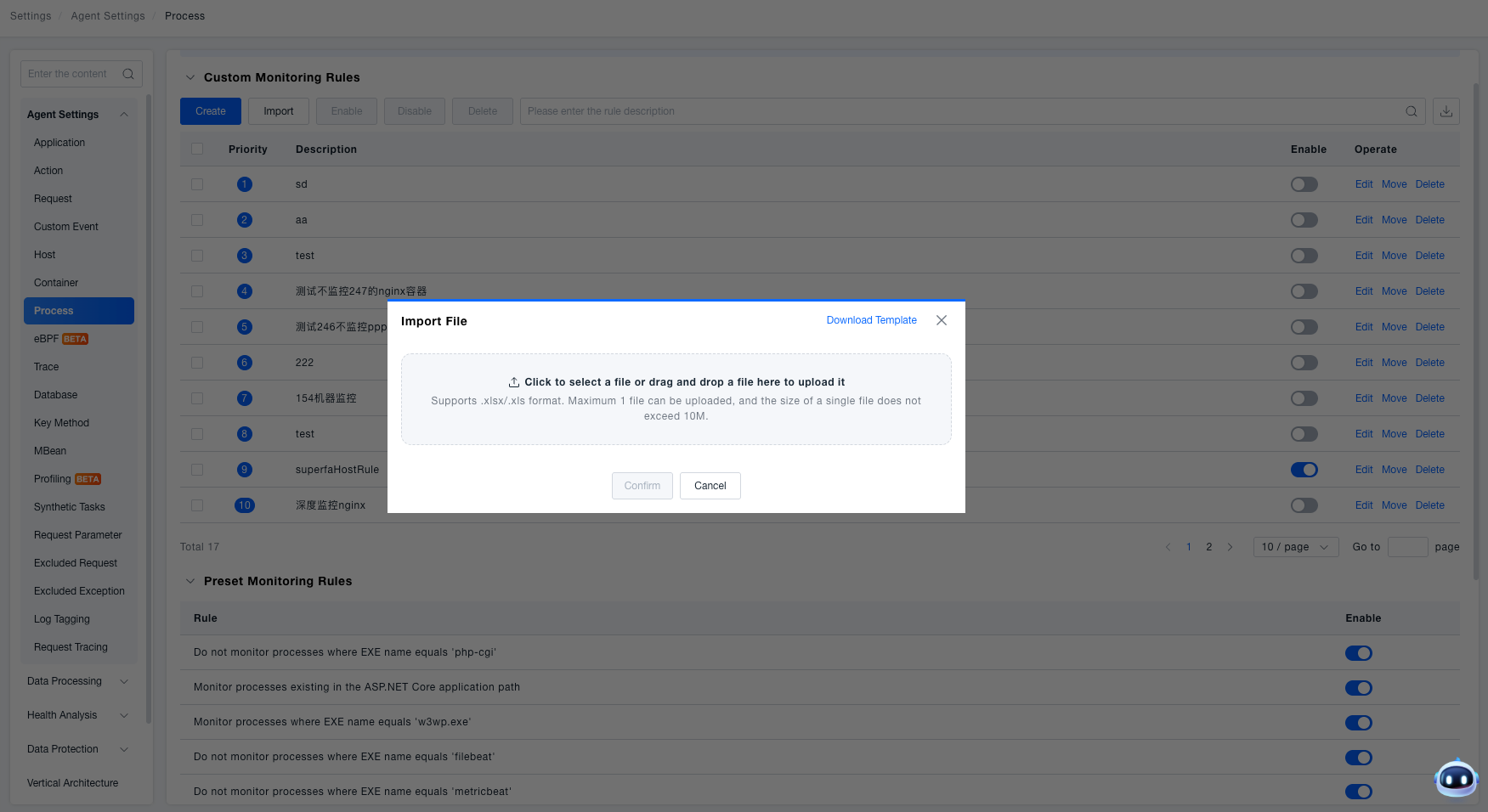
- Click [Import] to open the import popup.
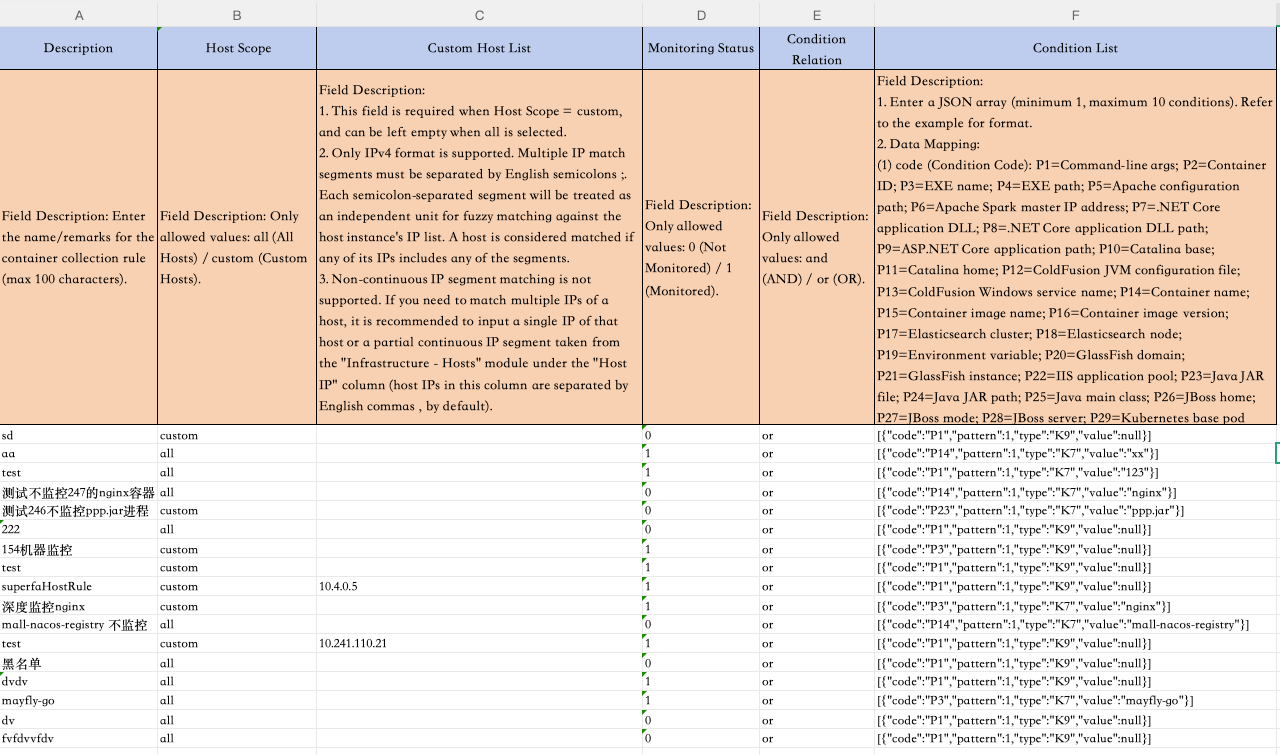
- Click [Download Template] to obtain the standard Excel template (
Process_Collection_Rule_Import_Template.xlsx). - After filling in the rule data according to the template format, drag the file into the upload area or click to select the file (supports
.xlsx/.xls, single file no more than 10M). - Click [Confirm], and the system will validate the data row by row:
- If any row fails validation (format error, duplicate data), the entire file import fails, and the page gives precise line numbers and error reason prompts.
- After all validations pass, batch import is automatically completed.
- After successful import, new rules are sorted in reverse order of import time by default (the higher up, the higher the priority).
Export Rules
Click the [Export] icon in the upper right corner of the rule list to export all current custom rules as an Excel file. The file name format is: Process_Collection_Rules_YYYYMMDDHHMMSS.xlsx. The data format is consistent with the import template and can be directly used for re-import.
Preset Monitoring Rules
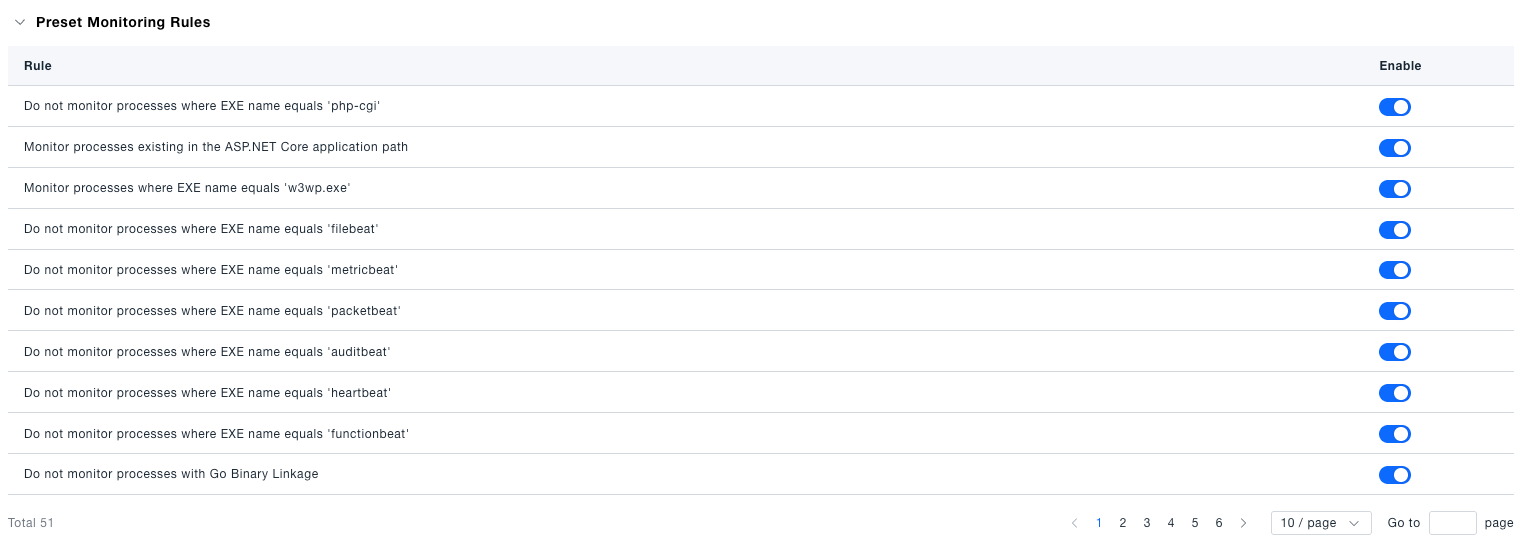
The system has 51 built-in preset rules covering common process types that need to be excluded or monitored (such as various beat components, ASP.NET Core applications, Go Binary Linkage, etc.). You can enable or disable each rule individually as needed, but they cannot be deleted or edited.
Default Monitoring Rules
Located at the bottom of the page, the default strategy is "Monitor All Processes" as a fallback rule that takes effect when neither custom rules nor preset rules are hit.

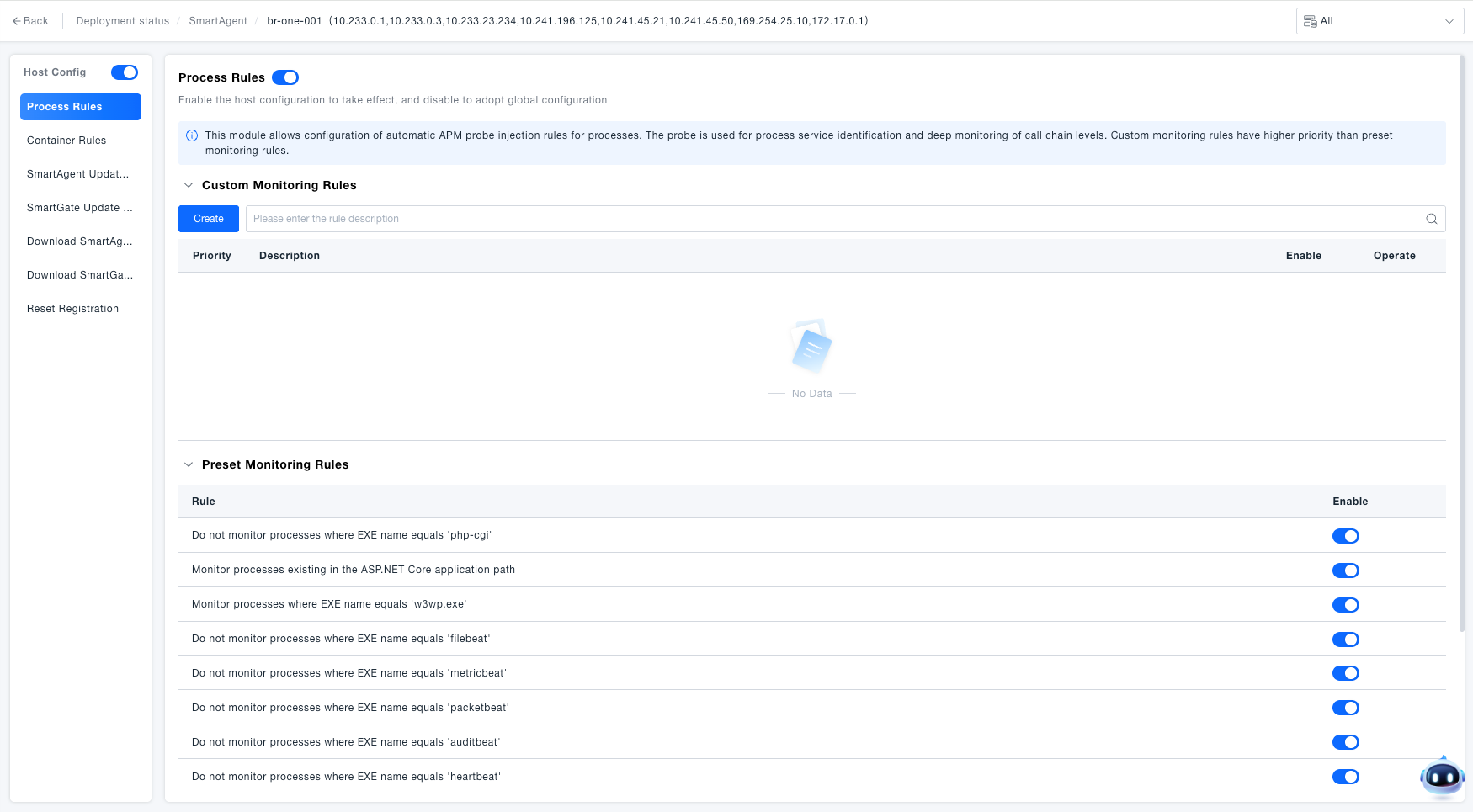
Host-Specific Configuration
Each single host supports independent configuration of process rules. You can use the configuration button corresponding to the host to switch between host-specific configuration and global configuration for that host.
Special Notes
Rule Matching Priority: Host-specific configuration > Global configuration. Within host-specific configuration / global configuration: Custom monitoring rules > Preset monitoring rules > Default monitoring rules, with priorities decreasing in order. Once a higher priority rule is hit, no further matching is performed.
Rule Limit: A maximum of 1000 custom collection rules are supported. Excess rules beyond the limit will fail to import, with rules in the earlier rows being imported first.
Duplicate Detection: The system automatically detects duplicate data (except for the description field) during import. Duplicates between Excel rows or with existing rules will prompt specific line numbers, and only valid and non-duplicate data will be imported successfully.
Guided and JSON Format Conversion: The two condition configuration modes can be switched at any time; when switching from JSON to guided mode, if the JSON format is incorrect or contains invalid data, the system will pop up a confirmation dialog asking whether to clear the abnormal data before continuing to switch.
Environment Variable Condition (P19): When the condition field is "Environment Variable", the key field is required and cannot be empty; the key field of other condition fields can be left blank.