Operational Monitoring
Overview
-
Operational monitoring is a fully functional, closed-loop module that starts from data sources (metrics and events) and utilizes flexible and diverse alert rule configurations (supporting single metric, multiple metrics, fixed thresholds, AI detection, AI prediction, and other detection methods) to identify anomalies.
-
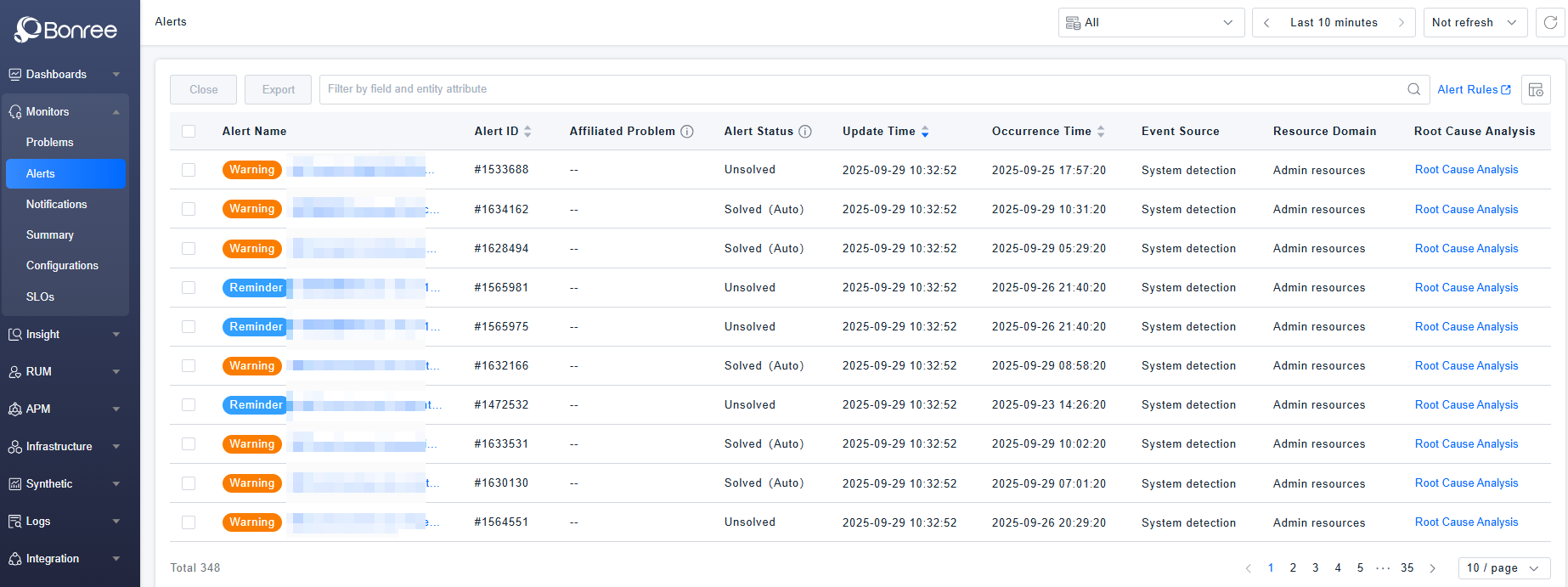
Once an alert is triggered, the system proceeds to the stages of in-depth analysis and policy processing, employing response, suppression, and convergence strategies for intelligent noise reduction and workflow management. Finally, all information converges at the intelligent alert center, where it is clearly presented in forms such as issue lists, alert lists, and notification records. Supplemented with statistical analysis and SLO monitoring reports, it helps users comprehensively grasp system health status and achieve efficient and precise fault detection, response, and handling.

Value
1. Enhance operational efficiency and achieve cost reduction and efficiency improvement
- Automation and Closed-Loop Management: The automated process of "Configuration → Detection → Analysis → Notification" reduces manual inspection and troubleshooting time, significantly shortening the Mean Time to Repair (MTTR).
- Intelligent Noise Reduction and Focus: Utilizing convergence, suppression, and response strategies effectively filters out invalid alerts, prevents alert storms, and allows the operations team to focus on truly critical issues, avoiding distraction.
2. Strengthen Fault Discovery and Response Capabilities, Ensuring System Stability
- Proactive Prediction and Detection: Integrated AI prediction and detection capabilities enable early warnings before metrics exhibit abnormal trends or reach thresholds, achieving "prevention before occurrence."
- Precise Localization and In-Depth Analysis: Through multi-metric correlation and deep analysis functions, quickly pinpoint the root cause of failures rather than merely addressing surface phenomena, accelerating the problem-solving process.
- SLO-Driven: Monitoring centered around SLO (Service Level Objectives) ensures that operational activities remain aligned with business stability and user experience, directly safeguarding business continuity.
3. Promote Standardization of Operational Processes and Knowledge Accumulation
- Unified Rule Template Library: Provides alert rule templates, notification templates, time templates, etc., promoting unified configuration standards, lowering the barrier to use, and ensuring the implementation of best practices.
- Knowledge Assetization: Knowledge base management and script management functions solidify handling experience into reusable assets, preventing knowledge loss due to staff turnover and empowering the entire team.
4. Enable Data-Driven Decision Making and Optimization
-
Comprehensive Observability: Through statistical analysis and notification record reports, it is possible not only to view the current status in real time but also to review history, analyze alert trends, and evaluate team response performance.
-
Drive Continuous Improvement: This data provides objective support for optimizing system architecture, adjusting resource allocation, and improving operational processes, forming a continuous improvement loop of "Monitor → Analyze → Optimize."