What Is Bonree ONE?
Bonree ONE is an integrated intelligent advanced observability platform for enterprise digital systems. It brings together observability data distributed across user endpoints, applications, services, networks, infrastructure, and business systems. A unified data platform and data model correlate these signals, while built-in observability applications and AI agents turn them into alerts, insights, diagnostic recommendations, and remediation actions.
Bonree ONE does more than consolidate monitoring tools in a single interface. It creates an end-to-end capability chain around unified data, unified models, unified analytics, and intelligent collaboration, helping R&D, testing, operations, and business teams answer three critical questions in the same context:
- Is the system healthy, and where is the anomaly?
- Which users, applications, and business services are affected by the technical issue?
- How should teams investigate, collaborate, and restore service?
Bonree ONE Product Architecture
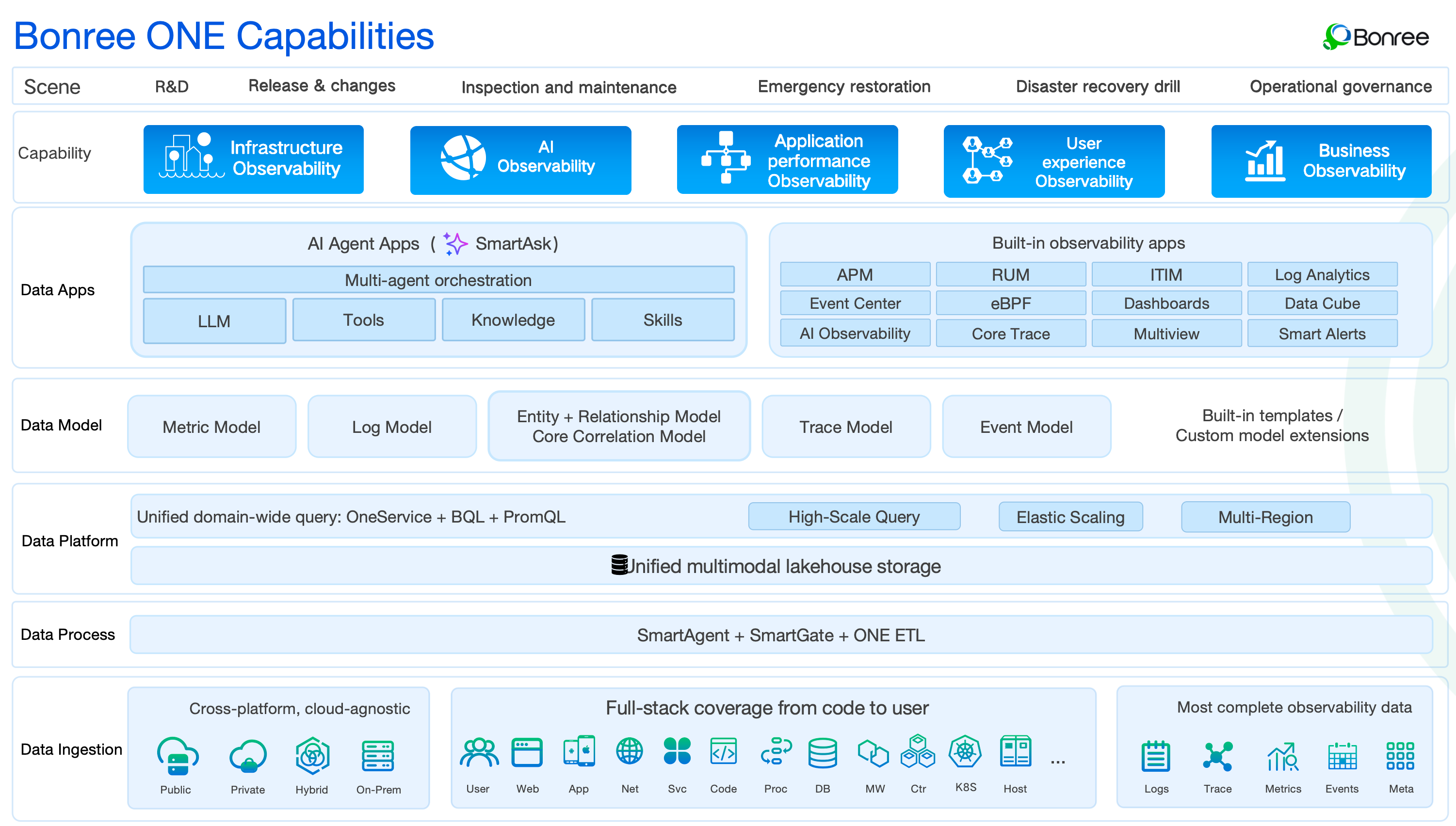
Bonree ONE uses a layered architecture. After data is ingested, it moves through processing, storage and query, and model correlation before powering observability applications and AI capabilities for different roles and scenarios.
Data ingestion: Covering the digital system from code to user
The platform supports public cloud, private cloud, hybrid cloud, and traditional IDC environments. Its unified collection system covers users, web pages, mobile applications, networks, services, code, processes, databases, middleware, containers, Kubernetes, and hosts.
Ingested data includes not only metrics, but also logs, traces, events, and metadata. Each observability signal retains its source and context as it enters the platform, providing the foundation for subsequent correlation analysis.
Data processing: Unified collection, aggregation, and fusion
- SmartAgent: Deployed in monitored environments to collect data from hosts, processes, applications, containers, logs, and traces.
- SmartGate: Aggregates data through a tiered gateway architecture and connects different network zones and data sources.
- ONE ETL: Provides low-code ingestion, transformation, and fusion of multi-source data, reducing the cost of governing heterogeneous data.
Together, these components create a data pipeline spanning edge collection, tiered aggregation, and platform governance, allowing observability data across platforms, clouds, and data centers to enter the same analytics system.
Data platform: Supporting unified queries and analytics at scale
The platform uses unified multimodal lakehouse storage for different types of observability data and provides domain-wide query capabilities through Titan, BQL, and PromQL. The architecture is also designed for high-scale, high-performance queries, elastic scaling, and multi-region or multi-data-center deployments, delivering consistent data services to upper-layer analytics and applications.
Data model: Reconstructing complete context from isolated signals
Bonree ONE provides five core models: metric, log, entity and relationship, trace, and event. The entity and relationship model connects users, applications, services, databases, containers, infrastructure, and other objects, forming the foundation for cross-domain correlation analysis.
The platform includes built-in model templates and supports custom extensions based on an enterprise's technology architecture and business entities. Once data is modeled, teams can inspect the metrics, logs, traces, and events related to the same entity, assess the blast radius, and trace the root cause in a unified context.
Data applications: Supporting both expert observability and intelligent analytics
The platform provides built-in applications for APM, RUM, log analytics, the Event Center, eBPF, dashboards, Data Cube, business observability, and Smart Alerts. It also includes AI Observability for monitoring the operation and performance of AI applications themselves.
On top of this foundation, Sage AI combines large language models, tools, knowledge bases, and skills. Through multi-agent orchestration, it provides a unified entry point for intelligent Q&A, incident diagnosis, inspection analysis, report generation, and other scenarios.
Observability capabilities and scenarios: Connecting technical health to business outcomes
Bonree ONE brings infrastructure observability, AI observability, application performance observability, user experience observability, and business observability into a single platform. These capabilities support R&D and testing, release and change, inspection and maintenance, emergency recovery, disaster recovery drills, and operations governance.
By correlating resources with business services, different teams can see not only the technical objects they own, but also the dependencies between those objects and the impact of anomalies on user experience and business operations.
Bonree ONE AI Architecture
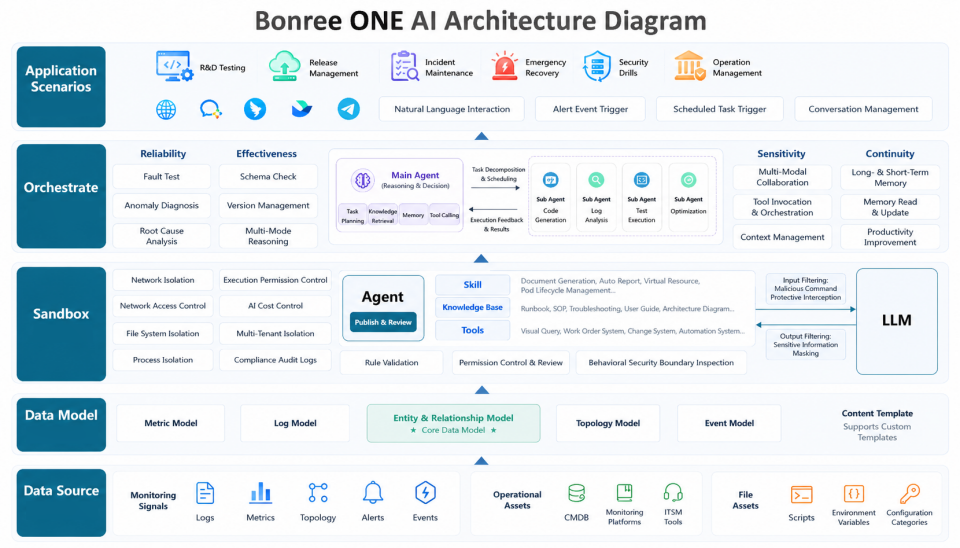
Bonree ONE's AI capabilities are built on the observability platform. Unified data and correlation models provide factual context for agents; knowledge, skills, and tools provide analytical and execution capabilities; and orchestration controls and a secure sandbox keep multi-agent collaboration controlled and traceable.
Data and knowledge foundation
AI agents can use three types of context:
- Observability signals: Logs, metrics, traces, alerts, and events.
- Operations assets: Enterprise operations data such as CMDB records, application resources, and ITSM tickets.
- File assets: Controlled resources such as scripts, environment variables, and authentication keys, together with knowledge assets such as runbooks, SOPs, incident postmortem checklists, user guides, and architecture diagrams.
This information is organized through metric, log, entity and relationship, trace, and event models. As a result, agent analysis does not rely solely on natural-language descriptions; it can incorporate live operational data, object relationships, and accumulated operations knowledge.
Agent capabilities and secure sandbox
Each agent can be equipped with skills, knowledge bases, and tools for a specific task. Agents undergo a release review before publication and access resources or invoke tools within a secure sandbox at runtime. Resource, network, file-system, process, and multi-tenant isolation—together with execution permission controls, human approval gates, compliance audit logs, standards validation, permission-declaration checks, and behavioral safety-boundary checks—constrain the agent's execution scope.
When interacting with a large language model, the platform filters malicious instructions from inputs and masks sensitive information in outputs, reducing security risks during model calls and tool execution.
Multi-agent orchestration and control
The main agent is responsible for task understanding, route planning, and result aggregation. It assigns work to specialized subagents for code generation, knowledge retrieval, test execution, review, optimization, and other tasks. The orchestration layer operates around four objectives:
- Reliability: Error retries, circuit breaking, and deterministic fallback.
- Effectiveness: Schema validation, version management, and multimodal understanding.
- Agility: Multi-agent collaboration, parallel tool calls, and context management.
- Coherence: Long- and short-term memory, memory decay and refresh, and artifact repositories.
Through unified orchestration, complex tasks can be decomposed, executed in parallel, and cross-validated before the platform returns the result as a continuous conversation or a structured artifact.
Interaction entry points and triggers
Users can interact with agents through natural language, while alert events and scheduled tasks can also trigger workflows. Session management preserves context throughout diagnosis and remediation, supporting R&D and testing, release and change, inspection and maintenance, emergency recovery, disaster recovery drills, and operations governance.
From Issue Detection to Closed-Loop Resolution
Bonree ONE connects monitoring, analysis, and collaboration processes that traditionally operate in isolation:
- Unified ingestion: Collect multidimensional observability data across clouds and platforms, from code to user.
- Correlation modeling: Organize metrics, logs, traces, events, and entity relationships in the same context.
- Continuous observation: Use built-in applications to identify performance anomalies, experience degradation, resource bottlenecks, and business impact.
- Intelligent analysis: Let agents combine live data, knowledge, and tools to break down tasks and produce diagnostic conclusions and recommendations.
- Collaborative remediation: Invoke tools to assist with or perform remediation under permission controls and human approval, while retaining the process and resulting artifacts.
- Feedback and optimization: Feed remediation results, postmortem experience, and updated knowledge back into future analysis to create a continuous improvement loop.
What You Can Do with Bonree ONE
- Build a full-stack observability view: Observe infrastructure, networks, applications, AI, user experience, and business health in one place.
- Reduce time to diagnose incidents: Start from an anomalous entity and correlate its metrics, logs, traces, events, and upstream and downstream dependencies.
- Assess business impact: Connect technical anomalies with user activity, core traces, and business metrics to establish remediation priorities.
- Support change and incident response: Continuously obtain data evidence and intelligent diagnostic support during releases, inspections, alerts, and recovery.
- Capture operations knowledge: Package runbooks, SOPs, postmortem experience, and tools into reusable knowledge and skills.
- Build secure, controlled intelligent operations collaboration: Use multi-agent orchestration, secure sandboxes, permission controls, and human approval to let AI participate in analysis and execution within clearly defined boundaries.
Core Value
The core value of Bonree ONE can be summarized in four points:
- Full-stack coverage: Connect the entire path from underlying resources, code, and services to user experience and business outcomes.
- Unified data: Use unified storage, queries, and models to eliminate fragmentation across tools and data sources.
- Correlated insights: Use entity relationships to organize different observability signals within the same problem context.
- Intelligent closed loop: Enable AI agents to use data, knowledge, and tools within a secure and controlled framework, moving operations from merely seeing problems to analyzing and collaboratively resolving them.